The Mount Sinai Hospital / Mount Sinai School of Medicine
1h ago
Researchers found that TIMP2 supports microglial function and reduces age-related cellular changes associated with inflammation in mice. As the brain grows older, its immune cells can become less effective at clearing debris and controlling potentially harmful responses. Researchers at The Icahn School of Medicine at Mount Sinai have identified a role for TIMP2, a protein [...]
A new study from the Yale Department of Pathology and Department of Ophthalmology and Visual Sciences suggests that immune cells that live at the borders of the brain are shaped not only by inflammatory signals, but also by the physical environment of the tissues they inhabit.
A new study from the Yale Department of Pathology and Department of Ophthalmology and Visual Sciences suggests that immune cells that live at the borders of the brain are shaped not only by inflammatory signals, but also by the physical environment of the tissues they inhabit.
A new study from the Yale Department of Pathology and Department of Ophthalmology and Visual Sciences suggests that immune cells that live at the borders of the brain are shaped not only by inflammatory signals, but also by the physical environment of the tissues they inhabit.
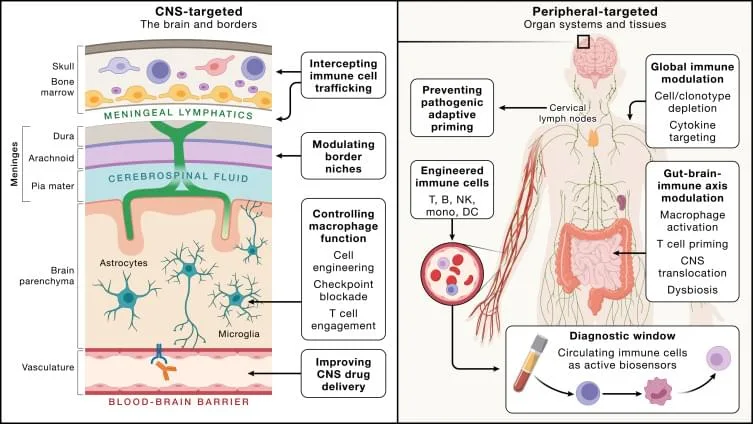
This perspective provides an overview of the growing literature on the role of the immune system in driving neurodegeneration and argues that restoring neuroimmune dialogue, rather than simply clearing protein aggregates, is the next frontier for therapeutic development.
IntroductionSleep deprivation (SD) impairs cognitive function and induces hippocampal injury, yet the gut-derived mechanisms underlying these deficits remain incompletely understood.MethodsHere, we established a mouse SD model using a modified multiple-platform water environment method and evaluated the effects of oral administration of Lactobacillus acidophilus CICC 22162.ResultsSD caused gut mi…
Unlike mice, human brains recruit fresh immune reinforcements from the bloodstream in middle age, upending decades of neuroscience doctrine about the brain's sealed-off defenses.
Nature Communications, Published online: 17 August 2026; doi:10.1038/s41467-026-76762-3 JC polyomavirus infection can result in progressive multifocal leukoencephalopathy, and T cells have been shown to express PD-1. Here the authors show that PD-1 regulates the CD4+ T cell mediated CD8+ T cell response in the brain regulating the antiviral response and neuroinflammation in a mouse polyomavirus c…
Scientists have discovered that the aging human brain may be far less isolated from the rest of the body than once believed. Stanford researchers found that large numbers of immune cells from the blood begin entering the brain as early as middle age, where they can transform into microglia, the brain’s specialized immune cells. The finding overturns a long-standing assumption that these cells rem…
Autism spectrum disorder (ASD) is a neurodevelopmental condition characterized by social deficits and repetitive behaviors, often accompanied by gastrointestinal (GI) symptoms such as constipation, diarrhea, and abdominal pain. Emerging evidence highlights the gut-brain axis as a key pathway linking GI dysfunction to ASD pathophysiology. This review synthesizes current findings on the interplay a…
BackgroundThe gut-brain axis has increasingly been implicated in the pathophysiology of traumatic brain injury (TBI). However, few human studies have simultaneously examined gut functional metagenomics and peripheral cytokine profiles across mild to moderate-to-severe TBI, which limits our understanding of how gut health may influence recovery outcomes in TBI patients.MethodsThis cross-sectional …
Autoimmune encephalitis associated with neuronal autoantibodies is increasingly recognized in veterinary medicine. In cats, previously reported antibodies have primarily targeted components of the voltage-gated potassium channel complex, such as leucine-rich glioma-inactivated 1 (LGI1) and contactin-associated protein-like 2 (CASPR2). Anti-metabotropic glutamate receptor 1 (mGluR1) antibodies are…
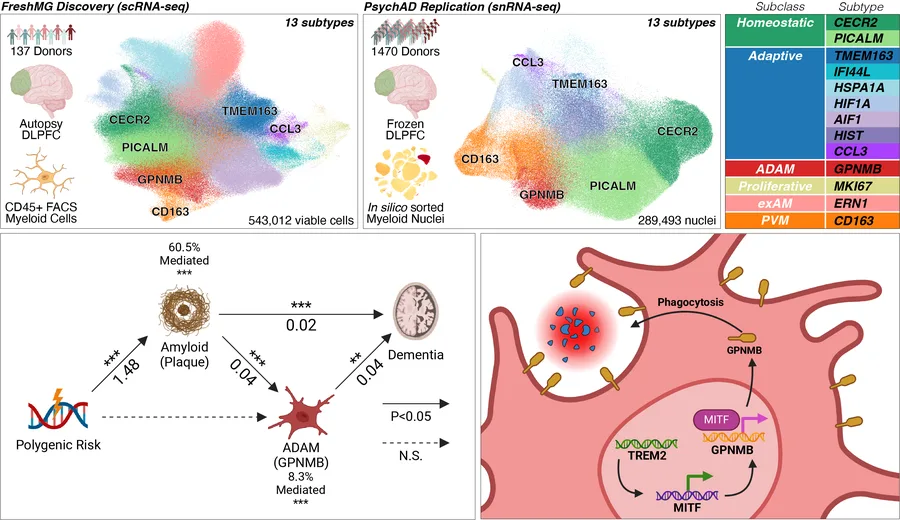
The brain's immune cells are increasingly recognized as key players in Alzheimer's disease, but exactly how they change as the disease develops has remained unclear. A new study published in Nature Genetics [DOI: https://10.1038/s41588-026-02716-6] provides the most comprehensive map to date of these cells, identifying a protective subtype of brain immune cell that expands as Alzheimer's disease …
The brain’s immune system has long been thought to exist independently from the rest of the body, complete with its own specialized immune cells and a blood-brain barrier that limits what can travel into the brain. Now, Stanford researchers have found that aging brings with it a large influx of immune cells into the brain, […]
Nature, Published online: 05 August 2026; doi:10.1038/s41586-026-10860-6 Astrocytes promote central nervous system (CNS) immunity through antigen presentation and activation of CD40 in astrocytes by CD40L expressed by CD4+ T cells in a model of experimental autoimmune encephalomyelitis.
The traditional Chinese medicine (TCM) theory of “Kidney Governs Bone' has been progressively validated in modern medical research. However, a purely endocrinological perspective cannot fully explain its regulatory implications under complex conditions such as stress, inflammation, and nerve injury. As bone metabolism research shifts toward a systemic regulatory paradigm, the “brain-bone axis' pr…
Gut microbiome-derived metabolites may influence stress-related mental disorders through neural, immune, endocrine, and epigenetic pathways. Evidence is strongest for depression and preclinical models, while larger longitudinal human studies are needed to establish causality and clinical value.
Researchers at Trinity College Dublin have discovered that microglia – the main immune cells of the brain – play a critical role in maintaining the stability of neuronal networks in Alzheimer's disease.
ObjectiveThis study aims to investigate the role of microglial Sestrin2 in chronic unpredictable stress (CUS)-induced depressive-like behaviors and cognitive impairment in mice, and to explore the upstream molecular mechanism underlying the abnormal expression of microglial Sestrin2.MethodsMicroglia-specific overexpression of Sestrin2 was achieved by injecting adeno-associated virus (AAV) into th…





 research.io