For decades, scientists have puzzled over why certain atomic nuclei unexpectedly produce large numbers of low-energy gamma rays. A new experiment traced the effect to magnetic changes inside the nucleus, where protons and neutrons effectively flip their tiny internal magnets. The discovery could sharpen models of everything from nuclear reactions on Earth to the creation of heavy elements in star…
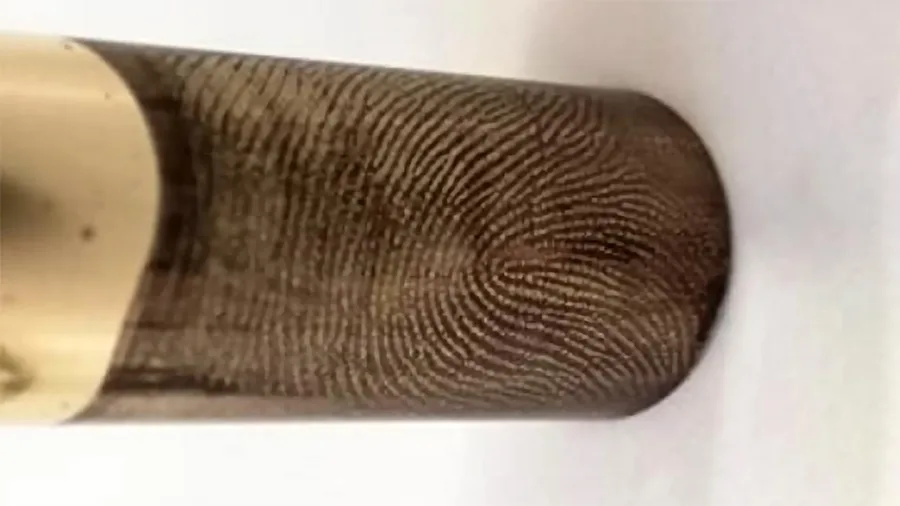
Researchers at Maynooth University have achieved a forensic milestone by revealing fingerprints on fired bullet casings using a safe electrochemical process. The method uses mild voltage and non-toxic materials to make hidden ridges visible within seconds. Effective even on aged casings, it could help investigators connect evidence directly to a suspect rather than just a weapon.
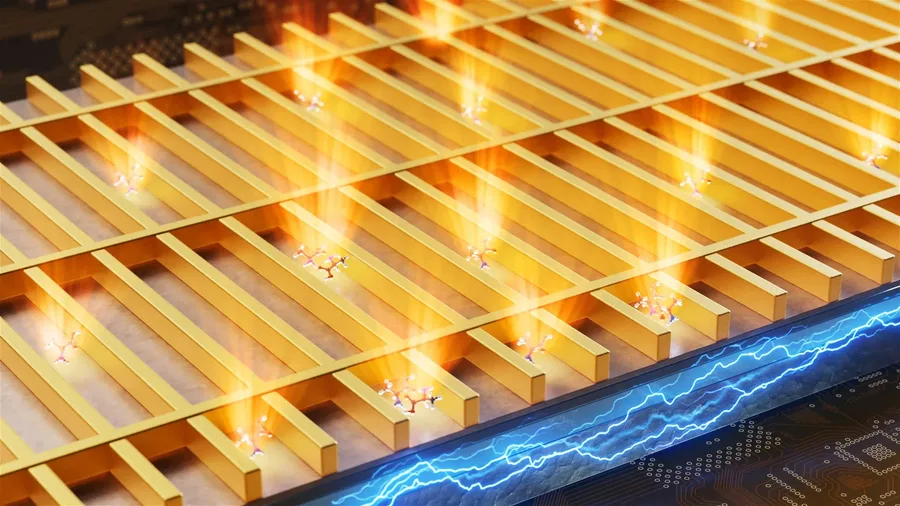
Imagine detecting a single trillionth of a gram of a molecule—like an amino acid—using just electricity and a chip smaller than your fingernail. That’s the power of a new quantum-enabled biosensor developed at EPFL. Ditching bulky lasers, it taps into the strange world of quantum tunneling, where electrons sneak through barriers and release light in the process. This self-illuminating sensor uses…
Researchers united insights from cellular biology, quantum computing, old-fashioned semiconductors and high-definition TVs to both create a revolutionary new quantum biosensor. In doing so, they shed light on a longstanding mystery in quantum materials.
A team of researchers has developed a new strategy for identifying hazardous pollutants in soil -- even ones that have never been isolated or studied in a lab.
A team of researchers has developed a groundbreaking high-temperature copper alloy with exceptional thermal stability and mechanical strength. The research team's findings on the new copper alloy introduce a novel bulk Cu-3Ta-0.5Li nanocrystalline alloy that exhibits remarkable resistance to coarsening and creep deformation, even at temperatures near its melting point.
Researchers presented advances shaping the world of forensics, from research that could improve how forensic scientists estimate a person's age at death, to technology demos of CSIxR -- a virtual reality (VR) application that simulates crime scenes scenarios to train crime scene investigators (CSIs).
As highly pathogenic H5N1 avian influenza continues to spread in the U.S., posing serious threats to dairy and poultry farms, both farmers and public health experts need better ways to monitor for infections, in real time, to mitigate and respond to outbreaks. Newly devised virus trackers can monitor for airborne particles of H5N1.
Scientists have used deep learning to design new proteins that bind to complexes involving other small molecules like hormones or drugs, opening up a world of possibilities in the computational design of molecular interactions for biomedicine.
Sustainable, renewable and good for the climate: Wood is the material of the future. But how much of it do we actually have and how do we make best use of it? Researchers have now analyzed the material flows of wood in Switzerland in detail -- and discovered untapped opportunities.
Researchers have succeeded in developing a microbial strain that efficiently produces pseudoaromatic polyester monomer to replace polyethylene terephthalate (PET) using systems metabolic engineering.
A research team developed an AI tool that traces back the most recent places you have been to. The tool acts like a satellite navigation system, but instead of guiding you to your hotel, it identifies the geographical source of microorganisms. This means you can use bacteria to determine whether someone has just been to the beach, got off the train in the city center or taken a walk in the woods.…
A new data-driven technique, called fingerprint mass spectrometry, provides a method for measuring the mass of individual proteins using nanoscale devices.
Promising new inroads into critical DNA testing has been forecast by experts who have applied machine learning to DNA profiling. From medical diagnostics to forensic tests and national security, PCR (polymerase chain reaction) DNA profiling has revolutionised high-throughput sampling this century -- but little has changed since it was developed in the 1980s.
Overlapping and weak fingerprints pose challenges in criminal cases. A new study offers a solution and brings hope for using chemical residues in fingerprints for personal profiling.
A pioneering new DNA forensics technique is looking for a reliable method to measure a suspect's individual level of natural shedding of skin and other cells to add to, and compare with, evidence collected at crime scenes. Using a novel technique of cell staining, forensic science experts have tested 100 people to confirm how people shed varying levels of touch DNA, from very low to very high.
Physicists have experimentally demonstrates a novel physical effect that was predicted 45 years ago. The effect will result in a new chemical analysis technique, to simultaneously identify molecular bonds and their 3D arrangement in space. This new technique will find applications in pharmaceutical science, security, forensics, environmental science, art conservation, and medicine.


















 research.io