
nuclear-physics
First dreamed up decades ago, the world’s first nuclear clocks are set to improve quickly, becoming more precise and aiding the hunt for dark matter.
When a nuclear accident happens, it’s vital that scientists have accurate fallout models.

How does the universe create gold? The answer may lie in a rare nuclear process that researchers have only now been able to observe in unprecedented detail.
A clock based on radioactive thorium atoms realises a long-held ambition, demonstrating a technology that could eventually beat the accuracy of today’s best atomic clocks
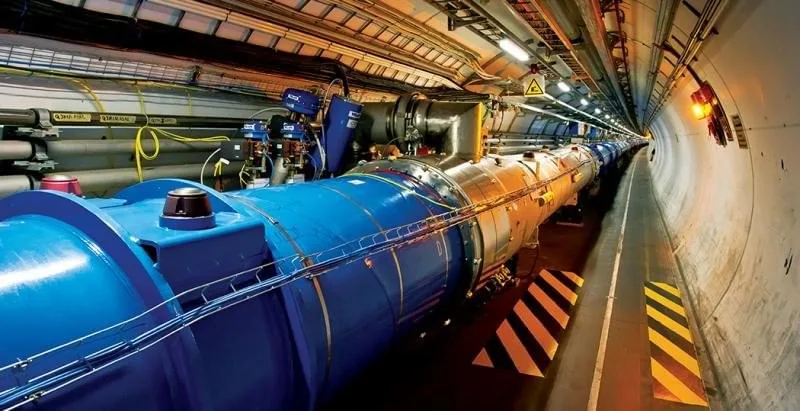
Immediately following the annual meeting of scientists who conduct research at the Relativistic Heavy Ion Collider (RHIC) and the Alternating Gradient Synchrotron (AGS), the U.S. Department of Energy's (DOE) Brookhaven National Laboratory hosted a science symposium to commemorate the end of RHIC operations. The two-day event, held May 14 and 15, celebrated more than 25 years of discovery science …
Scientists conducting research at the Relativistic Heavy Ion Collider (RHIC), Alternating Gradient Synchrotron (AGS), and the supporting accelerator complex at the U.S. Department of Energy's (DOE) Brookhaven National Laboratory gathered at the Lab May 11-13 for the annual RHIC & AGS Users' Meeting.
First dreamed up decades ago, the world's first nuclear clocks are set to improve quickly, becoming more precise and aiding the hunt for dark matter.
The reboot highlights a dire problem for the country's nuclear program. Japan is running out of space to store spent nuclear fuel and lacks plans for radioactive waste disposal.
Controlled nuclear fusion, recognized as the ultimate solution to humanity's energy crisis, has failed to achieve sustained stable operation with an energy gain factor Q > 10 after 70 years of research. The traditional research paradigm treats plasma and confinement fields as two opposing entities, trapping itself in a vicious cycle of "more complex technology, more instabilities". Based on the u…

During the Manhattan Project, Los Alamos scientists needed a diagnostic tool. Like an x-ray confirming a broken leg bone, the researchers wanted to be able to see into the smoke cloud of detonation products. They needed to verify that the implosion remained symmetric to ensure an efficient detonation.
An idea from topology explains why you can never get rid of your cowlicks—and, oddly enough, it’s critical in nuclear fusion
By recreating a nuclear fireball, scientists uncovered unexpected chemistry that could change how radioactive fallout is understood. In the first fraction of a second after a nuclear explosion or a major reactor accident, an immense surge of energy superheats the surrounding environment. Nearby materials and air are instantly vaporized, creating a rapidly expanding fireball made [...]
Nuclear physicists used a little magic in their latest experiment conducted at the U.S. Department of Energy’s Thomas Jefferson National Accelerator Facility, and the result has revealed surprising new information about the behavior of protons and neutrons inside the atom’s nucleus. Specifically, the research revealed another requirement that determines how protons and neutrons pair up. […] The p…
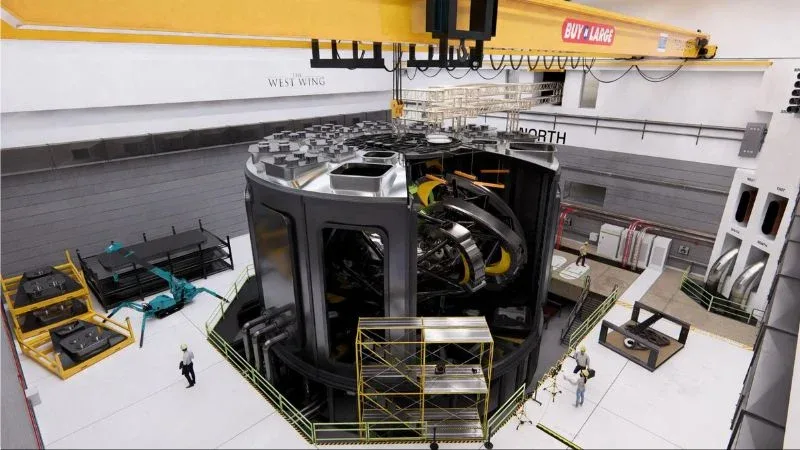
Nature, Published online: 08 June 2026; doi:10.1038/d41586-026-01795-z Commonwealth Fusion Systems published several papers detailing the design of its ARC fusion power plant.
Nuclear fallout events, whether triggered deliberately or accidentally, are something we hope will never happen....

By taking general relativity into higher dimensions, a trio of physicists has proven that a mathematical pattern of ripples in space-time geometry could give rise to naked singularities and microscopic black holes.
Scientific Reports, Published online: 06 June 2026; doi:10.1038/s41598-026-54830-4 Permeability calculation for glutenite reservoirs based on variable T 2 cutoff value in nuclear magnetic resonance logging
Investors across the globe are putting record amounts of money into cold fusion technology, which promises to bring us nuclear fusion without the need to create miniature stars on Earth. But are these companies actually delivering, or is this just another speculative tech bubble? Let’s take a look.
research.ioSign up to keep scrolling
Create your feed subscriptions, save articles, keep scrolling.