Let's say I want to calculate the wavelength of the photon emitted when an electron of an arbitrary element (let's say Carbon) drops from $n=4$ to $n=3$ . Correct me if I'm wrong, but I think I would have to find the change in the electron's energy value $\Delta E = E_i - E_f$ , set that equal to $hc/\lambda$ and solve for the wavelength ( $\lambda$ ). How could I find $E_f$ and $E_i$ ? My textbo…
Nature Communications, Published online: 22 August 2026; doi:10.1038/s41467-026-77053-7 Biomass derived α-, β-hydroxy acids can provide greener routes to valuable amino acids, but selective conversion remains difficult. This study shows isolated ruthenium sites can drive a new pathway from hydroxy acids to amino acids.
Nature Communications, Published online: 22 August 2026; doi:10.1038/s41467-026-76869-7 Reductive amination catalysed by imine reductases and reductive aminases is a powerful method for the asymmetric synthesis of chiral amines, yet the generality and practical limitations of these enzymes remain poorly understood. Here, the authors combine large-scale, iterative activity screening, sequence anal…
Scientific Reports, Published online: 22 August 2026; doi:10.1038/s41598-026-65358-y A density functional theory study of an S N 2 reaction mechanism for hydrolysis of Al-O-Si linkages: implications for dissolution of aluminosilicates under acidic and basic conditions
Fullerenes (FLNs) have attracted attention as lubricant additives because of their antioxidant properties and potential to reduce friction and wear. However, the mechanisms by which FLNs function in lubricating oils remain unclear, particularly with respect to their existence forms in oil and interactions with sliding surfaces. In this study, the tribological properties of FLN-containing oils wer…
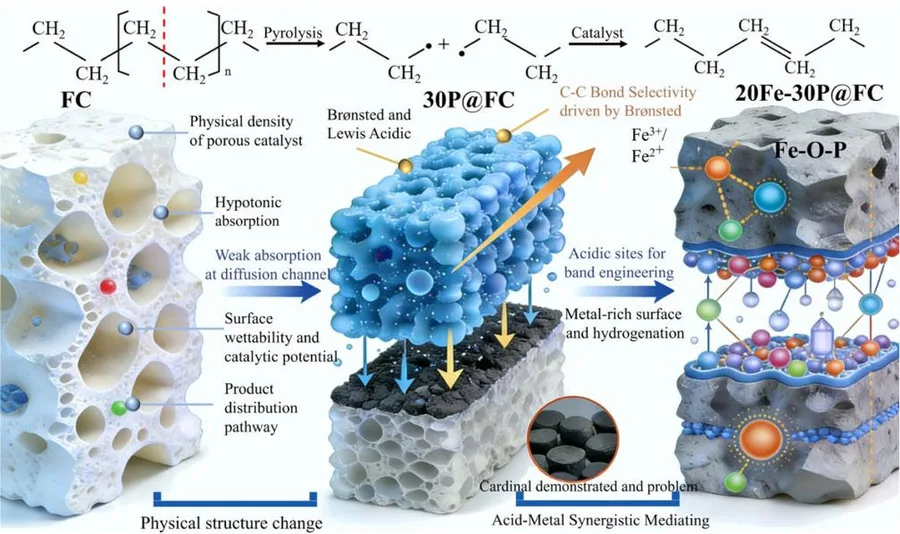
A research team developed an acid-metal bifunctional catalyst made from discarded fish bones that efficiently converted waste agricultural film into olefin-rich bio-oil through microwave-assisted pyrolysis. Under optimized conditions, the catalyst produced a bio-oil yield of 89.32 wt.%, with olefins accounting for 84.03% of the oil and C6-C12 compounds dominating the hydrocarbon fraction. By simu…
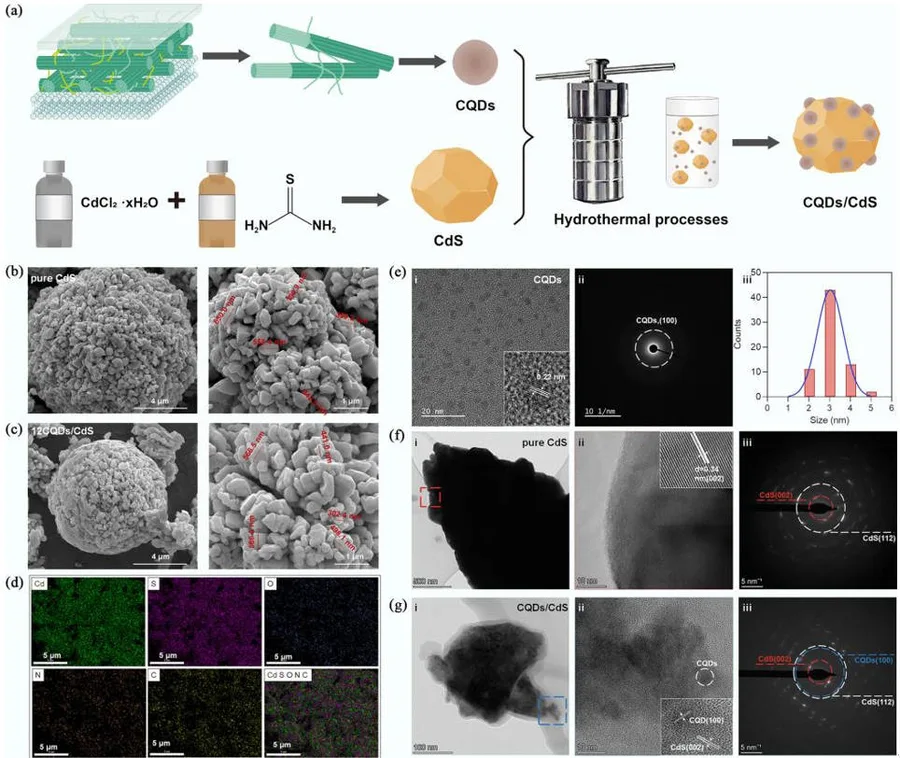
A research team has developed a visible-light photocatalyst that nearly doubled hydrogen production by decorating cadmium sulfide (CdS) nanoparticles with carbon quantum dots (CQDs) derived from cellulose. The optimized composite produced 7,812.5 (micro)mol of hydrogen per gram within five hours, compared with 4,633.5 (micro)mol/g for unmodified CdS. The CQDs improved light harvesting, accelerate…
Nature Communications, Published online: 21 August 2026; doi:10.1038/s41467-026-76887-5 To understand nitrogen activation in the Haber–Bosch process, the study simulates the iron catalyst at atomistic level under realistic industrial conditions of high pressure and temperature, revealing catalytic activity despite substantial coverage.
Fujifilm Corp. (Tokyo, Japan) has announced the completion of a new production facility for post-CMP cleaners at the Oita Factory of FUJIFILM Electronic Materials Co., Ltd. (FFEM), the core company leading Fujifilm’s semiconductor materials business. The facility began operations in August 2026. This investment will significantly expand production capacity for post-CMP cleaners used in the […] Th…
Enapter AG (Hamburg, Germany) is implementing its previously announced realignment toward an asset-light business model, with the start of AEM electrolyzer stack production at new production partner Runqing Hydrogen Technology Co., Ltd. (Shenzhen, China), a member of the Runshihua Group, one of China’s leading cleantech companies. The first stacks for Enapter’s megawatt-range electrolysers have b…
Selenosugars are the major urinary metabolites responsible for the physiological excretion of selenium. Understanding selenium metabolism relies on accurately detecting and identifying selenosugars.
Many members of the Department of Chemistry’s Graduate Student and Postdoctoral Researcher teaching community were selected to be honored for their outstanding contributions to Teaching, Graduate Grading, Research, and Leadership. The winners were chosen from a pool of nominations submitted by members of the Department of Chemistry’s faculty and instructional staff, and will be honore…
For more information, contact Mark K. Leader, Glenn Research Center, mark.leader@nasa.gov Download the PDF version NASA’s Chemical Equilibrium with Applications (CEA) code is a foundational tool for propulsion system analysis. It provides equilibrium chemistry, rocket performance, shock, and detonation calculations used across NASA and the broader aerospace community. NASA Engineering and Safety …
Solid-state silver/silver chloride pseudo-reference electrodes (PREs) are critical for miniaturized, low-cost disposable electrochemical sensors. This work systematically explores the coupling effects of substrate roughness and NaClO chlorination parameters on AgCl film microstructure and electrode electrochemical performance. Magnetron sputtering was used to deposit Cr adhesive layer/Ag function…
Renewable electricity-driven water electrolysis offers a promising route to low-emission hydrogen, yet exceptional laboratory catalyst performance does not necessarily translate into efficient, durable, and scalable electrolyzer operation. This review examines nanostructured electrocatalysts across interconnected length scales, linking atomic-level electronic structure and adsorption energetics w…



 research.io