


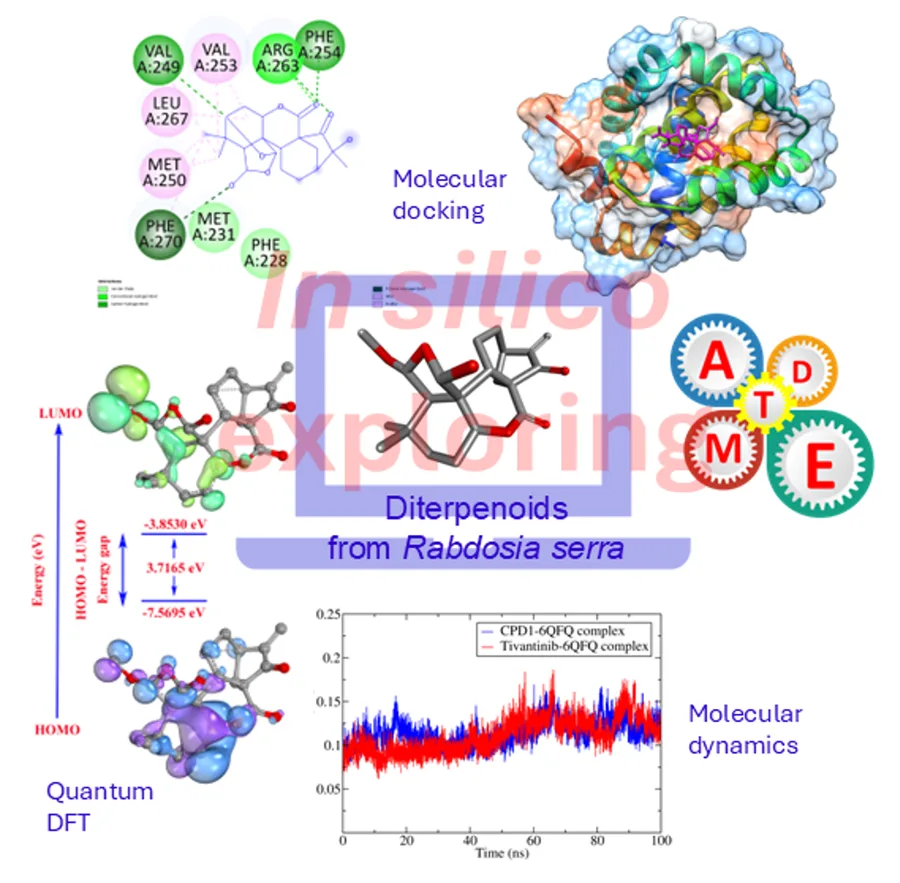
Introduction: Apoptosis resistance in non-small cell lung cancer is frequently sustained by pro-survival Bcl-2 family proteins such as Mcl-1, motivating the search for new Mcl-1 inhibitors from natural products, including diterpenoids from Rabdosia serra . Materials and Methods: An integrated in silico approach was applied to evaluate R. serra diterpenoids as putative Mcl-1 (PDB: 6QFQ) inhibitors, integrating molecular docking, molecular dynamics simulation, MM/GBSA rescoring, pkCSM-based ADMET prediction, and DFT calculations at the B3LYP/6-31G(d,p) level, with Tivantinib as the reference ligand. Results and Discussion: Docking prioritized CPD1 (-10.31 kcal/mol) over Tivantinib (-9.09 kcal/mol). Molecular dynamics simulation indicated stable complexes, with CPD1-6QFQ showing a more compact, less solvent-exposed ensemble (Rg 1.42-1.45 nm; SASA 83-89 nm²; RMSD 0.09-0.15 nm). MM/GBSA favored CPD1 (ΔTOTAL -26.17 ± 2.79 kcal/mol) versus Tivantinib (-24.25 ± 4.50 kcal/mol). ADMET predicted high intestinal absorption for CPD1 (98.243%), a higher unbound fraction, and fewer liabilities (negative hepatotoxicity; negative hERG II inhibition). DFT supported CPD1 with a smaller ΔE (3.7165 eV) and higher softness (0.5381 eV⁻¹) than Tivantinib . Conclusion: Convergent computational evidence nominates CPD1 as a leading putative Mcl-1 inhibitor for optimization, while target engagement, efficacy, and safety require experimental validation.
In silico exploring the mechanisms of action of diterpenoids from Rabdosia serra against lung cancer through inhibition of the anti-apoptotic pathway
Hung Duc Nguyen (hungks1986@gmail.com)