
quantum-physics
The Hamiltonian of a free particle in a rotating frame is given by $$ H = H_0 - \omega \cdot J, $$ where $H_0$ is the Hamiltonian in the non-rotating frame, $\omega$ is the angular velocity of the frame and $J$ is the angular momentum of the particle. This relation is too beautiful to be a coincidence. Does it hold for arbitrary systems with rotational invariance? Is a more general statement poss…

Gravitational wave astronomy has seen plenty of improvements since the original signal was captured in 2015 . Despite that, it remains an engineering challenge to actually create the detectors needed for the precise measurements required to spot gravitational waves. A new NASA Innovative Advanced Concepts (NIAC) grant is funding a concept from a team led by Paul Stankus at Brookhaven National Lab…
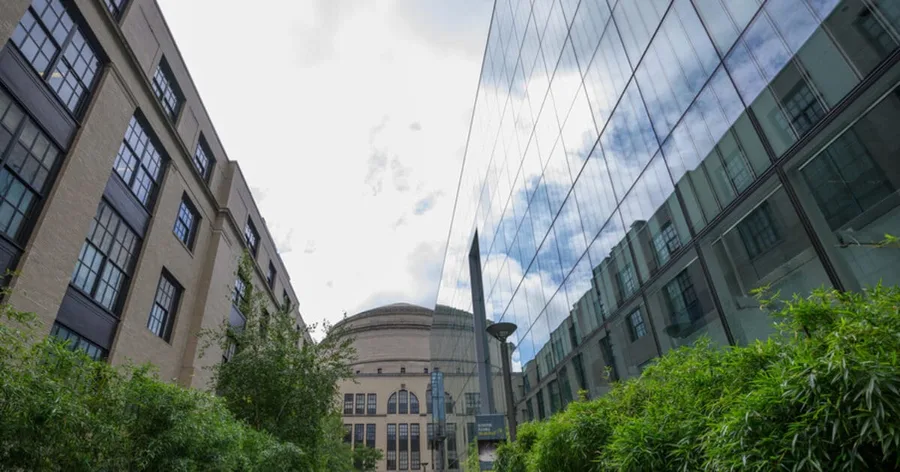
Quantum technology could one day make communications more secure and sensors far more sensitive. But there is a major obstacle: many quantum systems only work at extremely low temperatures, requiring large, expensive cooling equipment. MIT researchers have now developed a small magnetic device that can produce strongly linked microwave signals at room temperature. The advance […] The post Scienti…

Coupled systems require complete quantisation to preserve relationships between position and momentum quantified by ħω representing energy in quantum fields. Analyses from Chiara Marletto London and Vlatko Vedral at the University of Oxford show combining classical and quantum descriptions introduces inconsistencies because

MIT and University of Ferrara researchers created a mathematical blueprint for designing distinguishable non-Gaussian quantum states. Researchers worldwide are working to develop quantum systems for sensing, communications, computing, and control that could outperform today’s technologies. A major challenge is creating quantum states that are stable, measurable, and easy to distinguish, since the…

Researchers at the U.S. Department of Energy's (DOE) Brookhaven National Laboratory and the State University of New York at Stony Brook (Stony Brook University) have successfully transmitted light particles containing quantum information through open air between the two institutions. This is the first demonstration of its kind in the United States and a key milestone toward extending the nation's…

Researchers at the U.S. Department of Energy's (DOE) Brookhaven National Laboratory and the State University of New York at Stony Brook (Stony Brook University) have successfully transmitted light particles containing quantum information through open air between the two institutions. This is the first demonstration of its kind in the United States and a key milestone toward extending the nation's…
Hello to All,... Biswas et al. recently implemented a HaPPY holographic quantum error-correcting code on the IonQ Forte processor. Within this finite AdS-inspired model, logical bulk qubits were encoded in boundary qubits, an FLM-type entropy relation was reproduced, and non-stabilizer “magic”... Read more
This article details how the Belopol’skaya-Daletskii representation of a diffusion on a Riemann Manifold simplifies path integral construction.
And lead to an understanding of how gravity and quantum mechanics can play together in the same universe.
This theoretical work presents a causal-geometric framework providing a structural unification of quantum mechanics, general relativity, and the cosmological dark sector. Rooted in a single ontological postulate—the existence of an external causal space Z_0 from which discrete impulses (khrons) are projected into observable spacetime—the framework unfolds from a unique, fundamental dimensionless …
I have been reading 'Quantum Field Theory and the Standard Model' by Schwartz and have gotten stuck on a line of reasoning in Section 10.2.2. I understand that we can construct a (right-handed) four-vector $V_R^\mu$ given by, $$ V_R^\mu = (\psi_R^\dagger\psi_R, \psi_R^\dagger\vec{\sigma}\psi_R). $$ Schwartz then says that (eq. 10.54) $$ \psi_{R}^{\dagger} \partial_{t} \psi_{R}+\psi_{R}^{\dagger} …

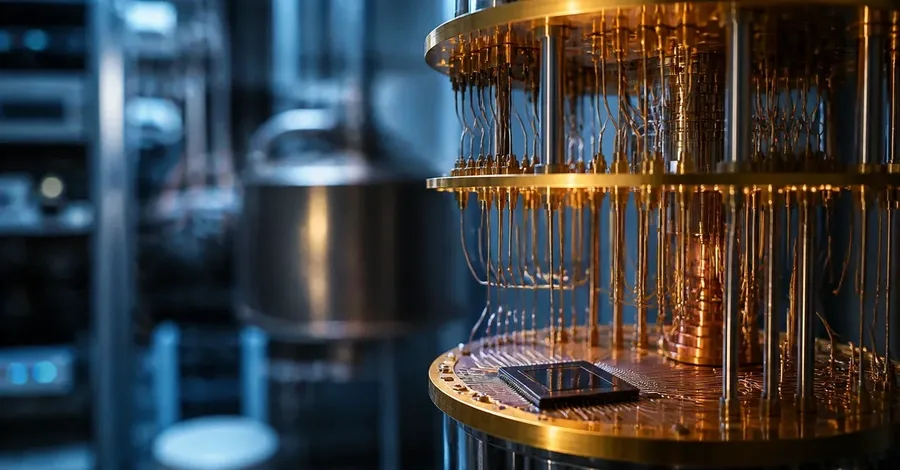
No one yet knows which technology will power the quantum computers of the future, but the race to create them has already produced some of science’s most intricate machinery.

research.ioSign up to keep scrolling
Create your feed subscriptions, save articles, keep scrolling.