Chemist here - thus a probably stupid physics related question. I will spare you the details and the background and try to break it down: (Assumably) I am looking at a system of lamellar micelles that have a somewhat defined mean interlamellar distance. These can reflect light and at a certain angle the bragg equation can be satisfied so that constructive interference can occurr. So let's say we …
When physicists at the ARC Centre for Transformative Meta-Optical Systems (TMOS) needed a key component for their terahertz experiments, they ran into a frustrating problem—they needed tiny optical devices, known as wire-grid polarizers, but these cost thousands of dollars each. “We were doing experiments in the terahertz frequency range and figured that some of the […]
Freezing the liquid core of an optical fiber produced an extreme environment where light and sound interact more than 1,000 times more strongly than in ordinary fibers. Researchers used the effect to create optoacoustic memory, potentially paving the way for lower-energy photonic computers and advanced quantum technologies.
Understand NA, diffraction limits, and sampling. Learn how wavelength, immersion media, and pixel size shape real resolution and useful magnification. The post Mastering NA, Resolution, and Magnification first appeared on .
The team’s bright source promises a pathway towards more complex hybrid quantum systems by efficiently merging continuous and discrete variables; however, the current theoretical description assumes an ‘ideal’ scenario which may not hold true in practice. While simulations predict squeezing levels approaching 20 dB alongside precise beam control, these calculations haven't yet fully accounted for…
Nature Physics, Published online: 21 August 2026; doi:10.1038/s41567-026-03410-4 The energy gain of laser wakefield accelerators is tied to the distance over which electrons are accelerated. Now this limitation can be overcome with flying-focus laser pulses, allowing electrons to surf the plasma wave over longer distances.
According to Wien's displacement law, [
\lambda_{\max}T=b,
] the peak wavelength of blackbody radiation shifts toward shorter wavelengths as temperature increases. As (T) becomes extremely large, (\lambda_{\max}) approaches zero. I have two related questions: Can the peak wavelength actually reach (\lambda_{\max}=0) at any finite temperature, or does it only approach zero in the limit (T\to\infty…
SPIE--International Society for Optics and Photonics
1d ago
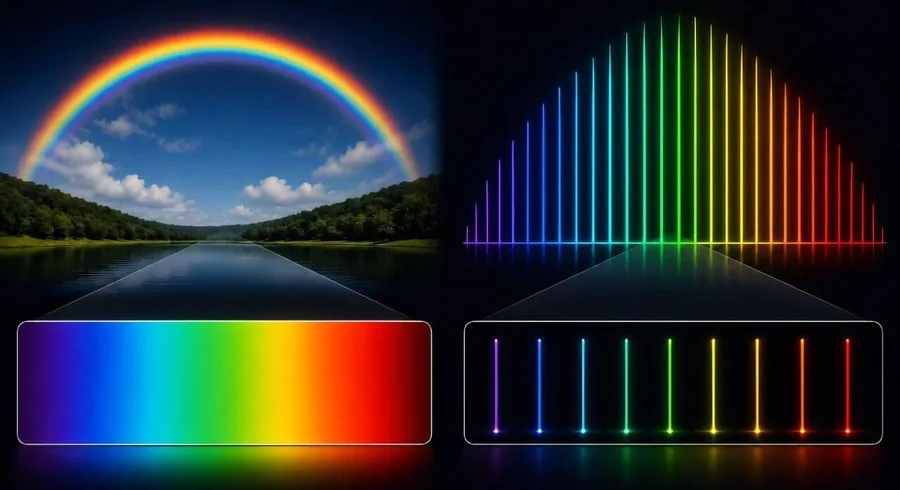
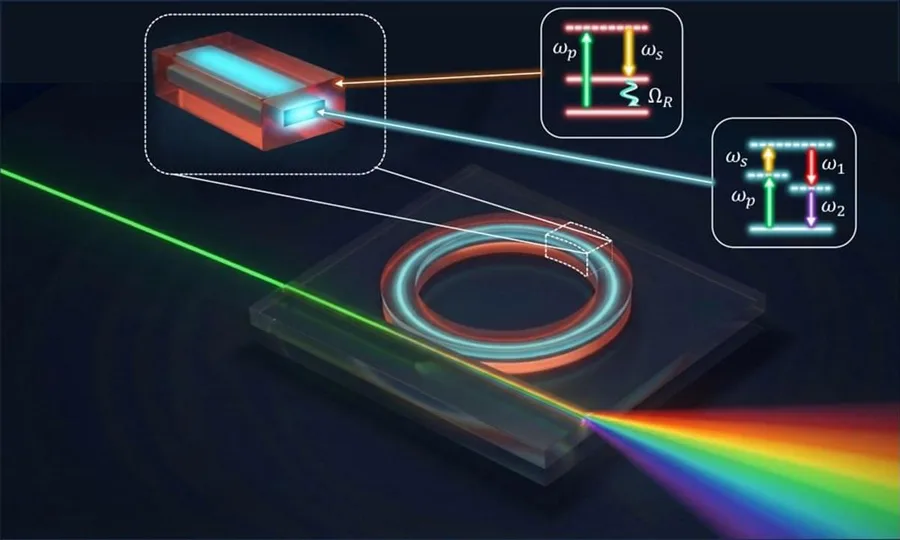
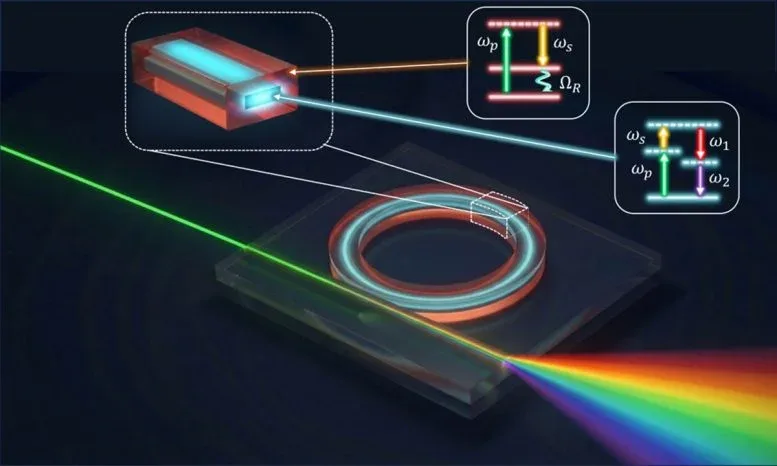
A layer once dismissed as mere support has transformed a tiny photonic chip into a powerful generator of new light frequencies. A laser usually produces one narrow color of light. A device small enough to sit on a fingertip can turn that single input into hundreds of precisely spaced frequencies, creating a tool for measuring [...]
Scientists watched a light-triggered hidden state form inside a material in only 30 femtoseconds, revealing a step that had never been seen before. The material first entered a fleeting electronic state in which its bonds reorganized in a repeating pattern, followed by tiny atomic shifts. This ultrafast pathway could offer a new way to control electronic properties with light and help inspire fas…
Hiwin Technologies Chairman Eric Y. T. Chuo stated that the company has supplied samples of miniature ball screws and single-axis robots to co-packaged optics (CPO) vendors across Taiwan and China for validation. Meanwhile, the timeline for its dual-arm logistics robot, originally scheduled for small-batch shipment in 2026, has been adjusted due to customer requirement changes. Hiwin expects to s…


 research.io