As AI chips continue to grow in size, the shift in advanced packaging from 300 mm wafers to square panels is becoming clearer, driving parallel development of new packaging technologies including FOPLP, CoPoS, and Glass Core. Manz Asia general manager Robert Lin said yield will determine whether Glass Core can move into mass production.
A research team led by Chair Professor Shinhyun Choi from the School of Electrical Engineering and the Graduate School of Semiconductor Technology has developed a programmable dynamic memtransistor (PDM), a semiconductor device whose time-response characteristics can be set to and retain multiple states, as well as an integrated array based on the device. The research […]
Tensile strength of coal naturally exhibit anisotropic characteristics and affected by the spatial distribution of its internal microstructures. Microwave heating realizes auxiliary coal breaking, via the thermal difference generated thermal stress in different material after microwave absorbing. Understanding the tensile strength anisotropy affected by microwave heating is significant for the st…
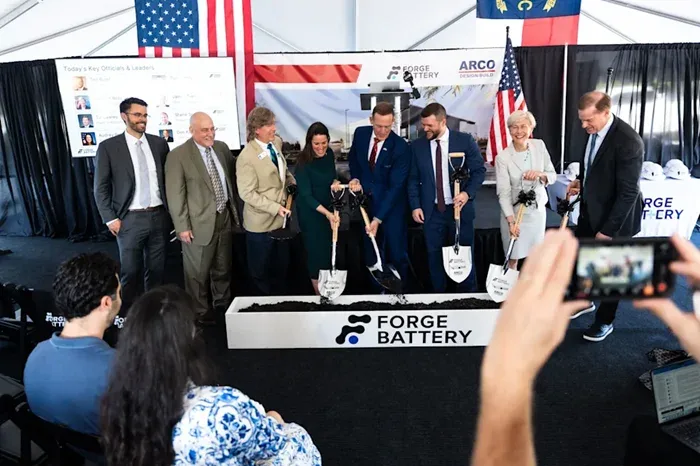
Forge Nano Breaks Ground on a major expansion of its lithium-ion battery manufacturing facility in Morrisville, North Carolina, as part of its U.S. battery manufacturing platform and in partnership with Samsung SDI.
Manufacturers are preparing for the next generation of electric vehicles, grid storage systems and high-performance computing infrastructure, and attention is beginning to shift from laboratory performance to industrial execution. That shift has renewed interest in dry electrode processing alongside the conventional wet-coating methods that have dominated lithium-ion battery manufacturing for dec…
Vibration isolation supports high-resolution microscopy in drug discovery, enabling stable imaging environments and reliable data at the nanometer scale.
From tiny robotic doctors repairing your body to the latest climate change-tackling tools, nanotechnology is fighting an invisible battle on our behalf.
To commercialize quantum computing, manufacturers need high-quality superconducting materials for microchips, but they also require a reliable, sustainable nanofabrication process. Tantalum is a corrosion-resistant metal that meets the first criterion but not the second. That’s because it has to be deposited on a substrate at temperatures that typically exceed 400°C (752°F)—too hot for many semic…
The development of alternative energy sources is crucial for reducing reliance on fossil fuels, particularly for mobile applications such as personal electronics and transportation. This necessitates the advancement of battery materials based on abundant and inexpensive constituent elements. To achieve this requires investigating materials in a broader compositional and structural design space. E…
Combinations of additive manufacturing methods such as inkjet printing and various 3D printing techniques have led to advances in customizable electronic devices by reducing the need for the complex assembly of individually fabricated components. Such combinations are particularly attractive for the fabrication of electrochemical sensing platforms, where the sizes and spatial configurations of el…
This role involves designing and laying out photonic integrated circuits (PICs) for quantum processor units (QPUs) using Python-based tools. The engineer will collaborate with cross-functional teams to integrate photonic components into multi-layer chips, perform layout verification (DRC/LVS), and contribute to custom...
2D CFET scaling; PIM chiplet voltage-droop control; advanced-node layout repair; lithography defect prediction; 3D-IC failure analysis; chiplet and interposer optimization; 4H-SiC wafer slicing. The post Chip Industry Technical Paper Roundup: Aug. 18 appeared first on Semiconductor Engineering .
Matthew Williams (https://www.universetoday.com/authors/houseofwilliams)
5d ago
Engineers developed a unique fabric-based design for a ground-penetrating radar that will be a key instrument on NASA’s SkyFall Mars helicopters. The hardware will enable the SkyFall mission’s trio of planetary rotorcraft to use ground-penetrating radar to study the Martian subsurface.
UK registered organisations can apply for a share of up to £150 million to create scale up manufacturing facilities for zero emission vehicle technologies.
DRIVE35 (Driving Research and Investment in Vehicle Electrification) is a BIST-led programme aimed at transforming the UK's automotive industry. Innovate UK
Innosphere, Montana Photonics and Quantum Alliance, & Headwaters Tech Hub will build a network to advance innovation, including facilities for quantum technologies.
Scientific Reports, Published online: 13 August 2026; doi:10.1038/s41598-026-66761-1 Explicit and refined QUBO modeling of anomalously reflective metasurfaces for annealing-assisted design optimization











 research.io