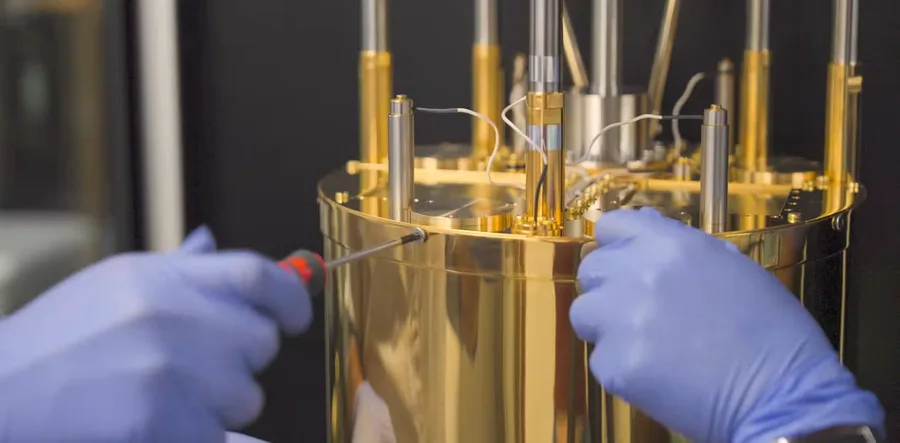
Google Quantum AI researchers have determined that breaking the core cryptography of various cryptocurrencies, secured by the secp256k1 curve, may require as few as 1200 logical qubits and 90 million Toffoli gates, a significantly lower threshold than previously understood.
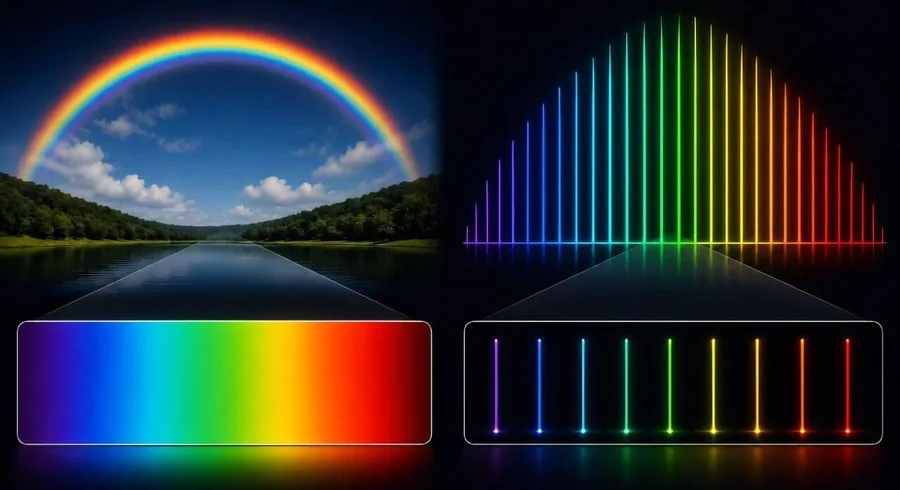
Loughborough University physicists and an international team have demonstrated that a grain-of-rice-sized microchip can be used to produce a spectrum of precisely spaced frequencies of light, which is then converted into multiple high-frequency electromagnetic signals known as millimeter waves. Millimeter waves are of growing interest for future communications because they offer much more bandwid…
MIT and University of Ferrara researchers created a mathematical blueprint for designing distinguishable non-Gaussian quantum states. Researchers worldwide are working to develop quantum systems for sensing, communications, computing, and control that could outperform today’s technologies. A major challenge is creating quantum states that are stable, measurable, and easy to distinguish, since the…
Researchers at the U.S. Department of Energy's (DOE) Brookhaven National Laboratory and the State University of New York at Stony Brook (Stony Brook University) have successfully transmitted light particles containing quantum information through open air between the two institutions. This is the first demonstration of its kind in the United States and a key milestone toward extending the nation's…
Researchers at the U.S. Department of Energy's (DOE) Brookhaven National Laboratory and the State University of New York at Stony Brook (Stony Brook University) have successfully transmitted light particles containing quantum information through open air between the two institutions. This is the first demonstration of its kind in the United States and a key milestone toward extending the nation's…
Week Ending 21 | 8 | 2026. What a blockbuster week for quantum tech—hubs opening in Colorado and Austin, D-Wave production apps cutting real network load, IBM modular cryogenics online, Pasqal heading for Nasdaq, record 420 km entanglement, and post-quantum crypto now live on Akamai’s network. Read it now! The post Quantum Computing Weekly Round-Up: Week Ending August 22, 2026 appeared first on T…
Rolando D. Somma of Google Quantum AI and colleagues have devised a quantum algorithm that efficiently solves the Sylvester equation, a fundamental linear matrix equation used in fields from control theory to physics. The approach constructs a solution matrix using a technique that allows faster access to its properties than traditional methods of preparing a quantum state.
The query and gate com…
Scientific Reports, Published online: 21 August 2026; doi:10.1038/s41598-026-67369-1 A hybrid framework based on quantum genetic algorithm and quantum support vector machine for noise-aware qubit mapping in NISQ systems
Researchers at the University of Cambridge have identified a stricter criterion for when quantum computers can outperform classical machines. Magic states, special qubit configurations required for universal quantum computation, are necessary but not always sufficient. Many states previously regarded as useful magic can still be simulated efficiently on classical computers. The team used the Kirk…
arXiv:2608.19707v1 Announce Type: new Abstract: Generative AI creates an assessment challenge in quantum software education: a student can provide a homework notebook to ChatGPT and request a completed submission. This study examined whether introductory Qiskit homework could remain autogradable while requiring students to run, review, and discuss results rather than banning AI. Three packages we…






 research.io