restor3d, a specialist in 3D printed personalized orthopedic solutions, launched MyFit by restor3d Digital Suite on September 8, 2026, a new patient engagement platform designed to give orthopedic implant patients visibility into their treatment and connect that experience to long-term clinical outcomes data. The company is making the suite available to all its surgeons with…
A sore knee can start as a small annoyance and gradually become a problem that changes how a person lives. For millions of adults, the cause is osteoarthritis, a common joint disease that can affect work, sleep, exercise and even emotional well-being. The knee carries much of the body’s weight whenever a person stands, walks […] The post Why Knee Arthritis Is Not Just an Aging Problem appeared fi…
Femoral fractures represent a major global orthopedic burden, particularly among elderly and osteoporotic populations, and are associated with substantial morbidity, mortality, and healthcare costs. Intramedullary fixation, in which a metallic nail is inserted into the medullary canal to stabilize fractured bone, remains the clinical gold standard because it provides load-sharing stabilization th…
Knee pain is extremely common, especially as people get older. One of the most frequent causes is osteoarthritis, a condition that slowly changes the tissues inside the joint and can make everyday activities painful. The knee is a large joint where several bones meet. In a healthy knee, smooth cartilage covers the ends of the […] The post Simple Ways to Protect Your Knees appeared first on Knowri…
Osteoarthritis (OA) is a prevalent degenerative joint disorder characterized by progressive cartilage destruction, chronic inflammation, pain, and functional impairment. Conventional therapies primarily focus on symptom management and are unable to restore damaged articular cartilage or effectively modify disease progression. Consequently, increasing attention has been directed toward biologic an…
Knee osteoarthritis can seriously affect mobility and quality of life, but its progression isn’t completely out of your control. Exercise, stronger leg muscles, a healthier diet, and even modest weight loss can dramatically reduce stress on the knees and help keep pain in check.
Back pain affects millions of people and can make everyday activities such as walking, sitting, working and sleeping difficult. New research suggests that changes in gene activity may help explain why the soft discs between the bones of the spine gradually become damaged and unusually hard. The study was carried out by researchers from the […] The post Scientists Find New Clues to Why Spinal Disc…
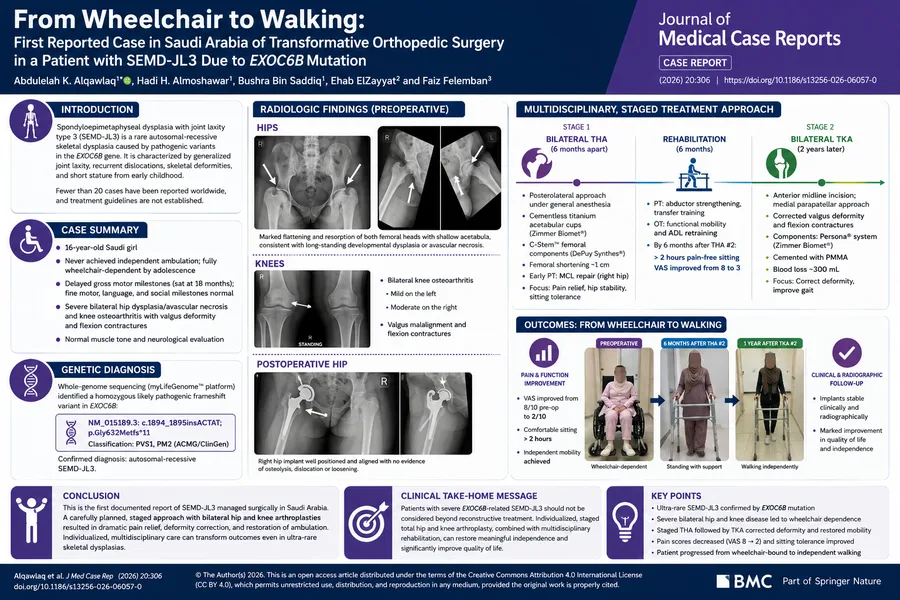
Can modern arthroplasty restore independence in an ultra-rare skeletal dysplasia? This first Saudi Arabian report shows how staged bilateral hip and knee replacements enabled a teenager with SEMD-JL3 to progress from wheelchair dependence to walking.
Mercy Medical Center's Institute for Foot and Ankle Reconstruction (IFAR) presents The Center for Orthopedic Innovation, a state-of-the-art research and education facility designed to accelerate orthopedic innovation, advance research, enhance physician education and support the development of next-generation foot and ankle implants and biologic therapies.
A randomized controlled trial compared first metatarsophalangeal joint (MTPJ) arthrodesis, a joint fusion surgery for painful hallux rigidus (arthritis of the big toe joint), with watchful waiting in reducing walking pain.
A randomized controlled trial compared first metatarsophalangeal joint (MTPJ) arthrodesis, a joint fusion surgery for painful hallux rigidus (arthritis of the big toe joint), with watchful waiting in reducing walking pain.
BackgroundDemand for arthroplasty due to osteoarthritis (OA) is rising with population aging and need for revision surgeries. Efforts to slow OA progression and prevent post-operative complications have been ineffective, likely due to inadequate identification of the primary disease-driving mechanisms underlying cartilage destruction. The aim of this study was to identify the primary disease-driv…
Hip pain is one of the most common reasons adults visit an orthopedic specialist. Many people immediately assume arthritis is responsible, but researchers from Yale University say that assumption can sometimes hide more dangerous problems. Their review, published in EFORT Open Reviews, describes three nonarthritic conditions that can quietly damage the hip and eventually destroy […] The post Thre…
With the support of National Institutes of Health funding, Johns Hopkins Medicine investigators, led by pathologist Aaron W. James, M.D., Ph.D., previously discovered that sensory neurons in skeletal tissue are constantly sensing their environment and are quick to respond to injuries. Now, through federally-supported research published today in Science Translational Medicine, they describe how th…
With the support of National Institutes of Health funding, Johns Hopkins Medicine investigators, led by pathologist Aaron W. James, M.D., Ph.D., previously discovered that sensory neurons in skeletal tissue are constantly sensing their environment and are quick to respond to injuries. Now, through federally-supported research published today in Science Translational Medicine, they describe how th…
Knee osteoarthritis affects ~16% of adults in the world and is considered one of the most incapacitating diseases. Despite the advances in scientific knowledge and biological treatments in the field of orthopedics, available nonsurgical treatments for knee osteoarthritis are limited and still ineffective in delaying or stopping the progression of arthritis. Biologics such as platelet-rich plasma,…






 research.io