A new study put ChatGPT to the test by asking it to judge whether hundreds of scientific hypotheses were true or false—and the results were far from reassuring. While the AI got it right about 80% of the time on the surface, its performance dropped significantly when accounting for random guessing, revealing only modest reasoning ability. Even more concerning, it frequently contradicted itself wh…
Quantum key distribution promises ultra-secure communication by using the strange rules of quantum physics to detect eavesdroppers instantly. But even the most secure quantum link can falter if the transmitter and receiver aren’t perfectly aligned. Researchers have now taken a deep dive into this often-overlooked issue, building a powerful new analytical framework to understand how tiny beam misa…
Kidney disease often creeps in silently, and many patients aren’t diagnosed until major damage is already done. New research shows that even “normal” kidney test results can signal danger if they’re unusually low for someone’s age. By mapping kidney function across the population, scientists revealed who’s quietly at higher risk. A new online tool could help doctors catch these warning signs year…
Researchers have turned artificial intelligence into a powerful new lens for understanding why cancer survival rates differ so dramatically around the world. By analyzing cancer data and health system information from 185 countries, the AI model highlights which factors, such as access to radiotherapy, universal health coverage, and economic strength, are most closely linked to better survival in…
More screen time among children and teens is linked to higher risks of heart and metabolic problems, particularly when combined with insufficient sleep. Danish researchers discovered a measurable rise in cardiometabolic risk scores and a metabolic “fingerprint” in frequent screen users. Experts say better sleep and balanced daily routines can help offset these effects and safeguard lifelong healt…
Scientists have developed a groundbreaking tool called Effort.jl that lets them simulate the structure of the universe using just a laptop. The team created a system that dramatically speeds up how researchers study cosmic data, turning what once took days of supercomputer time into just a few hours. This new approach helps scientists explore massive datasets, test models, and fine-tune their und…
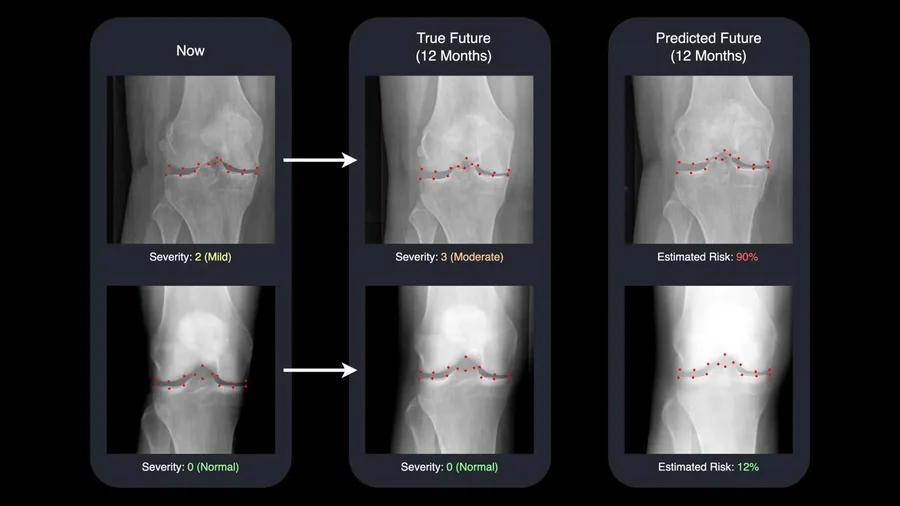
Researchers at the University of Surrey developed an AI that predicts what a person’s knee X-ray will look like in a year, helping track osteoarthritis progression. The tool provides both a visual forecast and a risk score, offering doctors and patients a clearer understanding of the disease. Faster and more interpretable than earlier systems, it could soon expand to predict other conditions like…
A team of international physicists has brought Bayes’ centuries-old probability rule into the quantum world. By applying the “principle of minimum change” — updating beliefs as little as possible while remaining consistent with new data — they derived a quantum version of Bayes’ rule from first principles. Their work connects quantum fidelity (a measure of similarity between quantum states) to cl…
Astronomers have long relied on supercomputers to simulate the immense structure of the Universe, but a new tool called Effort.jl is changing that. By mimicking the behavior of complex cosmological models, this emulator delivers results with the same accuracy — and sometimes even finer detail — in just minutes on a standard laptop. The breakthrough combines neural networks with clever use of phys…
Scientists at Mount Sinai have created an artificial intelligence system that can predict how likely rare genetic mutations are to actually cause disease. By combining machine learning with millions of electronic health records and routine lab tests like cholesterol or kidney function, the system produces "ML penetrance" scores that place genetic risk on a spectrum rather than a simple yes/no. So…
By using quantum dots and smart encryption protocols, researchers overcame a 40-year barrier in quantum communication, showing that secure networks don’t need perfect hardware to outperform today’s best systems.
What if your old chest scans—taken years ago for something unrelated—held a secret warning about your heart? A new AI tool called AI-CAC, developed by Mass General Brigham and the VA, can now comb through routine CT scans to detect hidden signs of heart disease before symptoms strike.
Is artificial intelligence (AI) capable of suggesting appropriate behavior in emotionally charged situations? A team put six generative AIs -- including ChatGPT -- to the test using emotional intelligence (EI) assessments typically designed for humans. The outcome: these AIs outperformed average human performance and were even able to generate new tests in record time. These findings open up new …
Researchers have unveiled a breakthrough in solid-state cooling technology, doubling the efficiency of today's commercial systems. Driven by the Lab's patented nano-engineered thin-film thermoelectric materials and devices, this innovation paves the way for compact, reliable and scalable cooling solutions that could potentially replace traditional compressors across a range of industries.
New research shows that cyberbullying should be classified as an adverse childhood experience due to its strong link to trauma. Even subtle forms -- like exclusion from group chats -- can trigger PTSD-level distress. Nearly 90% of teens experienced some form of cyberbullying, accounting for 32% of the variation in trauma symptoms. Indirect harassment was most common, with more than half reporting…
Researchers have developed a digital laboratory (dLab) system that fully automates the material synthesis and structural, physical property evaluation of thin-film samples. With dLab, the team can autonomously synthesize thin-film samples and measure their material properties. The team's dLab system demonstrates advanced automatic and autonomous material synthesis for data- and robot-driven mater…
As kids spend more time on screens, a new national survey conducted by Ipsos on behalf of The Kids Mental Health Foundation, founded by Nationwide Children's Hospital, identifies parents' greatest fears for their children around screen time.
A new article puts artificial intelligence and machine learning on the task of finding new, powerful electrolytes for designing next-generation batteries for electric vehicles, phones, laptops and grid-scale energy storage. The paper outlines a new framework for finding molecules that maximize three components that make an ideal battery electrolyte -- ionic conductivity, oxidative stability and C…
Researchers made a technique that improves the trustworthiness of machine-learning models, which could help improve the accuracy and reliability of AI predictions for high-stakes settings such health care.
















 research.io