Iron in its elemental form has rarely been detected in the interstellar medium despite being the most abundant refractory element. The presence of iron oxides in the interstellar medium and the recent discovery of FeC in the circumstellar envelope of IRC+10,216 suggest iron-carbon-oxygen molecules as potential interstellar species. In light of this possibility, the potential energy surface of FeC…
Nature Communications, Published online: 05 August 2026; doi:10.1038/s41467-026-76371-0 Polycyclic aromatic hydrocarbons (PAHs) are ubiquitous in space, yet astrochemical models fail to reproduce their observed abundances because known growth mechanisms are far too slow. Here, the authors report a plausible pathway for rapid PAH mass growth mediated by multi-ring aryl radicals via the aryl additi…
The question of how our planet was formed and, more generally, how a planetary system forms is fundamental and has been addressed in a broad range of research domains. However, we still lack a comprehensive understanding of the basic aspects of the process of star and planet formation. In particular, the challenge of measuring the mass and chemical composition of young protostellar disks has, so …
The laws of chemistry get pushed to the limits in Jenny Bergner’s astrochemistry lab at the University of California, Berkeley, where she is pondering some of the biggest questions in the universe: How do planets form? And how did life arise in the first place? To do so, she leads a team studying the exotic chemistry that happens under the crushing cold and near-perfect vacuum of interstellar spa…
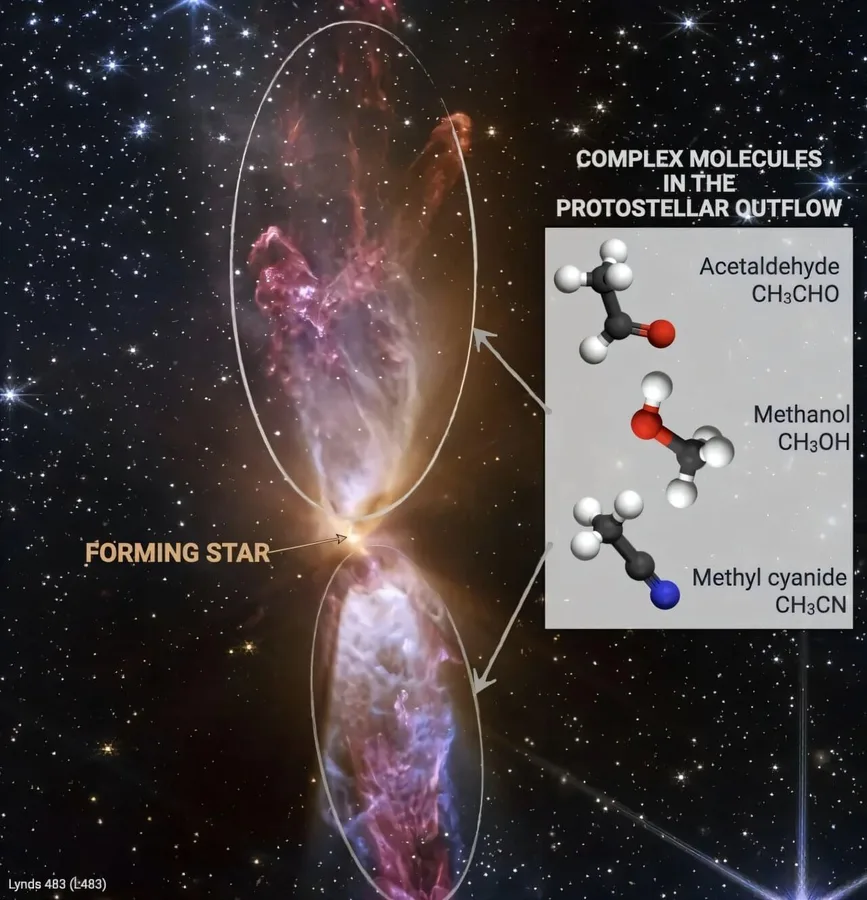
Life exists because elements combine to form complex organic molecules. Astrochemistry studies this process, trying to understand how nature creates carbon-based molecules critical for life. One source for these types of molecules is the outflows emitted by protostars. Protostars grow by accreting gas, and while they do so, they also emit energy. Protostars haven’t begun […]
Argonne postdoctoral appointee Galiia Galimova receives the 2026 ACS Astrochemistry Subdivision Outstanding Dissertation Award for her doctoral research on the mechanisms and kinetics of reactions between hydrocarbon radicals and unsaturated hydrocarbons.
1 Background and motivation
Molecular abundances are crucial for obtaining information about astronomical objects, spanning from molecular clouds to star-forming regions and planetary atmospheres (Herbst and van Dishoeck, 2009; Tielens, 2013). In this context, the importance of tracers and proxy species is unquestionable. For example, the study of species with distinct isotopic composition (also …
Thank you for visiting nature.com. You are using a browser version with limited support for CSS. To obtain
the best experience, we recommend you use a more up to date browser (or turn off compatibility mode in
Internet Explorer). In the meantime, to ensure continued support, we are displaying the site without styles
and JavaScript.
Astrochemistry is the study of the composition and reactions of a…
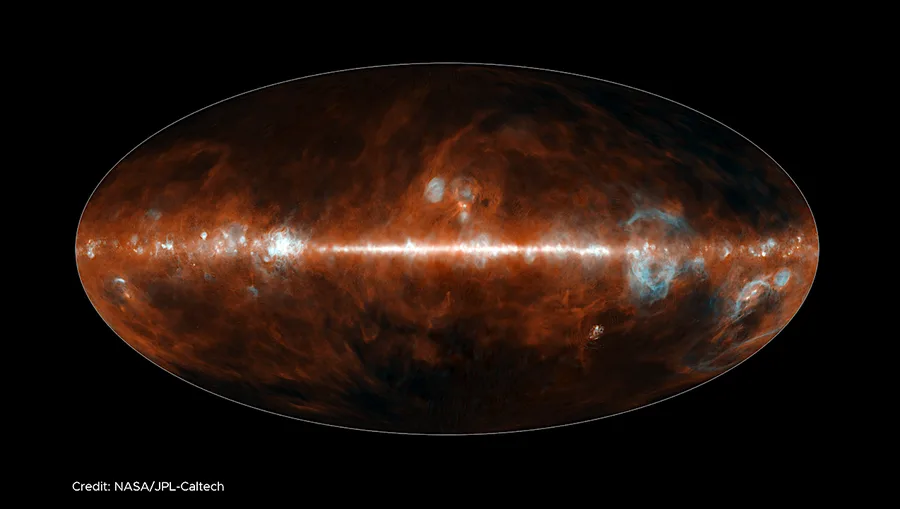
Launched in March, NASA’s SPHEREx space telescope has completed its first infrared map of the entire sky in 102 colors. SPHEREx will help scientists answer big-picture questions about everything from water deposits in the Milky Way to what happened in the first second after the big bang. While not visible to the human eye, these […] The post Astrochemistry Update: SPHEREx Observatory Completes Fi…
LIVE SEMINAR: 1 April 2025 16:00 CEST
Despite its complexity, terrestrial life is built from relatively small precursor molecules containing carbon, oxygen, hydrogen, and nitrogen.
To date, more than 330 different molecular species have been discovered in the interstellar medium, some of which could have served as building blocks for prebiotic chemistry. To determine whether these molecules playe…
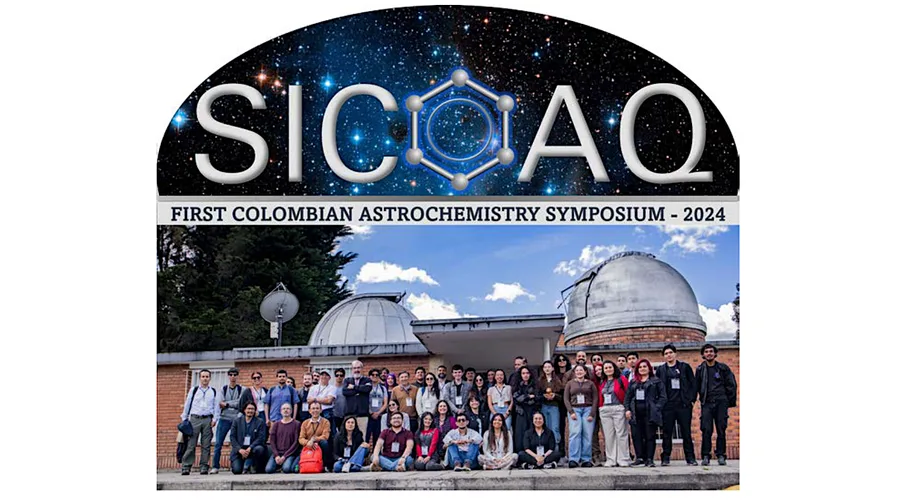
The First Colombian Astrochemistry Symposium (SICOAQ), held in Bogotá in October 2024, brought together 98 participants, including 23 speakers, to foster interdisciplinary collaboration in the rapidly growing field of astrochemistry. The programme featured engaging lectures, courses, and discussions on a wide variety of topics, extending from chemical processes in planet-forming discs and the ast…
Class of 1943 Career Development Assistant Professor Brett McGuire has added podcast host to his repertoire with Astrochem Coffee, a monthly podcast designed as a continuation of his efforts to broaden awareness of the field of Astrochemistry. Astrochem Coffee was designed and launched in August 2023 by the organizers of the Astrochemistry Discussions Webinar series. […]
Zachary Fried, a graduate student in Professor Brett McGuire‘s research group, has been named the winner of the 2023 Lewis E. Snyder Astrochemistry Award at this year’s International Symposium on Molecular Spectroscopy for his talk, “Machine Learning Of The Chemical Inventory And Rare Isotopologues Of The Solar‐type Protostellar Source Iras 16293‐2422 B”. This award is […]
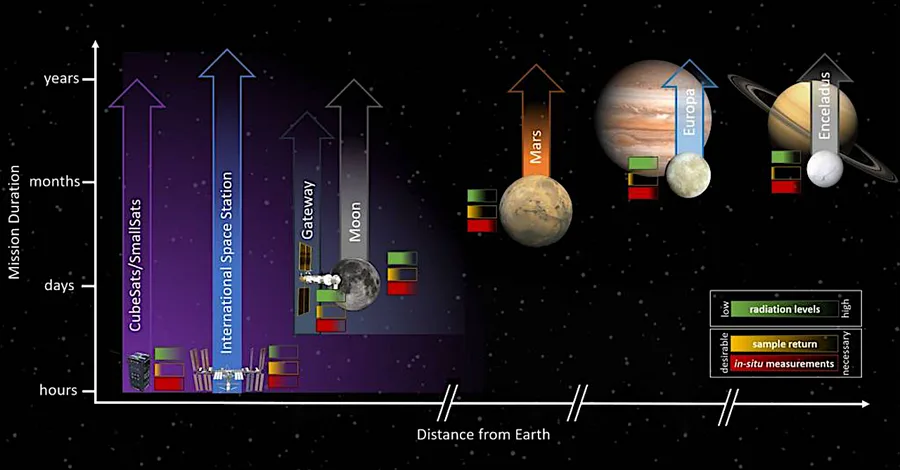
Space experiments are a technically challenging but a scientifically important part of astrobiology and astrochemistry research. The International Space Station (ISS) is an excellent example of a highly successful and long-lasting research platform for experiments in space, that has provided a wealth of scientific data over the last two decades. However, future space platforms present […] The pos…
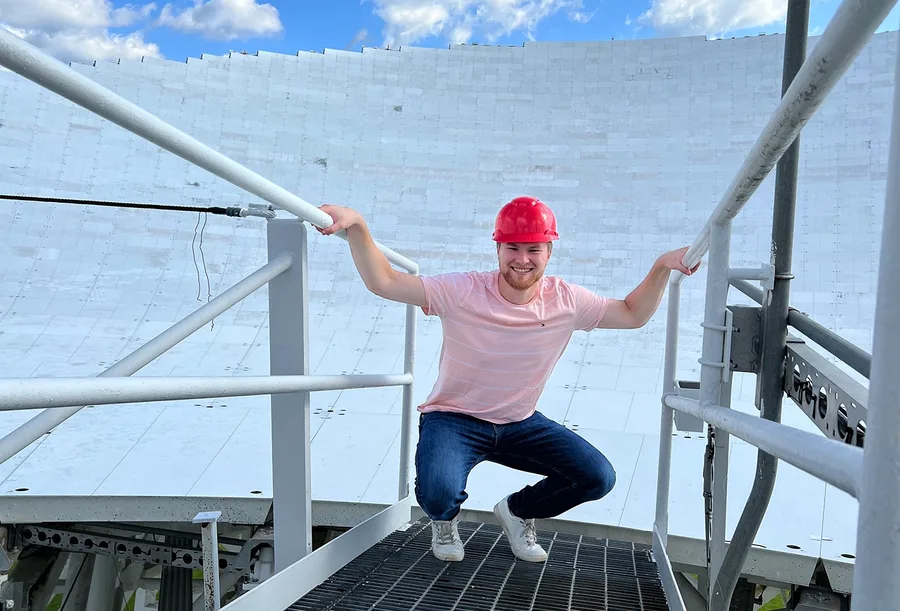
Originally from Florida, Zachary Fried primarily grew up overseas, in Hong Kong. He is a second year graduate student in Professor Brett McGuire‘s group, and credits his interest in researching the unknowns with inspiring him to pursue a PhD in chemistry. “Astrochemistry is an especially exciting and compelling field of study since there is still […]
In a new study, researchers used ultrafast lasers to explore the chemistry of H3+ molecule. They observed how roaming H2 molecules evolve to H3+.
H3+ is prevalent in the universe, the Milky Way, gas giants and the Earth’s ionosphere.
The team first documented this process using methanol and they expand and duplicate this process in a number of molecules and identified a number of new pathways.
Th…
At the national ACS meeting in Philadelphia, the ACS-PHYS division established a new Astrochemistry Subdivision. Astrochemistry is the study of the abundances and chemical reactions of atoms, molecules, and ions and how they interact with radiation in both gas and condensed phases in Solar Systems and in the Interstellar Medium. The new Subdivision provides an … Read More The post New Astrochemis…