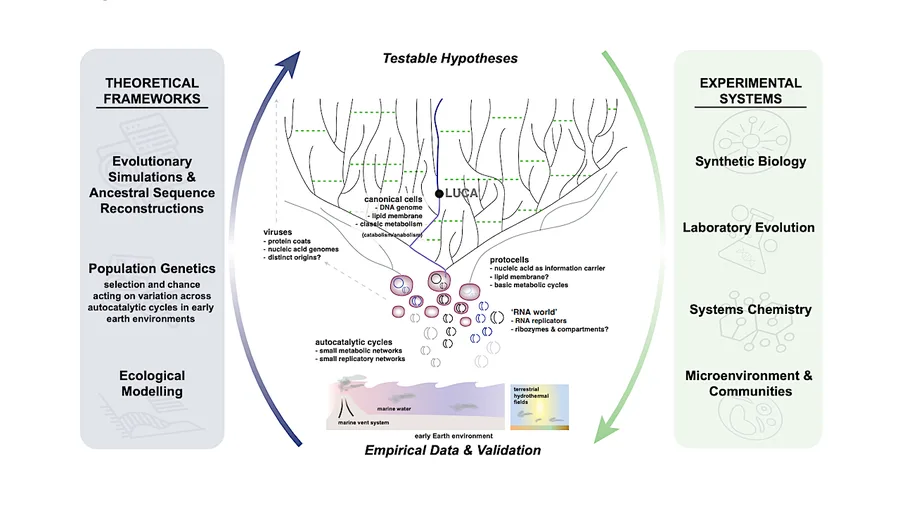
[q-bio.PE] The origin of life is often framed primarily as a chemical problem, yet life s defining feature is evolution. Advances in geochemistry, prebiotic chemistry and molecular biology have suggested […] The post The Emergence Of Life In The Light Of Evolution appeared first on Astrobiology .
Thanks to support from the Joan and Bob Field Evolution Education Fund, UCMP’s Understanding Evolution project has a new module on the Origin of Life.  Inspired by Director Charles Marshall and Clifford Brunk’s 2021 examination of criteria for evaluating origin-of-life scenarios, the AP- and college-level tutorial provides an accessible introduction to this area of fascinating […]
[physics.soc-ph] The origin of life poses a problem of combinatorial feasibility: How can temporally supported functional organization arise in exponentially branching assembly spaces when unguided exploration behaves as a memoryless […] The post Crossing The Functional Desert: Cascade-Driven Assembly And Feasibility Transitions In Early Life appeared first on Astrobiology .
It’s one of the origins-of-life chicken-or-egg problems: How could RNA have helped give rise to the first cells before there were cells to contain it? Without the compartmentalization of a cell, it would have been extremely difficult for these vulnerable molecules to have found enough of each other in the proverbial primordial soup, let alone […]
From the visionary imagination of Isaac Asimov to the pioneering experiments of Stanley Miller, science has spent decades trying to answer one of humanity’s deepest questions: how did life arise?
Testing a Rock-RNA world to create early Life Prof. Dieter Braun, AG Braun, Physics, LMU Munich - Germany LIVE SEMINAR: Tuesday 5th May 2026 16:00 CEST EAI Zoom We are…
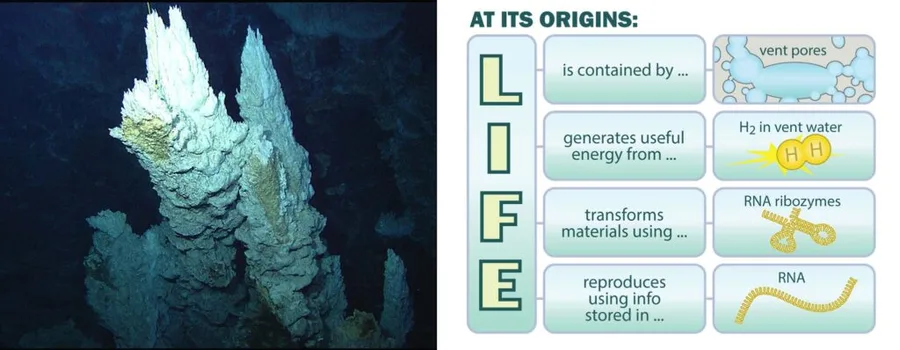
Deep beneath the ocean’s surface, mineral-rich hydrothermal vents may have hosted a critical chemical reaction that helped spark life on Earth. Researchers at the University of Alberta report that they may have identified a missing piece in one of science’s biggest questions: how life first began on Earth. Many scientists think life started deep on [...]
The Genesis Project On The Origin Of Life Becomes A National Centre Of Competence In Research
The Federal Council has approved funding for the “Genesis” project on the origins of life, led by ETH Zurich in collaboration with the University of Lausanne. Genesis is one of six new National Centers of Competence in Research (NCCRs).
How did life emerge on Earth? Is there life elsewhere in the univers…
Researchers are uncovering how a poisonous chemical could have helped life emerge. A chemical that is deadly to humans may have contributed to the earliest steps toward life on Earth. Hydrogen cyanide can freeze into solid crystals at low temperatures. Computer modeling work reported in ACS Central Science shows that certain crystal surfaces are highly [...]
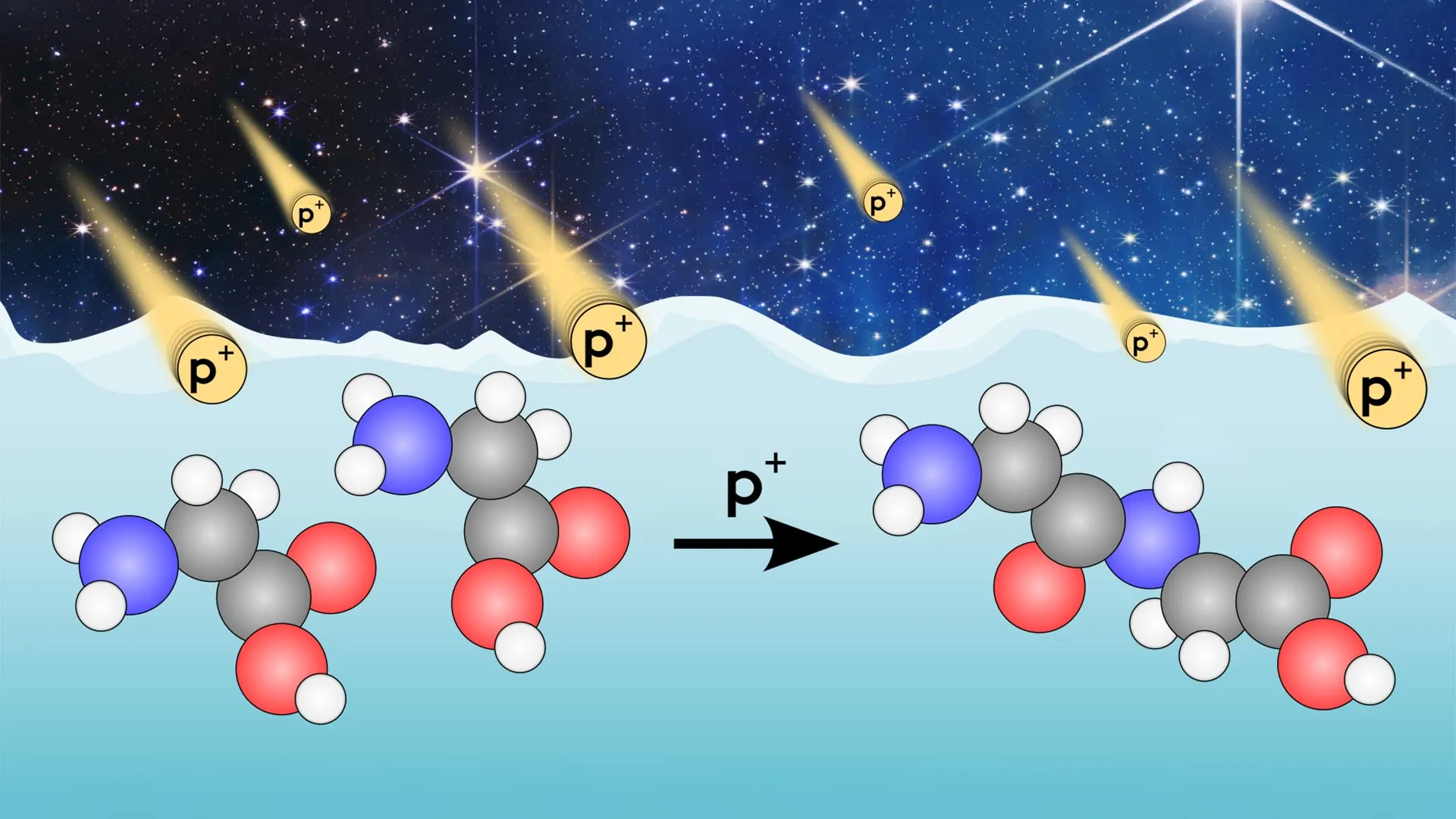
Life’s chemistry may begin in the cold darkness of space
The building blocks of life may be forming in deep space long before planets are born.
- Date:
- January 21, 2026
- Source:
- Aarhus University
- Summary:
- New experiments reveal that protein precursors can form naturally in deep space under extreme cold and radiation. Scientists found that simple amino acids bond into peptides on interste…
The exact moment when life began on Earth may be forever hidden from us. But scientific research can explore the events leading up to that moment. Researchers have mad a lot of progress in finding the building blocks of life and in understanding how they formed.
New research in ACS Central Science extends that understanding.
It's titled "Electric Fields Can Assist Prebiotic Reactivity on Hydrogen…
How did life begin on Earth? Based on studies of fossilized bacteria, scientists theorize that life first emerged on Earth over 4 billion years ago as simple, single-celled organisms. Over time, these organisms evolved to incorporate photosynthesis and sexual reproduction, eventually giving rise to more complex multicellular organisms, plants, and, eventually, mammals. Despite this scientific con…
Assistant Professor, Purdue University
Who am I?
I'm an astrobiologist and Assistant Professor in the Earth, Atmospheric, and Planetary Sciences (EAPS) Department at Purdue University. The focus of my lab, the Laboratory for Origins and Astrobiology Research (LOAR) is to experimentally and theoretically explore the origin of life on Earth and the search for life on other worlds.
I will be hiring …
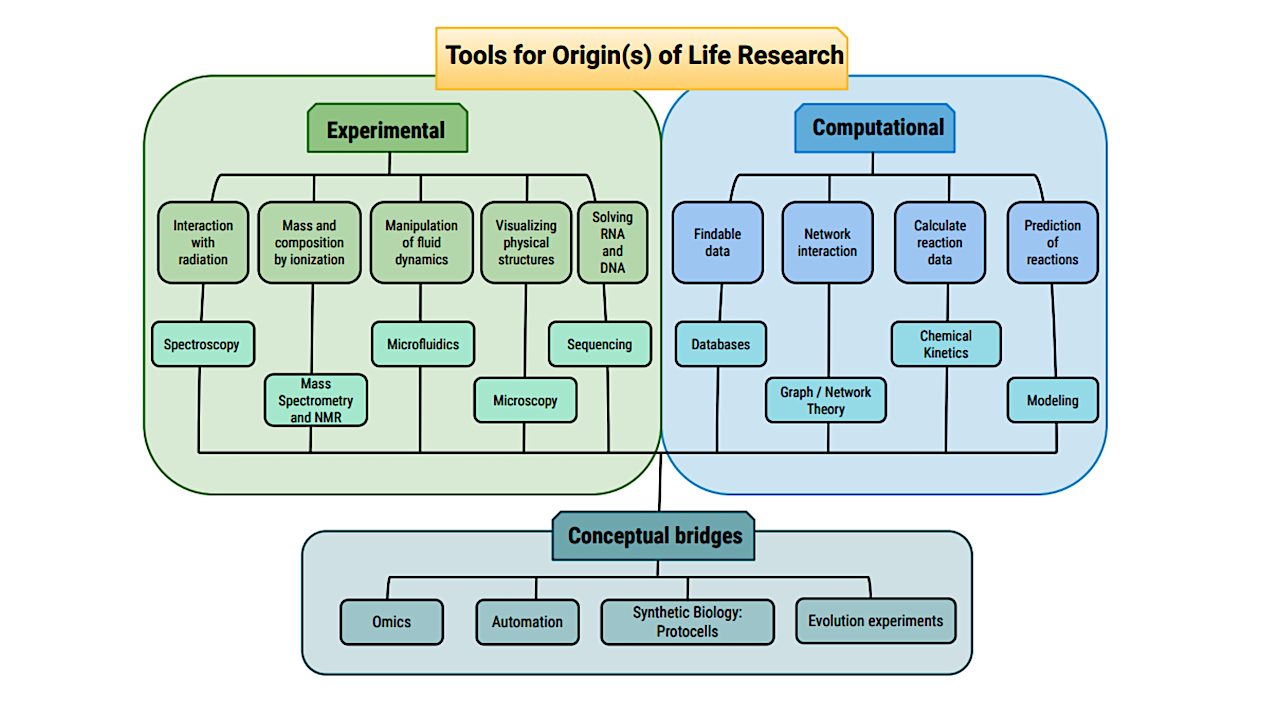
Understanding the origin(s) of life (OoL) is a fundamental challenge for science in the 21st century. Research on OoL spans many disciplines, including chemistry, physics, biology, planetary sciences, computer science, mathematics and philosophy. The sheer number of different scientific perspectives relevant to the problem has resulted in the coexistence of diverse tools, techniques, data, and [……
The gap between chemical evolution and the beginning of biological evolution may be smaller than we originally thought. Two Japanese scientists created a microscopic particle capable of replicating itself, known as a “coacervate droplet”. Link: https://www.studyfinds.org/missing-link-origins-of-life/
Researchers have long sought to understand the origins of life on Earth. A new study conducted by scientists at the Institute for Advanced Study, the Earth-Life Science Institute (ELSI), and the University of New South Wales, among other participating institutions, marks an important step forward in the effort to understand the chemical origins of life. The findings of this study demonstrate how …
Hydrothermal vents: famous for being one of the leading origin-of-life hypotheses; explaining the chicken-and-egg conundrum of DNA and cells. Read more about the teams’ findings and the paradoxes proposed here: Link: https://www.science.org/content/article/was-life-s-first-meal



 research.io