[PNAS]. Kerogen, insoluble organic matter preserved in sediments, represents some of the earliest known terrestrial biosignatures which have provided important insights into the origin of life and planetary habitability. Direct […] The post Direct Dating Of 3.5 Ga Biogenic Carbon In A Microbial Mat Remnant, Singhbhum Craton, India appeared first on Astrobiology .
[astro-ph.IM] The Commensal Open-Source Multimode Interferometer Cluster (COSMIC) runs software that searches for technologies elsewhere in the Universe (“technosignatures”) using the Karl G. Jansky Very Large Array (VLA). Specifically, it […] The post The VLA and High-Frequency SETI: Expanding The Search for Life appeared first on Astrobiology .
[astro-ph.EP] HATS-6 b is one of several recently discovered Giant Exoplanets orbiting M-dwarf Stars (GEMS) and is part of a JWST survey that aims to compare bulk and atmospheric properties […] The post GEMS JWST: HATS(-6 b): A Sub-solar Metallicity Giant Planet With Water, Methane And Ammonia In Its Atmosphere appeared first on Astrobiology .
[astro-ph.EP] The demographics of terrestrial planets and their orbits reveal a vast diversity in overall planetary energy budgets. Terrestrial exoplanets in short-period or eccentric orbits can experience intense tidal heating […] The post The Tidal Venus Phenomenon: Demographics and Case Studies appeared first on Astrobiology .
[University at Buffalo] It’s one of the origins of life’s chicken-or-the-egg problems: How could RNA have helped give rise to the first cells before there were cells to contain them? […] The post RNA Droplets May Have Helped Start life on Earth appeared first on Astrobiology .
[astro-ph.GA] Modern radio telescopes generate vast amounts of observational data, offering valuable insights into the molecular composition of interstellar sources. Identifying the molecules within these datasets typically involves time-consuming and […] The post Automated Assignment and Prediction of Molecules in Astronomical Line Surveys Using Machine-Learning-Based Chemical Embeddings appeare…
[astro-ph.EP] Thousands of sub-Neptunes have been discovered mainly through space-based surveys such as Kepler and TESS. Their bulk compositions and internal structures are thought to reflect their formation and evolutionary […] The post A Search for Helium in the Atmospheres of Three Sub-Neptunes and a Super-Earth Around M-dwarfs appeared first on Astrobiology .
[astro-ph.EP] Aerosols are a near-ubiquitous feature of sub-Neptune atmospheres, yet their microphysical nature remains poorly understood. Both condensate clouds and photochemical hazes have been proposed to explain observations, but have […] The post Wet Removal and Cloud Enhancement: The Microphysics of Cloud-Haze Interactions on Sub-Neptunes appeared first on Astrobiology .
[Nature Astronomy] Among icy moons of the outer Solar System, subsurface water oceans and large collisions both seem to be common, but the impact of the latter on the presence […] The post The Role of Disruptive Impacts on Ocean Generation and Longevity in Icy Moons appeared first on Astrobiology .
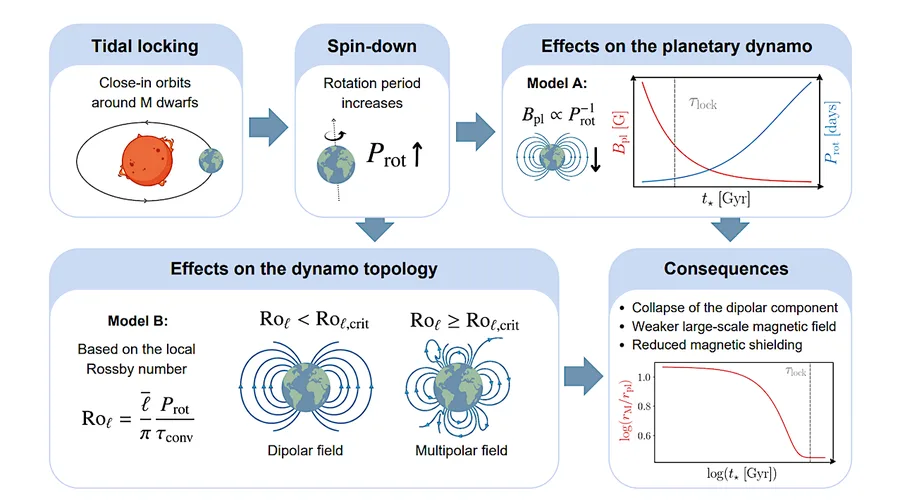
[Astronomy & Astrophysics] We investigate how tidal locking affects the magnetic field generation and magnetospheric protection of Earth-like planets orbiting the habitable zone of M dwarfs. While the role of […] The post Tidal Locking As A Negative Feedback On Earth-like Planetary Dynamos: Consequences For Magnetic Shielding And Habitability appeared first on Astrobiology .
[NASA] Some of Earth’s microbes likely to hitch a ride to space with human explorers could survive in the shaded nooks and crannies of the Moon’s South Pole region, NASA […] The post Human-Related Microbes May Survive At The Moon’s South Pole appeared first on Astrobiology .
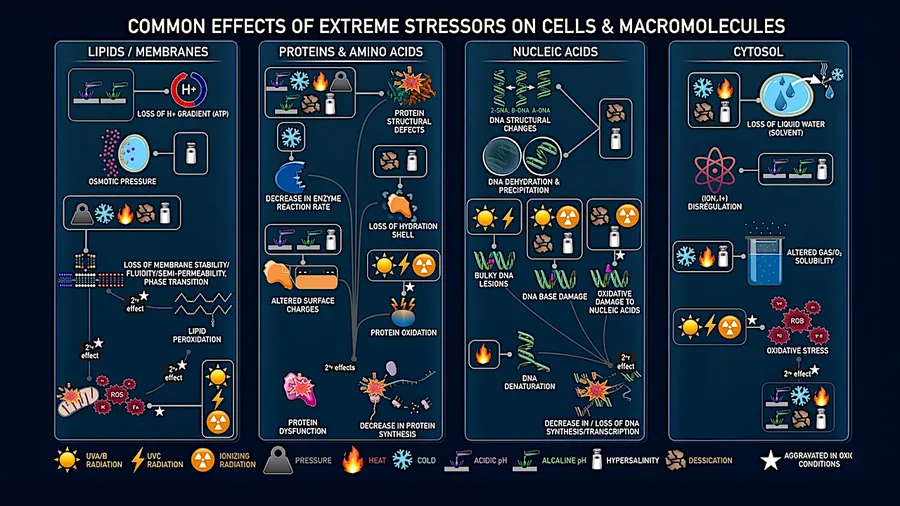
[FEMS Microbes] Extremophiles are used to study both the limits of life and its potential elsewhere. Categories are commonly employed to describe extreme conditions, however, changing the focus to the […] The post Extremophiles: Life Resists Chemistry Not Conditions appeared first on Astrobiology .
[Proceedings of the IAU]. The search for extraterrestrial life, especially intelligent life, is among the most profound scientific endeavors. Although the international community achieved consensus within a few years of […] The post International Law and the Search for Extraterrestrial Intelligence appeared first on Astrobiology .
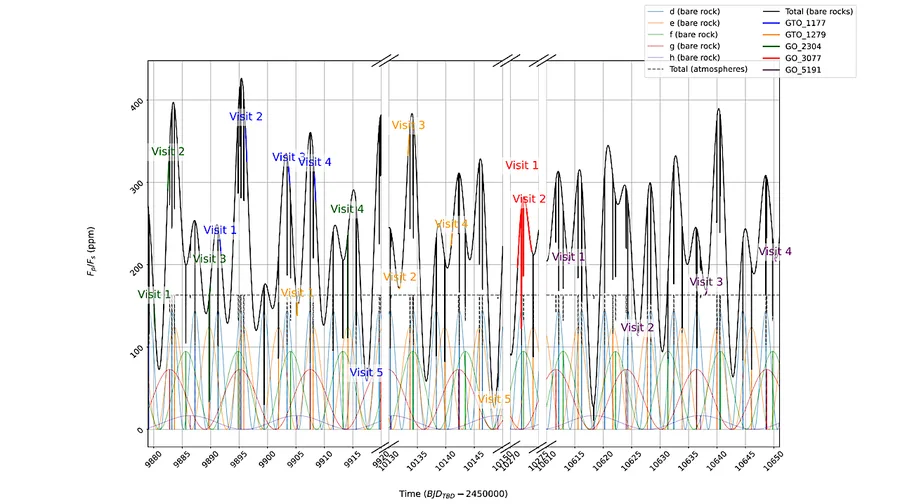
[astro-ph.EP] The TRAPPIST-1 system has been thoroughly observed with JWST. Unfortunately, stellar contamination issues strongly limit the interpretation of transit observations. As for emission observations, only the two closest planets […] The post Looking For TRAPPIST-1 External Planets’ Emission In JWST Archival Data appeared first on Astrobiology .
[astro-ph.EP] Aims. We investigated the properties of the water snow line during the early stages of disk evolution, paying particular attention to the effects of gravitational instability and dust growth […] The post Hydrodynamics Modeling Of The Water Snow Line In Young Protoplanetary Disks With Dust-size-dependent Opacities appeared first on Astrobiology .
[astro-ph.EP] In just over three years of operation, JWST has observed all seven planets of the TRAPPIST-1 system. The two innermost planets were found to have little to no atmosphere, […] The post Atmospheric Reconnaissance of TRAPPIST-1 f with JWST NIRISS SOSS: No Evidence for the Transit Light Source Effect appeared first on Astrobiology .
[Boston College] Scientists have determined a newly discovered meteorite from Mars is 1.27-billion years old and derived from a previously unsampled, pristine source on the Red Planet, the team reported […] The post Meteorite Helps Bridge The Data Gap In the Geologic History Of Mars appeared first on Astrobiology .
[astro-ph.EP] Three of Jupiter’s Galilean satellites – Europa, Ganymede, and Callisto – are of particular scientific interest due to their icy shells and suspected subsurface oceans. However, the radar properties […] The post Radar Observations Of Europa in 2011-2024: New Insights Into Radar Scattering Properties appeared first on Astrobiology .
[Syracuse University] An international team of researchers analyzed manganese and other chemical signatures preserved in more than 27,000 ancient seafloor samples collected from six continents. Across six major glaciations spanning […] The post Metal Deposits Linked To Oceanic Oxygen Loss During Ancient Ice Ages appeared first on Astrobiology .
[Nature Communications Earth & Environment] Ferruginous conditions in the Precambrian oceans gave rise to ancient iron formations that contain the oldest recognized traces of life in the form of mineral […] The post Metagenomics Deciphers Diagenetic Processes Of Ferruginous Mineralization In The Deep Biosphere appeared first on Astrobiology .

 research.io