Suppose we have a drinking flask with styrofoam between outer and inner walls. The heat can be transferred through styrofoam by conduction. Is the heat transferred by radiation as well? My lecturer says "no": There is no radiative transfer: material is opaque. Radiation is absorbed on surfaces. Is he right?
In physics, a local Lagrangian induces a covariant phase space equipped with a canonical presymplectic form. The quotient of this by symmetries that, in good cases, make the pre-symplectic form a genuine symplectic form, is called the reduced phase space.
Generally, given a symplectic manifold or presymplectic manifold or Poisson manifold regarded as a phase space equipped with a suitable (Hamilt…
Feeling too warm or too cold indoors may depend on more than the thermostat. The spectrum of indoor lighting plays a role in how people perceive temperature, according to research led by scientists at Penn State.
ARTCONTEXT AND RUPTURE: Standard clinical paradigms traditionally evaluate human physiological degradation as a sequence of isolated kinetic errors and spontaneous chromosomal decay. This manuscript initiates a formal epistemological expansion, proposing that chronic peripheral disease and inherited genetic failure are not random molecular accidents, but the highly organized thermodynamic exhaust…
National Research Council of Science and Technology
2d ago
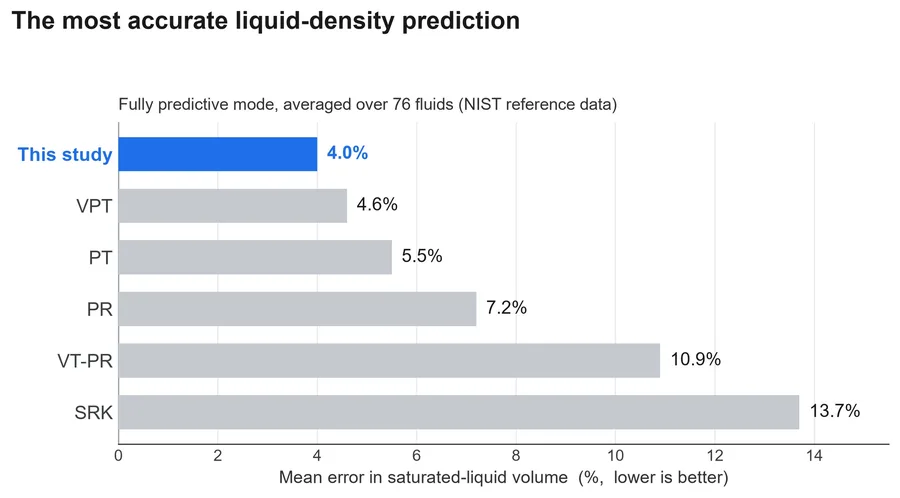
Korea Institute of Civil Engineering and Building Technology (KICT, President Park, Sun-Kyu) has developed a new cubic equation of state (EOS) that provides a physical justification for a mathematical structure that the chemical and petroleum industries have relied on for more than half a century without a first-principles explanation.
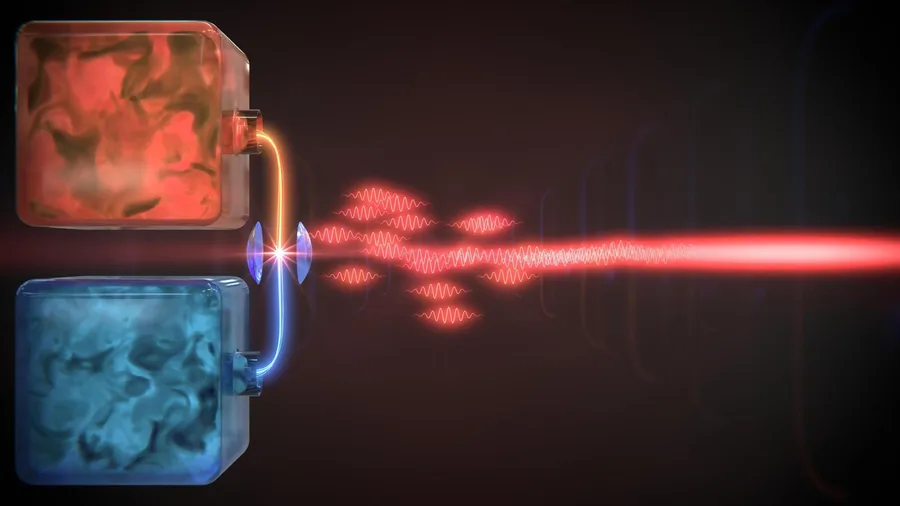
Thermodynamics was built for steam engines; quantum mechanics for atoms. The two meet again in a driven cavity, where an atom absorbs and emits photons while a laser continuously supplies energy and light leaks through the mirrors. Patrick Potts and colleagues at the University of Basel treat this textbook open system as a miniature light engine. Their key step is not to count every escaping phot…
So say I've got a pipe, and it's got some kind of an internal pressure. Now, it's completely enclosed, so atmospheric pressure cannot affect it. Then, if I wanted to measure the pipe's pressure by drilling a hole and attaching a piezometric tube, like in the picture, wouldn't I be providing an entrance to the atmospheric pressure, and thus the pressure inside the pipe would increase accordingly, …
Previously, predicting thermalisation relied on describing systems at infinite timescales. Now, a mechanism links aperiodicity in quantum dynamics to the thermalisation of macroscopic properties, offering computable predictions applicable even over finite observation times in complex systems. This approach recovers established infinite-time theories as a specific instance, yet delivers stronger, …
A tiny machine made from just an atom and particles of light may sound impossibly simple, but it raises a surprisingly difficult question: what counts as heat, and what energy can still do useful work? University of Basel researchers have developed a theoretical framework that brings quantum physics and thermodynamics into better agreement for these microscopic “light engines.”
What is heat, and what is useful work if a machine consists only of an atom and light particles? In modern quantum technologies, this kind of question connects thermodynamics with quantum physics. Researchers at the University of Basel, Switzerland, have developed a theoretical approach that can reconcile both theories.
So, temperature is formally defined as the inverse of the rate of change of entropy in respect to internal energy. I'm fine working with this mathematically but I don't get it intuitively. Does anyone have some intuition as to why temperature is defined this way?
This paper reframes the Second Law of Thermodynamics as an algebraic consequence of informational invariance under scales of resolution. To ensure structural objectivity across varying observer resolutions, macroscopic evolution must remain invariant under arbitrary refinements of the coarse-graining scale. Microscopic dynamics are taken to be reversible and information-preserving (Liouville[1] o…
Washing dishes in cold water and soap can leave plates looking clean, but looking clean is not the same as being clean. Hot water changes the physics of the whole job: it melts fats that cold water leaves stuck to the surface, it shortens drying time, and it kills far more of the microorganisms that […] The post Why Hot Water Wins at the Sink: Temperature, Grease, and Hygiene in Dishwashing appea…



 research.io