I am a slow adopter of new technologies. I have recently been playing around with AI at a very basic level on some research problems. Colleagues are also telling me about their experiences. I want to write something about its potential, both good and bad, for research and teaching. I want to hear from more people, particularly in condensed matter theory. However, before that, I think it is worth …
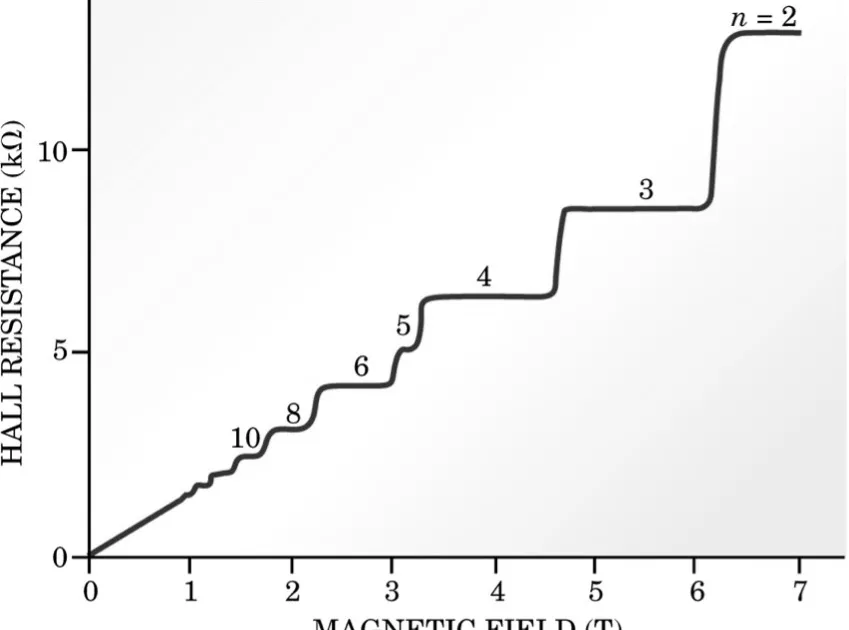
And why is it so amazing? Surprises [about physics in two dimensions] occurred in the 1980s when it became possible to study Landau levels [the quantised energy levels of electrons in a magnetic field] in Flatland. This happens when the electrons are completely constrained to move in only two dimensions. The surface within which the electrons move needs to be extremely flat and free from defects …
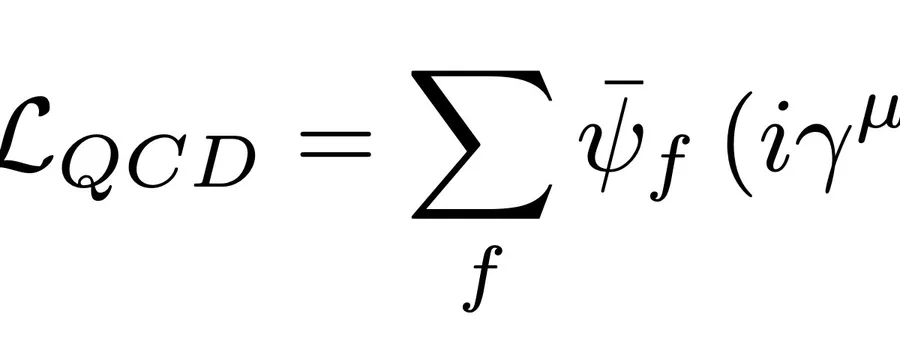
A characteristic of emergent phenomena is how novel and complex properties can emerge from apparently simple laws. Quantum ChromoDynamics (QCD) describes the interaction of quarks and gluons. The classical Lagrangian is remarkably simple. It has an SU(3) local gauge symmetry and the A_v^mu are the associated gauge fields (gluons). The quarks are fermions with fractional electrical charge. The onl…
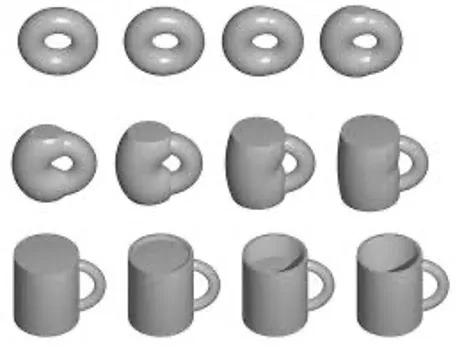
Topology is the field of mathematics describing the properties of geometric objects that do not change when they are smoothly deformed. These properties only change in steps by cutting or gluing. Concepts in topology can be illustrated with everyday objects such as balls, doughnuts, coffee cups, and pretzels. For example, a doughnut can be gradually and smoothly deformed into the shape of a coffe…
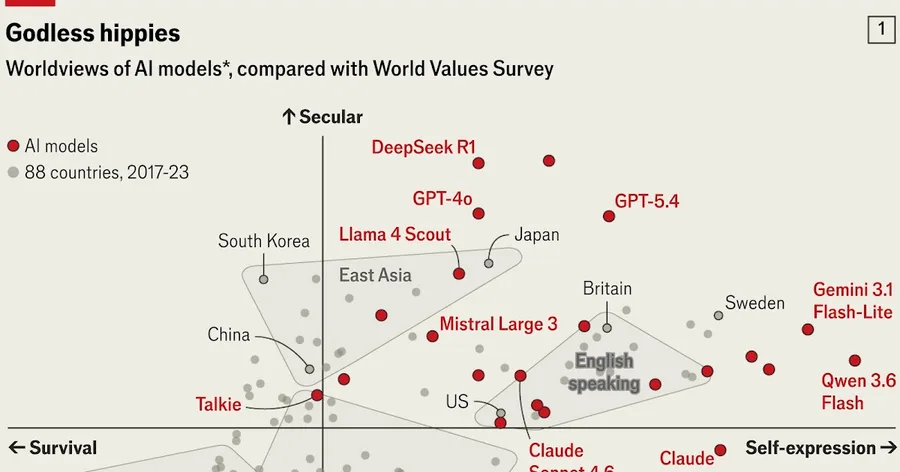
I continue to enjoy reading my hard copy of The Economist every week. Occasionally, I post examples of insightful graphics presented in articles. Here are some graphics that struck me recently. They are taken from a fascinating article. AI models’ values are very different from most people’s The first figure shows a comparison of the answers given to the World Values Survey by different Large Lan…
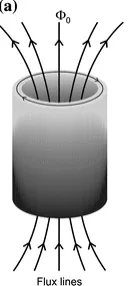
Quantisation of magnetic flux in a superconductor Magnets and electrical currents produce magnetic fields, regions of space where other magnets and electrical wires experience a mechanical force. For a circle of wire in the presence of a magnetic field the magnetic flux is defined as the strength of the magnetic field passing through the circle multiplied by the area of the circle. A law of elect…
Rudolph Marcus died last week. He was 102. There is a nice obituary in The New York Times . He was best known for his theory of electron transfer, for which he was the sole recipient of the Nobel Prize in Chemistry in 1992. Although the theory was proposed for electron transfer in a polar solvent it applies to a wide range of other systems, where two quantum states are coupled to one another and …
In philosophical discussions of emergence and reductionism in chemistry, molecular structure has received significant attention and debate. Sometimes molecular structure is used to justify strong emergence, i.e., that molecular cannot be predicted, even in principle, solely from quantum theory. Primas was one of the first to claim that molecular structure could not be reduced to quantum physics. …
On the arXiv, I have posted a new version of my review article, Emergence: from physics to biology, sociology, and computer science . I have added expanded sections on molecular structure, quantitative measures of causal emergence, and biological evolution. There are also many minor additions and corrections. I hope the hyperlinked Table of Contents is helpful. I welcome feedback and suggestions.…
An example of emergent entities in condensed matter physics are quasiparticles. The concept can be described with the following analogue. When a horse gallops through the desert it stirs up a dust cloud that travels with it. The motion of the horse cannot be separated from the accompanying dust cloud. They act as one entity. Similarly, in a system consisting of many interacting particles, when on…
The theory of evolution explains the origin of biological diversity and levels of similarity between species. A characteristic of emergence is that many iterations of a simple law (natural selection of the fittest to reproduce) can produce novel, diverse and rich structures. In biological evolution many generations in a population can produce new traits and species. Many of the most debated issue…
Every person is unique. No two people are identical. We differ in physical appearance, personality, fingerprints, heartbeat, gait, and DNA. Such differences are used to identify criminals and in video surveillance of citizens by nation states. Yet in other ways all humans are the same. We all have brains, hearts, and lungs. All our bodies use the same biochemistry to stay alive: whether to breath…
In computational quantum chemistry, the Born-Oppenheimer approximation (BOA) is used to determine potential energy surfaces (PES) for electronic states of molecules. It is standard practise to identify local minima on a PES with molecular structures. Molecular binding energies are identified with the difference in energy between these minima and the energies of the isolated atoms of which the mol…
Adventures in Flatland In everyday life we think of most objects as having three dimensions. But what would life be like in a two-dimensional world? For one thing, it would be harder to move around. We could no longer step over things but would have to move around them. In 1884 Edwin Abbott published Flatland: A Romance of Many Dimensions , under the pseudonym, A. Square, a satirical novella abou…
Most philosophical debates about the emergence of molecular structure centre around the issue of irreducibility. Specifically, can the existence of structures be predicted from quantum theory without assuming their existence or invoking classical concepts? I will argue that the answer is yes, contrary to much of the philosophical literature, which relies heavily on the widespread use of the Born-…
The order of things Life and the world around us sometimes appears chaotic and random. We may feel this way about traffic, weather, economics, social change, politics, or our personal relationships. Perhaps that is why many yearn for regularity, predictability, order, and stability. Science is a search for patterns and order in the natural world. Condensed matter physics is about how order emerge…
Most debates about the emergence of molecular structure centre around the issue of irreducibility. Specifically, can the existence of molecular structures be predicted from quantum theory without assuming their existence or invoking classical concepts? Consider a molecule that contains Ne electrons and Nn atomic nuclei (ions). The full quantum-mechanical Hamiltonian for the system is where e is t…
Snowflakes form incredibly diverse structures, seen when they condense onto a plate of glass. Every snowflake is different. On the other hand, every snowflake is the same. They are all composed of ice, a solid state of water. Every snowflake is composed of units that have a six-fold symmetry (Figure 8). Every snowflake is composed solely of water molecules. This paradox of the particular and the …
In discussions of emergence, particularly in chemistry, isomers are often given as an example of an emergent phenomenon. In Anderson's original "More is Different" article, he discussed the chirality of sugar molecules as an example of symmetry breaking. More recently, isomers (and the associated concept of molecular structure) are invoked to justify contentious claims about strong emergence and …
Diamond and graphite are distinct solid states of carbon. They have qualitatively different physical properties, at both the microscopic and the macroscopic scale. Condensed matter physics is all about states of matter. In science classes at school, you were probably taught that there are only three states of matter: solid, liquid, and gas. Like other things you were told in school, this is incor…

 research.io