We prove that for any for clause/variable ratios up to the Gibbs uniqueness threshold of the corresponding Galton-Watson tree, the number of satisfying assignments of random -SAT formulas is given by the ‘replica symmetric solution’ predicted by physics methods [Monasson, Zecchina: Phys. Rev. Lett. 76 (1996)]. Furthermore, while the Gibbs uniqueness threshold is still not known precisely for any …
Nature Communications, Published online: 25 June 2026; doi:10.1038/s41467-026-74456-4 This study shows that cities grow upward through random, self-amplifying processes moderated by local interactions, linking urban form and economic growth to universal patterns from statistical physics.
The 1D Smoluchowski equation is often defined as $$\frac{\partial p(x,t)}{\partial t} = -\frac{\partial j(x,t)}{\partial x}$$
Where $j$ is the probability flux given by the relation;
$$j = -\frac{\...
This study explores a simple ternary (-1, 0, +1) majority vote model. Starting from a checkerboard initialization (+1 where i+j is even, -1 otherwise), the system spontaneously emerges a stable zero-state fraction of approximately 4.5% without any pre-specified global rules, and this fraction is independent of system size. Through systematic parameter scanning, we discover two continuous phase tr…
Statistics of Gaussian polymer chains in harmonic applied fields
Mikhail, John P; Rutledge, Gregory C
The model of an ideal polymer chain in a harmonic applied field has broad applicability in situations involving polymer confinement and deformation due to applied stress. In this work we (1) formulate a general analytical model for a continuous Gaussian chain under a harmonic applied potential an…
The state probability or the probability of finding system A in a given state having energy $U_n$ is defined as
\begin{equation}
P_n=\frac{1}{Z}e^{-\beta U_n},
\end{equation}
where $Z$ is the ...
On 16 January, physicists and statisticians met in the CERN Council Chamber to celebrate 25 years of the PhyStat series of conferences, workshops and seminars, which bring together physicists, statisticians and scientists from related fields to discuss, develop and disseminate methods for statistical data analysis and machine learning.
The special symposium heard from the founder and primary orga…
In 1827, botanist Robert Brown observed an odd jittery motion of particles as he watched grains of pollen floating in water under his microscope. He saw the random motion also with inorganic — which is to say definitely Not Alive — particles as well. But it was Einstein nearly 80 years later who figured out […]
American Physics Society (APS) March meeting is one of the largest physics meetings in the world. To help the community quickly catch up on the work presented in this conference, Paper Digest Team processed all accepted work, and generated one highlight sentence (typically the main topic) for each. Readers are encouraged to read these machine generated highlights to quickly get the main idea of e…
American Physics Society (APS) March meeting is one of the largest physics meetings in the world. To help the community quickly catch up on the work presented in this conference, Paper Digest Team processed all accepted work, and generated one highlight sentence (typically the main topic) for each. Readers are encouraged to read these machine generated highlights to quickly get the main idea of e…
Four Fields Medals were awarded for major breakthroughs in geometry, combinatorics, statistical physics and number theory, even as mathematicians continued to wrestle with how computers are changing the discipline. The post The Year in Math first appeared on Quanta Magazine
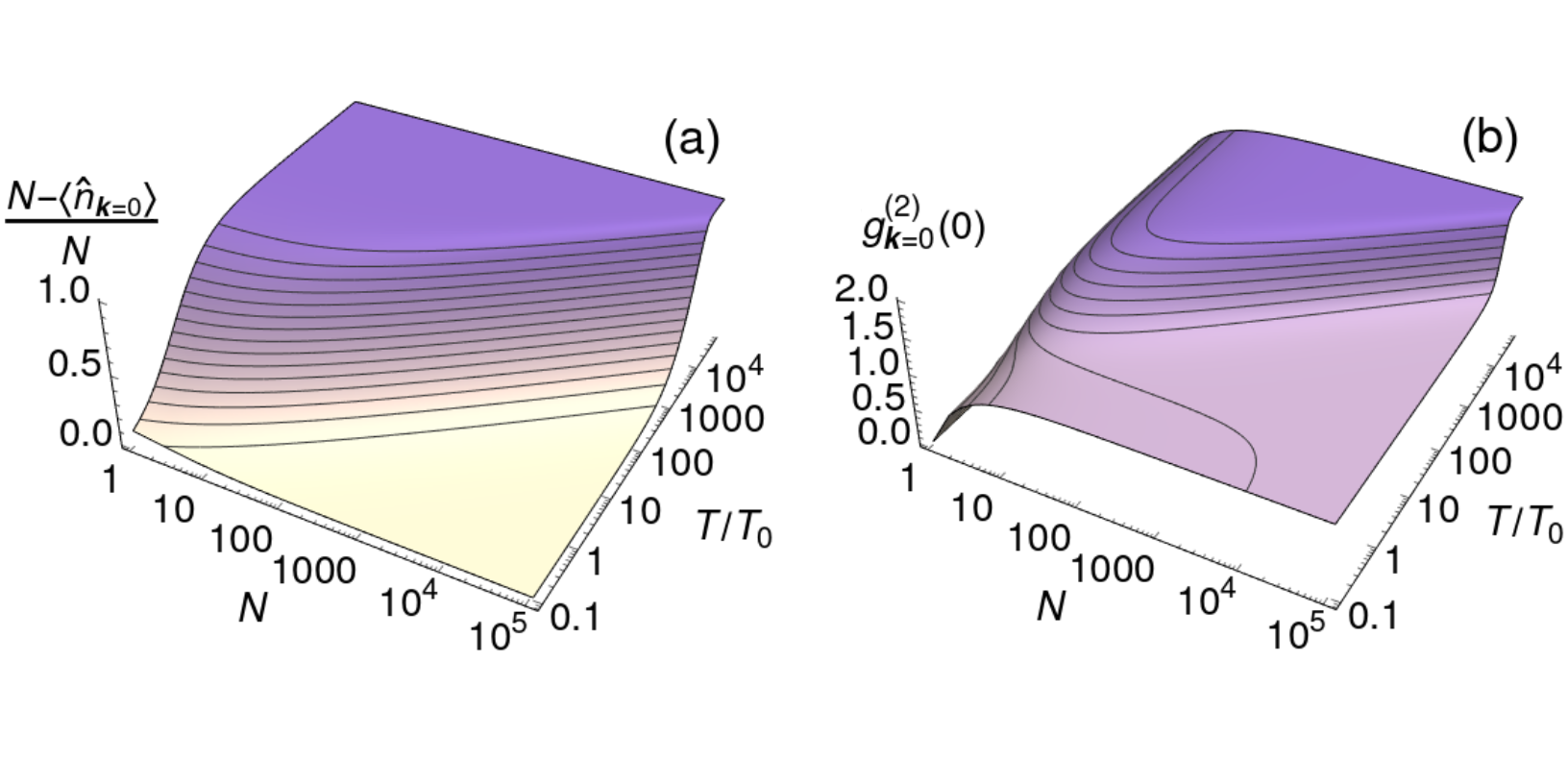
Quantum 6, 719 (2022). https://doi.org/10.22331/q-2022-05-24-719 The theoretical description of non-equilibrium Bose–Einstein condensate (BEC) is one of the main challenges in modern statistical physics and kinetics. The non-equilibrium nature of BEC makes it impossible to employ the well-established formalism of statistical mechanics. We develop a framework for the analytical description of a no…
American Physics Society (APS) March meeting is one of the largest physics meetings in the world. In 2022, the meeting will take place in Chicago. To help the community quickly catch up on the work presented in this conference, Paper Digest Team processed all accepted papers, and generated one highlight sentence (typically the main topic) for each paper. Readers are encouraged to read these machi…
by Markus Deserno
One of the fundamental facts of statistical physics is that microscopic systems are subject to constant thermal fluctuations. They are fundamentally random, but still exhibit many regularities that permit us to learn a great deal about those systems. For instance, any individual quadratic degree of freedom of the form $\frac{1}{2}Kx^2$ has an expected value of the energy equal t…
You can’t escape him, working where information theory meets statistical mechanics. Information theory concerns how efficiently we can encode information, compute, evade eavesdroppers, and communicate. Statistical mechanics is the physics of many particles. We can’t track every particle in a … Continue reading →
Cosima Schuster is program director in the German Research Foundation (DFG) for the fields of statistical physics, soft matter, biological physics and nonlinear dynamics. Read more Continue reading →
Cosima Schuster is program director in the German Research Foundation (DFG) for the fields of statistical physics, soft matter, biological physics and nonlinear dynamics. Read more Continue reading →
A few recent items that caught my eye: The ever-creative McEuen and Cohen groups at Cornell worked together to make graphene-based origami widgets . Access to the paper seems limited right now, but here is a link that has some of the figures. Something else that the Cohen group has worked on in the past are complex fluids, such as colloidal suspensions. The general statistical physics problem …
Here is a helpful quote from William Bialek. It is a footnote in a nice article, Perspectives on theory at the interface of physics and biology . The Boltzmann distribution is the maximum entropy distribution consistent with knowing the mean energy, and this sometimes leads to confusion about maximum entropy methods as being equivalent to some sort of equilibrium assumption (which would be obviou…









 research.io