Some interesting science results recently, but I wanted to talk about one a little off the beaten path. Most people have some exposure to the concept of thermal expansion , the idea that solids tend to increase in size as temperature is increased. This is why people suggest running a stuck (metal) lid on a glass jar under hot water to make it easier to open - the idea is that the metal expands …
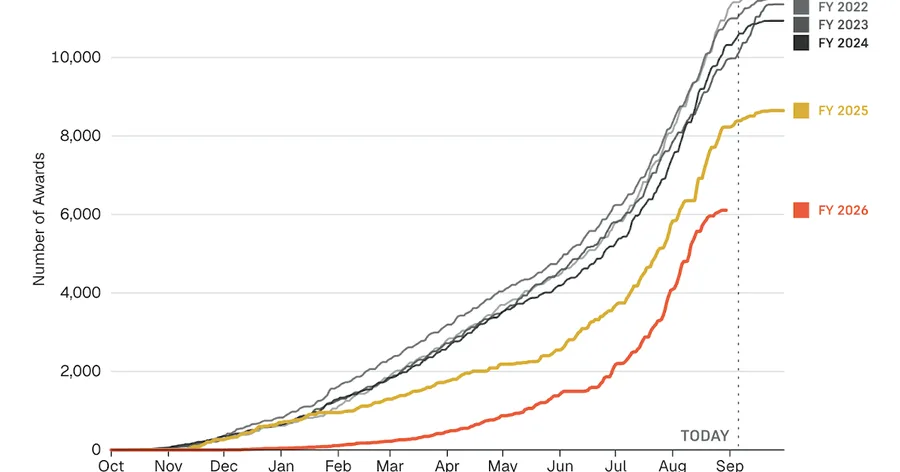
We are less than one month away from the end of the federal fiscal year, and traditionally there are internal deadlines for agencies to allocate their final spending by around September 9. Right now, the NSF is on track to issue about 4000 fewer (!!) awards in FY26 than it did annually back in FY21-FY24, and 2000 fewer than it did in the incredibly tumultuous FY25 (with its government shutdowns a…
This past week was a genuinely horrific reminder of the importance of lab safety, especially in the realm of hazardous chemicals. First, a graduate student at Hokkaido University was killed due to some kind of large-scale exposure to hydrofluoric acid . For those who don't know, HF is used at some rate in semiconductor-related work, because it's a way to etch SiO\(_2\) from silicon surfaces and …
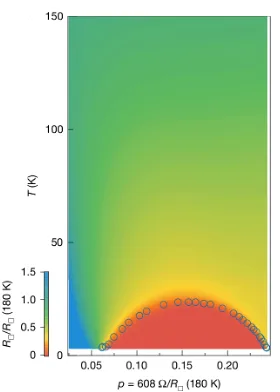
Much as I feel like I should write about the latest developments in US science policy, instead I want to point out two exciting recent superconductivity results. Below I will also append a couple of other items, including open positions at Rice. After Fig. 2b from here In this paper , researchers demonstrated high temperature superconductivity in a monolayer of Bi\(_2\)Sr\(_2\)CuO\(_{6+\delta}\)…
In case you weren't aware, in addition to the OMB proposed rule changes which just concluded their public comment period, the NSF has put forward proposed changes in their proposal procedures for public comment, and the last day for feedback is August 24. The proposal and award policies and procedures guide (PAPPG) is to be replaced with the revised document called the "Guide for Financial Assis…
Yesterday I attended the 40th annual summer research colloquium of the Smalley-Curl Institute at Rice, a fun internal conference that provides a great opportunity for undergrads (including visitors), graduate students, and a few postdocs to present their work. The keynote speaker was our EVPR, Prof. David Sholl , who gave a very informative talk about reproducibility in the chemical engineering/…
I think it's safe to say that most people who've considered the issue think that a doctoral degree in the sciences and engineering in the US often takes too long. How long? According to the latest data (see here , Table 1-12), the median time to degree in the physical sciences, for example, is 5.7 years after starting the program, while in all of engineering it's 5.3 years. Too long for what? Wel…
First, some science, clearing out a number of papers and articles that I've been collecting for some time in my far-too-numerous browser tabs: I've written before ( here ) about dimensional analysis and similarity, techniques commonly used in the engineering world that can seem quasi-miraculous at times. This paper gets into why this approach works, and different categories of physical similarity…
I've been blogging for 21 years now (!!), and over that time I've had a wide variety of comments on here, but there have been a couple of anonymous ones in the last few weeks that really worried me. It's the internet, so you can't readily tell when someone is trolling, but these made me concerned for the safety and emotional state of the commenter. Just remember, there is always someone to tal…
This past week I attended META 2026 , the 16th International Conference on Metamaterials, Photonic Crystals and Plasmonics, at Trinity College, Dublin. This was the first time I've ever gone to this conference, which has grown from somewhat blurry beginnings to a ~ 900+ person annual event. Here are a few scientific highlights: Metasurfaces , built up from spatial arrays of dielectric (or somet…
When I wrote this post last month , I really did not want it to be first in a series. The inciting incident to write that post was a news article in Science reporting that there have been draconian ~ 30% cuts in present fiscal year budgets within the NSF. Program officers were instructed to keep this confidential and not talk about it with PIs. The rumor was that this funding would go to suppor…
For non-US folks, feel free to skip. For US folks: The Office of Management and Budget , which for much of its history has been a comparatively uncontroversial element of the executive branch, has set rules and guidelines for how many executive-branch agencies conduct business and interact with, e.g., universities. For the purposes of how the research ecosystem operates, the most relevant is OM…
Some brief science and technology items heading into the weekend: IBM has reported making prototype chips for the "0.7 nm node" . As always, one should not interpret that size scale literally, since the effective diameter of a single silicon atom is around 0.2 nm. The basic building block of their architecture here is the nanostack , which is a limiting case, somewhat 3D-integrated version of …
This is a US research ecosystem post. Feel free to skip if this isn't your cup of tea. I'm showing my internet age in thinking that the right image to put at the top of this post is either the Drudge Report emergency light icon or an animated Star Trek "red alert" sign. As you may be aware, NSF spending is incredibly low this year. How low is "low"? Check out this graph from grant-witness . Th…
A few days ago I wrote about localization , where waves in a medium can become trapped due to interference by scattering off disorder. This is an extremely general phenomenon that applies to light, sound, and electronic waves in solids. Now I want to write about a phenomenon that is specific to electrons (or at least wavepackets that carry electronic charge, if we want to be very general). Rath…
Physicists love simplifying idealizations , and this is especially true in the physics of materials. The simplest decent model for metals, for example, is the ideal Fermi gas , where we neglect the existence of atoms entirely and just model the electrons as noninteracting particles in some box. One step up from there, the Sommerfeld model , assumes that the electrons are in a perfectly periodic…
It's been almost a decade since I last wrote about this topic , and a preprint on the arXiv this week is a good jumping off point for more discussion. Thermometers are devices that allow us to take some physical observable and infer temperature. I wrote about the nature of temperature 17 years ago (!!!) in a way that did not completely satisfy me or most of my readers, so maybe I should take ano…
I watched the webcast of the NAS State of Science address by outgoing NAS president Dr. Marcia McNutt . (I did not watch the panel discussion afterward, so sorry if I missed critical pieces.) A few thoughts on this: The intro music was a very classy baroque string quartet. Hard not to think of this scene from Titanic . The main theme was about ways to revitalize US science, and there were six …
Introductory undergraduate labs are a recurring challenge at nearly every university. Is the purpose to teach students something about how experimental science works (formulating hypotheses, defining measurement needs, setting up equipment, acquiring and analyzing data)? Is the purpose to emphasize and reinforce specific scientific points from the curriculum? How structured should they be? Wh…
The Manhattan Project was the largest government sponsored research and development project of its time. Some things worth noting, in light of the present US government attitude toward science: It's hard to overstate the role played by immigrant scientists in this story. Szilard, Einstein, Fermi, Wigner, Teller, von Neumann, and many more. I was trying to remember when the Manhattan Project bec…
research.io
Sign up to keep scrolling
Create your feed subscriptions, save articles, keep scrolling.


 research.io