


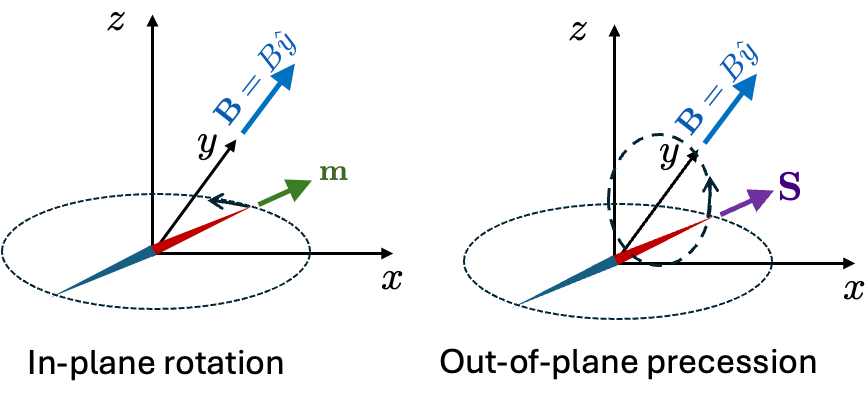
We've all seen a traditional compass. A ferromagnetic, magnetized needle is mounted on a rotating bearing (or floated on the surface of a liquid) so that it can rotate in the (x-y) plane. If there is an in-plane magnetic field (\mathbf{B}), the needle will rotate to align with that component of the field. (It stops in the aligned state because of friction; otherwise it would "librate", oscillating back and forth about the field direction.) In first-year undergrad physics, we learn a simple model of why this happens. The magnetized needle can be modeled as a magnetic dipole (\mathbf{m}). We learn that a magnetic dipole in a uniform magnetic field generates a torque (\boldsymbol{\tau} = \mathbf{m}\times \mathbf{B}). If both (\mathbf{m}) and (\mathbf{B}) are in the (x-y) plane, any torque must be directed along (z), and the torque goes to zero when (\mathbf{m} || \mathbf{B}). The simplest result of (\boldsymbol{\tau} || z) is an angular acceleration that would cause an otherwise at-rest compass needle to rotate in the plane counterclockwise about the (z) axis. Left: A compass needle out of alignment with an in-plane magnetic field produces a torque along (z), and angularly accelerates to reorient toward the field . Right: Under the right circumstances, the spin angular momentum of the needle could also precess around the field. So, how sensitive of a magnetic field detector could you make using this basic approach? This week I came upon this paper from a few years ago, which looks at this problem from the theoretical modeling side, and then this paper from last year that does the experiment. The magnet in question is a little (21 (\mu)m diameter) sphere of Nd2Fe14B, a rare-earth magnet. The authors put that inside a lead chamber with a rounded bottom, and they cool the lead down to 4.2 K, well below its superconducting transition temperature. As a result, the sphere is magnetically levitated inside thanks to the Meissner effect , with its magnetization lying in the (x-y) plane. There is some residual magnetic flux trapped in the setup that does lead to a preferred field direction. The authors can use cleverly wound pickup coils inside the chamber to detect the orientation of the sphere, as well as apply AC magnetic fields. The authors are primarily concerned in thinking about energy resolution of detection, because they are thinking about detecting unusual particles (e.g. dark matter, axions), but they point out that it should be possible to achieve tens of atto-Tesla per Hz(^{1/2}) field sensitivity per unit bandwidth - pretty wild. But wait, there's more! The magnetic moment of the magnetized needle originates from the spins of electrons in there. This is gyromagnetism, so (\mathbf{m} \propto \mathbf{S}), the total spin angular momentum of the electrons in the magnet. This means that in the presence of (\boldsymbol{\tau} || z), if mechanically possible the needle could start swinging up out of the (x-y) plane to project a component of (\mathbf{S}) along (z). This is gyroscopic precession . For macroscopic magnets, it's hard to be in the regime where this is the dominant effect, because that would require the precessional angular momentum to be small compared to (\mathbf{S}), and that's tough to achieve. Maxwell (!) tried to do it in 1861 (!!), with no success. In a very recent paper , this precessional response was finally observed, again in Nd2Fe14B microspheres. (For a uniformly magnetized sphere of radius (R), the moment of inertia (I \propto R^{5}), and (|\mathbf{S}| \propto R^{3}), so it's easier to get regime with smaller (R).) This precession approach is a pathway to even higher sensitivity measurements of magnetic fields. I think this is very cool, and it is a strong reminder that spin angular momentum is just as real as any "mechanical rotation of solids" angular momentum.
Floating magnets to sense magnetic fields
Douglas Natelson (noreply@blogger.com)