Let's say I want to calculate the wavelength of the photon emitted when an electron of an arbitrary element (let's say Carbon) drops from $n=4$ to $n=3$ . Correct me if I'm wrong, but I think I would have to find the change in the electron's energy value $\Delta E = E_i - E_f$ , set that equal to $hc/\lambda$ and solve for the wavelength ( $\lambda$ ). How could I find $E_f$ and $E_i$ ? My textbo…
Are there some good reference about transition rates? I am talking about atomic physics transition rates, including the physics and how to compute the rates.
I was wondering why atoms, when pulled apart and then released, attract together, but I notice that there is a special distance at which this attractive force doesn't seem to act but rather those atoms repel each other when pushed even closer. So my first analogy was a bar magnet, here's a diagram: The poles face opposite of each other and thus attract, no matter how far or close I place the magn…
Suppose two orthogonal neighbouring orbitals ##|\phi _1 \rangle## and ##|\phi _2 \rangle## so that ##\langle \phi_1|\phi _2 \rangle =0##. Applying an electric field adds a new term ##u (c_1^{\dagger}c_1-c_2^{\dagger}c_2)## to the Hamiltonian which u is a constant potential. Obviously, we still... Read more
Nature, Published online: 19 August 2026; doi:10.1038/s41586-026-10914-9 Double-slit interferometry at the atomic scale is demonstrated using scanning transmission electron microscopy to provide evidence of interference fringes generated with a focused electron beam encountering two silicon atomic columns separated by 1.36 Å.
I have a question about JJ Thomson’s cathode ray experiment evidencing electric charge in an atom. A DC power source was used to create voltage, evidently some kind of battery. So, at the time of the experiment, they could make DC power sources, but did not know those caused charge to flow... Read more
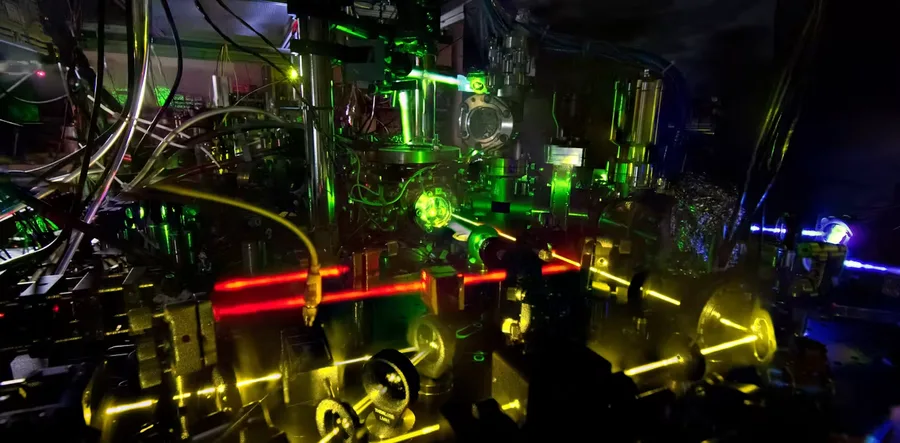
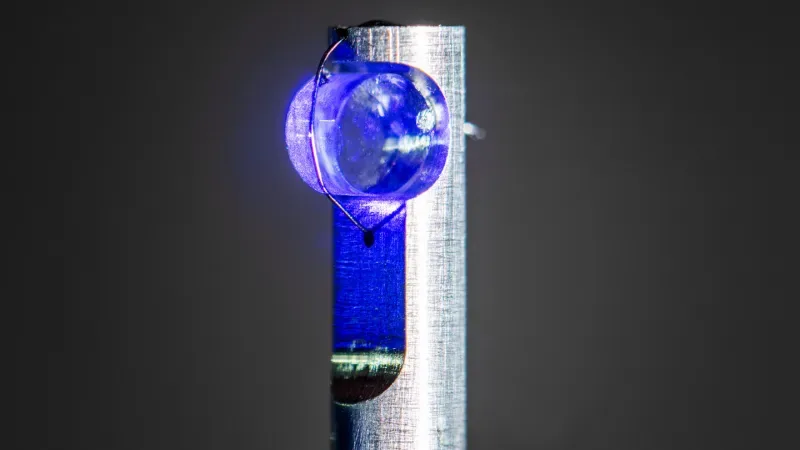
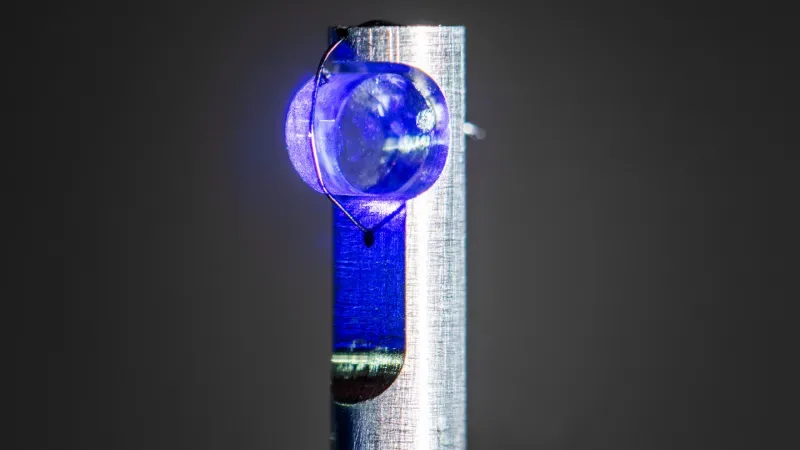
These super high-tech timepieces use the chemical element thorium to keep time. And as the clocks improve, they could help solve some mysteries in physics.
These super high-tech timepieces use the chemical element thorium to keep time. And as the clocks improve, they could help solve some mysteries in physics.
Scientific Reports, Published online: 04 August 2026; doi:10.1038/s41598-026-63634-5 Isotopic effect on collisional widths and shifts of Hg clock transition induced by cold Rb atoms
Official websites use .gov
A .gov website belongs to an official government organization in the United States.
Secure .gov websites use HTTPS
A lock (
) or https:// means you’ve safely connected to the .gov website. Share sensitive information only on official, secure websites.
https://www.…
Nature Communications, Published online: 29 July 2026; doi:10.1038/s41467-026-75966-x Time-crystal phases have raised both theoretical and experimental interest across various platforms. Here, the authors report the observation of a discrete time-quasicrystal in a driven-dissipative ensemble of interacting Rydberg atoms, advancing the understanding of symmetry breaking in these systems.
Nature Communications, Published online: 28 July 2026; doi:10.1038/s41467-026-76019-z Despite advances in attosecond spectroscopy methods, observation of electron dynamics on natural timescales remains challenging due to the use of near-infrared pulses. Here, the authors demonstrate time-resolved all-attosecond transient absorption spectroscopy of Xe+ ions and other atoms by means of XUV pulses f…
Results from an experiment at the Facility for Rare Isotope Beams answer a fundamental question about the structure of atomic nuclei and help explain how different elements formed in space. For decades, some atomic nuclei have emitted more low-energy gamma rays than theory could explain. A collaboration led by researchers at the Facility for Rare [...]
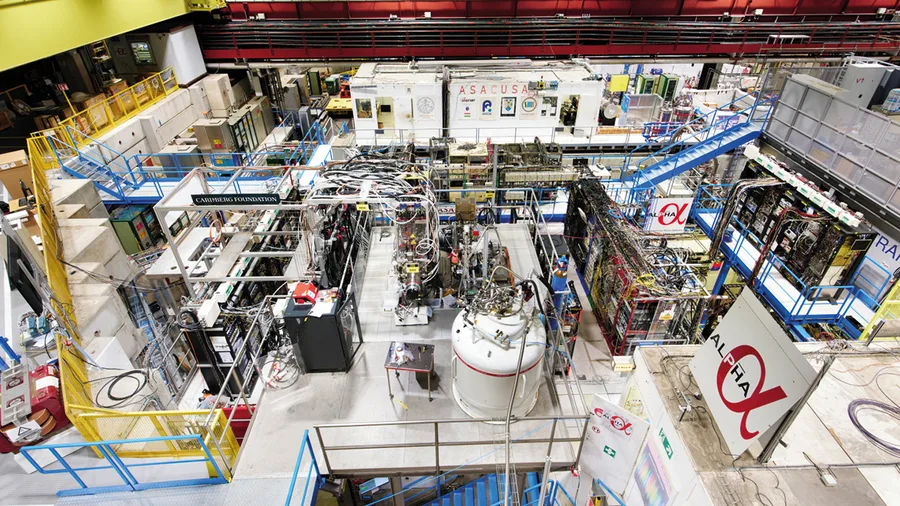
ALPHA has measured the ground-state hyperfine splitting of antihydrogen a hundred times more precisely than before, sharpening its test of CPT symmetry. The post Antihydrogen toes the line appeared first on CERN Courier .
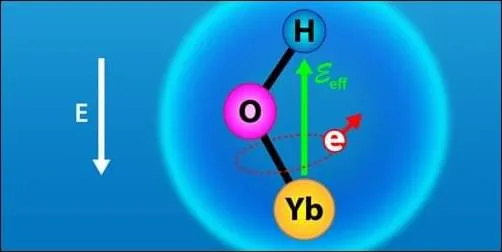
Certain molecules can be placed into states that are less sensitive to external noise, offering researchers a quiet system for probing fundamental physics. Molecules are like tiny sandboxes for exploring fundamental physics. Within the molecular environment, bound electrons and nucleons can be exposed to exceptionally strong fields, inducing effects that can’t easily be observed elsewhere. [̷…
The role involves developing atomic system designs for inertial sensing applications using atom-based quantum technologies. You will perform modelling, simulations, and analytical calculations, while integrating complex opto-mechanical systems, electronics, and software into quantum devices. The position requires close...
In the lecture note of MIT on Saha's equation, there is a table describing the properties of the atom, wherein the electronic degeneracy of a hydrogen ion is considered to equal to 1.
Why would such ...



 research.io