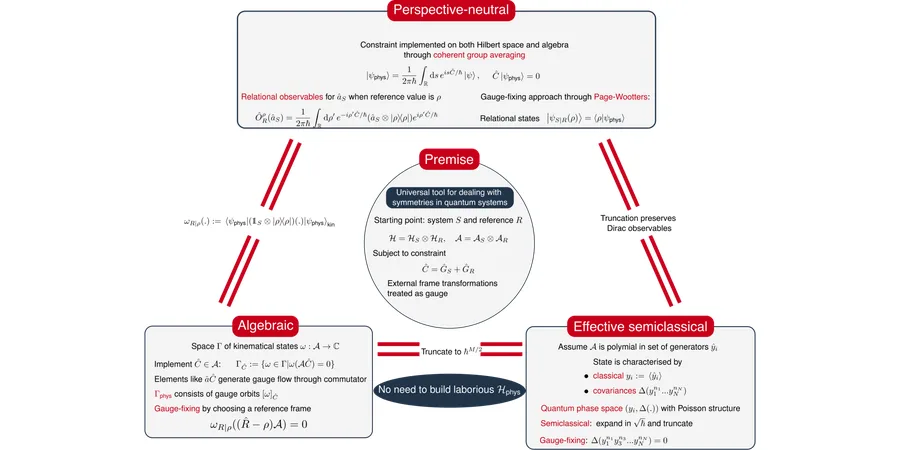
Quantum 10, 2196 (2026). https://doi.org/10.22331/q-2026-08-20-2196 The framework of internal quantum reference frames (QRFs) constitutes a universal toolset for dealing with symmetries in quantum theory and has led to new revelations in quantum gravity, gauge theories and foundational physics. Multiple approaches have emerged, sometimes differing in scope and the way symmetries are implemented, …
Quantum 10, 2195 (2026). https://doi.org/10.22331/q-2026-08-19-2195 There have been significant recent advances in constructing theoretical and practical quantum error correcting codes that function well as quantum memories; however, performing fault-tolerant logical gates on these codes is less studied, and the protocols that do exist often require significant complexity. Building off the symple…
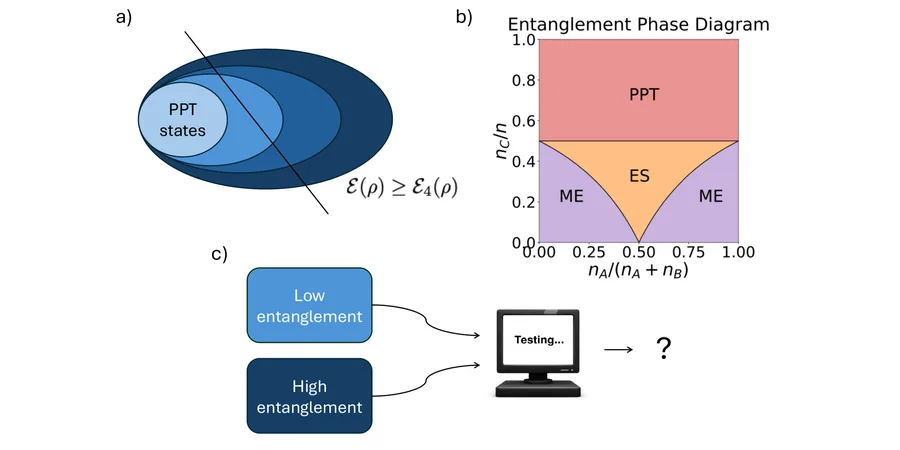
Quantum 10, 2194 (2026). https://doi.org/10.22331/q-2026-08-19-2194 Entanglement plays a crucial role in quantum information science and many-body physics, yet quantifying it in mixed quantum many-body systems has remained a notoriously difficult problem. Here, we introduce families of quantitative entanglement witnesses, constructed from partial transpose and realignment moments, which provide r…
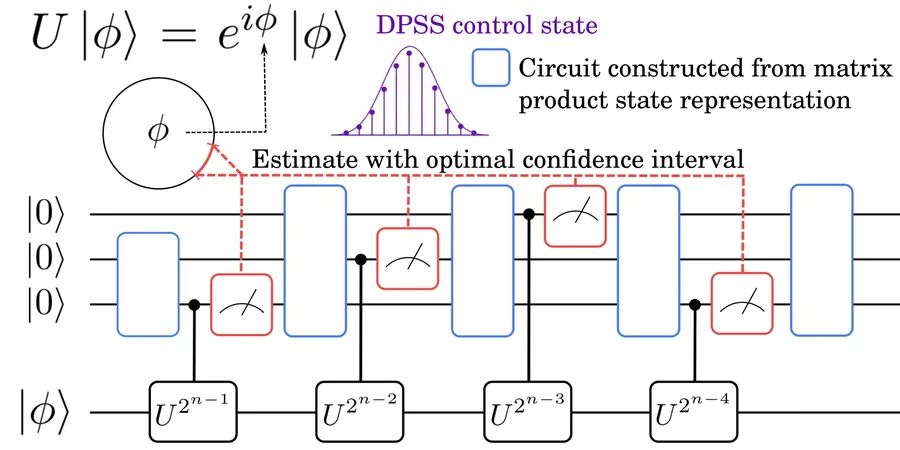
Quantum 10, 2193 (2026). https://doi.org/10.22331/q-2026-08-19-2193 Quantum phase estimation is an important routine in many quantum algorithms, particularly for estimating the ground state energy in quantum chemistry simulations. This estimation involves applying powers of a unitary to the ground state, controlled by an auxiliary state prepared on a control register. In many applications the goa…
Quantum 10, 2192 (2026). https://doi.org/10.22331/q-2026-08-13-2192 We present a comprehensive and pedagogical formulation of Bayesian multiparameter quantum estimation. Within this framework, we analyse the role of measurement incompatibility and establish its quantitative effect on attainable precision. We achieve this by deriving upper bounds based on the pretty good measurement – a notion fro…
Quantum 10, 2191 (2026). https://doi.org/10.22331/q-2026-08-13-2191 We show that the $T$-depth of any single-qubit $z$-rotation can be reduced to $3$ if a certain catalyst state is available. To achieve an $\epsilon$-approximation, it suffices to have a catalyst state of size polynomial in $\log(1/\epsilon)$. This implies that $\mathsf{QNC}^0_f/\mathsf{qpoly}$ admits a finite universal gate set c…
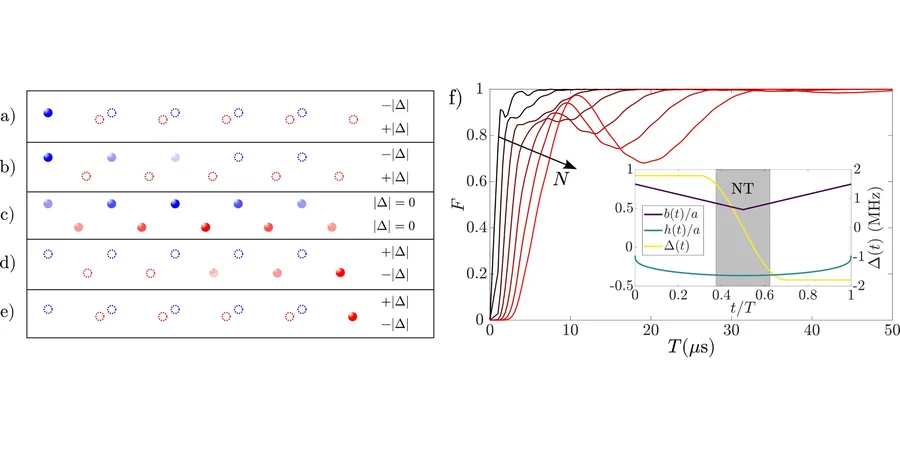
Quantum 10, 2190 (2026). https://doi.org/10.22331/q-2026-08-13-2190 We develop a theoretical framework for fast, robust and high-fidelity topological quantum state transfer in one-dimensional systems with long-range couplings, motivated by chains of Rydberg atoms with dipole–dipole interactions. Such long-range interactions naturally give rise to extended Su–Schrieffer–Heeger and Rice–Mele models…
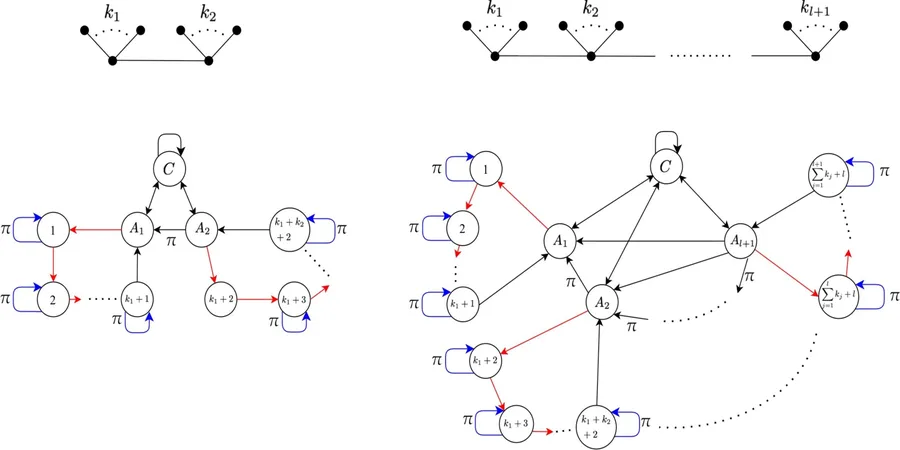
Quantum 10, 2189 (2026). https://doi.org/10.22331/q-2026-08-13-2189 Graph states are central resources for quantum information processing, supporting applications in computation, communication, and error correction. In photonic systems, they are typically assembled from smaller entangled states using probabilistic fusion gates, which demand many photons and suffer from low success rates. We prese…
Quantum 10, 2188 (2026). https://doi.org/10.22331/q-2026-08-12-2188 Recent work by Bravyi, Gosset, and Koenig showed that there exists a search problem that a constant-depth quantum circuit can solve, but that any constant-depth classical circuit with bounded fan-in cannot. They also pose the question: Can we achieve a similar proof of separation for an input-independent sampling task? In this pa…
Quantum 10, 2187 (2026). https://doi.org/10.22331/q-2026-08-10-2187 Hamiltonian simulation is one of the most promising candidates for the demonstration of quantum advantage within the next ten years, and several studies have proposed end-to-end resource estimates for executing such algorithms on fault-tolerant quantum processors. Usually, these resource estimates are based upon the assumption th…
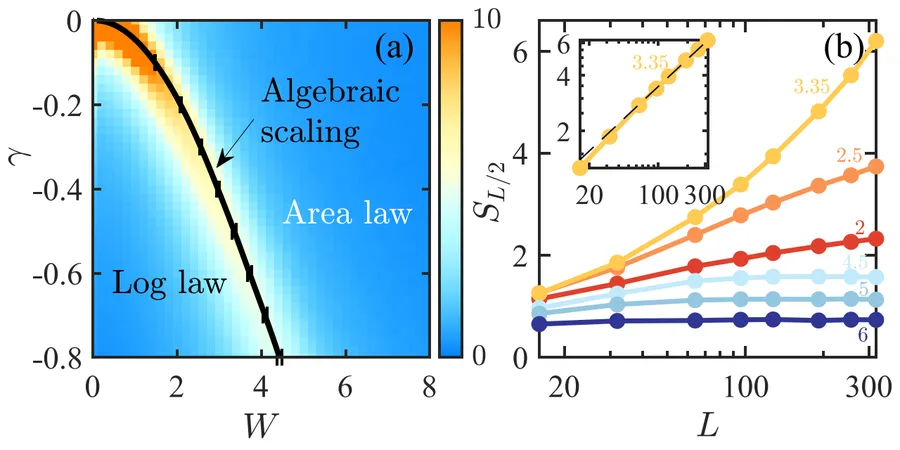
Quantum 10, 2186 (2026). https://doi.org/10.22331/q-2026-08-07-2186 Non-Hermitian dynamics is ubiquitous in various physical systems. While recent study shows that such a dynamics leads to an area-law scaling of the entanglement entropy due to the non-Hermitian skin effects, it remains unclear how disorder changes the behavior of the entanglement entropy in a non-Hermitian system with skin effect…
Quantum 10, 2185 (2026). https://doi.org/10.22331/q-2026-08-07-2185 We develop new approximate compilation schemes that significantly reduce the expense of compiling the Quantum Approximate Optimization Algorithm (QAOA) for solving the Max-Cut problem. Our main focus is on compilation with trapped-ion simulators using Pauli-$X$ operations and all-to-all Ising Hamiltonian $H_\text{Ising}$ evoluti…
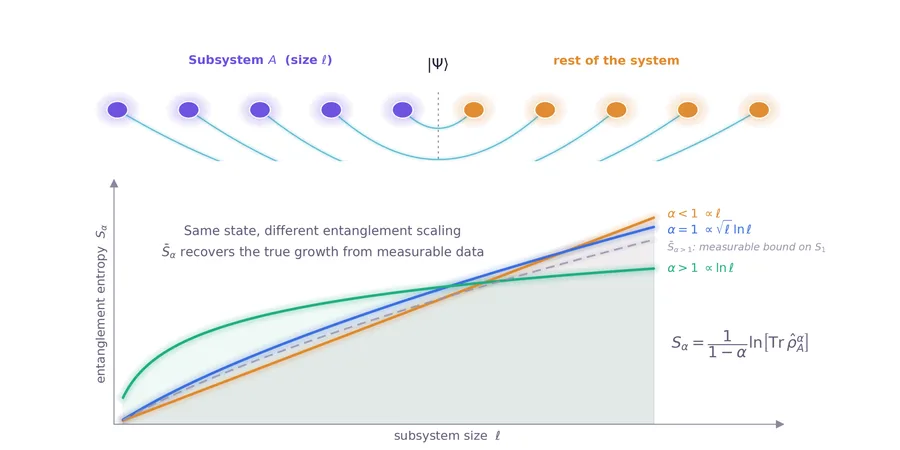
Quantum 10, 2184 (2026). https://doi.org/10.22331/q-2026-08-07-2184 The scaling of entanglement with subsystem size encodes key information about phases and criticality, but the von Neumann entropy is costly to access in experiments and simulations, often requiring full state tomography. The second Rényi entropy is readily measured using two-copy protocols and is often used as a proxy for the von…
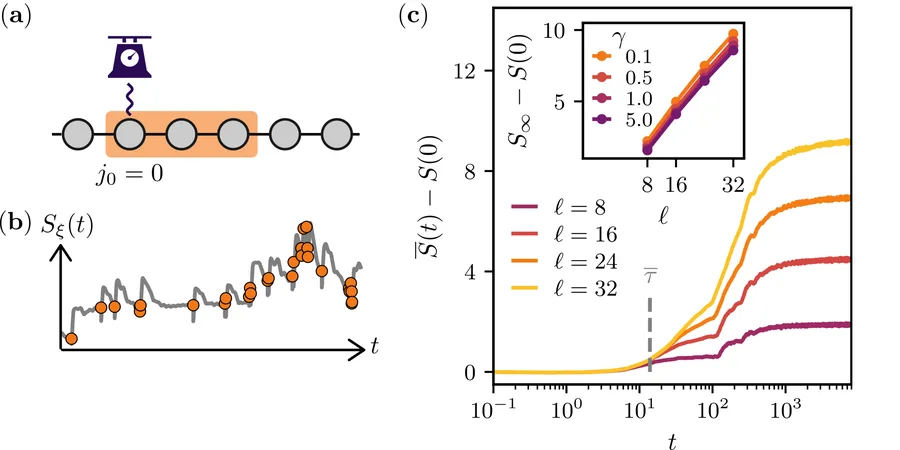
Quantum 10, 2183 (2026). https://doi.org/10.22331/q-2026-08-03-2183 We consider a free fermionic chain with monitoring of the particle density on a single site of the chain and study the entanglement dynamics of quantum jump trajectories. We show that the entanglement entropy grows in time towards a stationary state which display volume law scaling of the entropy, in stark contrast with both the …
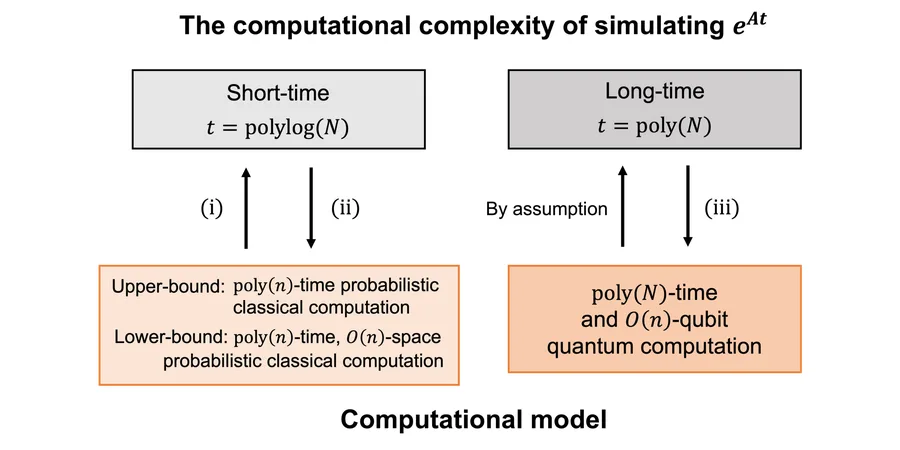
Quantum 10, 2182 (2026). https://doi.org/10.22331/q-2026-08-03-2182 The simulation of large-scale classical systems in exponentially small space on quantum computers has gained attention. The prior work demonstrated that a quantum algorithm offers an exponential speedup over any classical algorithm in simulating classical dynamics with long-range interactions. However, many real-world classical s…
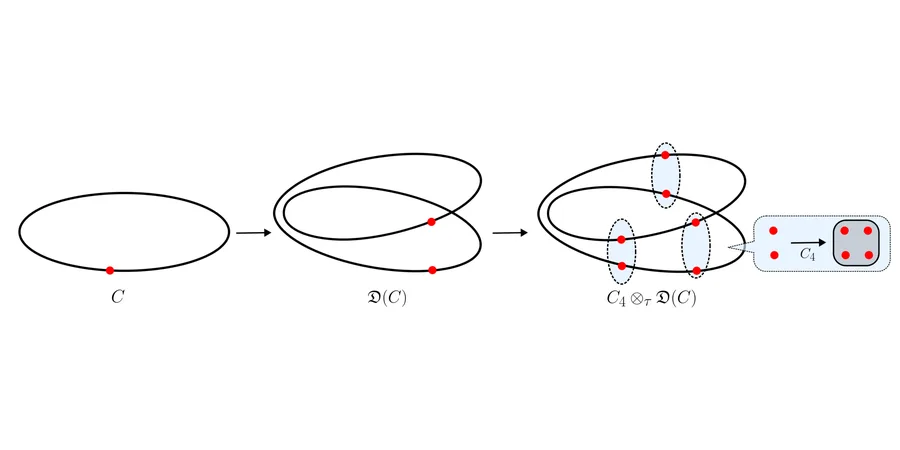
Quantum 10, 2181 (2026). https://doi.org/10.22331/q-2026-07-31-2181 We construct several families of entanglement-assisted quasi-cyclic quantum LDPC (EA-QC-QLDPC) codes via structured tilings of permutation matrices. The entanglement-unassisted portion of the joint Tanner graph of the proposed EA-QC-QLDPC code derived from two distinct classical QC-LDPC codes is free of 4-cycles. Notably, one of …
Quantum 10, 2180 (2026). https://doi.org/10.22331/q-2026-07-30-2180 In recent work [Phys. Rev. X 16, 021050], we proposed a unified notion of nonclassicality that applies to arbitrary processes in quantum theory, including individual quantum states, measurements, and sets thereof. This notion is derived from the principle of generalized noncontextuality, but in a novel manner that applies to indi…
Quantum 10, 2179 (2026). https://doi.org/10.22331/q-2026-07-29-2179 In 2024, Kliuchnikov and Schönnenbeck showed a connection between the Barnes Wall lattices, stabilizer states and Clifford operations. In this work, we study their results and relate them to the problem of lower bounding stabilizer ranks. We show the first quantitative lower bound on stabilizer fidelity as a function of stabilize…
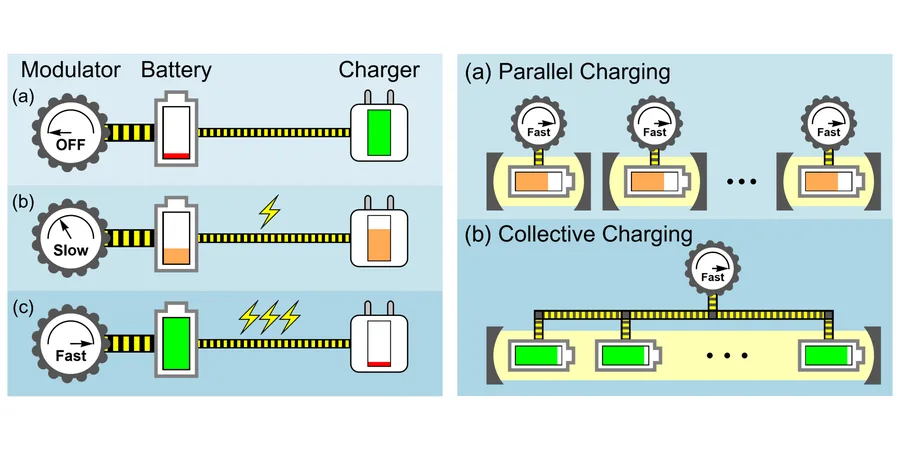
Quantum 10, 2178 (2026). https://doi.org/10.22331/q-2026-07-29-2178 Efficient operation of quantum batteries requires not only fast energy transfer but also the ability to halt the charging process to prevent reverse flow. Existing approaches typically rely on direct control of the charger-battery interaction, which can be experimentally demanding. Here we propose a modulator-assisted quantum bat…
Quantum 10, 2177 (2026). https://doi.org/10.22331/q-2026-07-29-2177 The task of atom rearrangement has emerged in the last decade as a fundamental building block in the development of neutral atom-based quantum processors. As such processors grow to thousands of atoms, it becomes increasingly important to design algorithms robust to experimental sources of error. While recent progress has been ma…









 research.io