



muscle-biology
The surprising reason older adults grow weaker has less to do with tired muscles than with their body's selective loss of the fastest, most powerful fibers.
As people grow older, muscles naturally become smaller and weaker. This process can make walking, lifting objects, and keeping balance more difficult. Ageing muscles also contain more fat and scar tissue, while the fast muscle fibres needed for quick movements gradually disappear. Scientists hope that understanding why this happens will lead to treatments that help […] The post New Discovery May …
Skeletal muscle is one of the first tissues to decline with age. This decline can lead to weakness, scarring, fat accumulation inside muscle, and the loss of fast-twitch muscle fibers that are important for quick and powerful movements.
Scientific Reports, Published online: 07 July 2026; doi:10.1038/s41598-026-60437-6 Heterogeneity, longitudinal decline, and metabolic risk in MRI-based quantification of 20 individual hip and thigh muscles

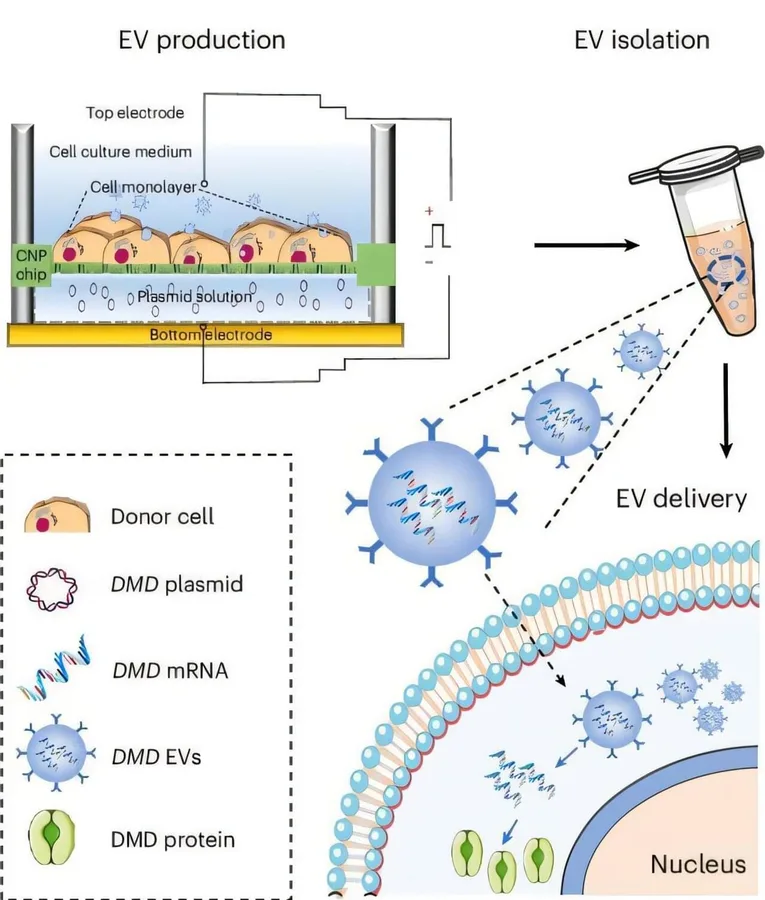
A new treatment platform developed by researchers at the University of Texas MD Anderson Cancer Center was able to deliver messenger RNA (mRNA) of the full-length DMD gene into preclinical models of Duchenne muscular dystrophy, successfully restoring the production of an important muscle protein, dystrophin, and dramatically improving muscle strength, endurance and function in vivo. […]
A new treatment platform developed by researchers at The University of Texas MD Anderson Cancer Center was able to deliver messenger RNA (mRNA) of the full-length DMD gene into preclinical models of Duchenne muscular dystrophy, successfully restoring the production of an important muscle protein, dystrophin, and dramatically improving muscle strength, endurance and function in vivo.
University of Maine researchers have published new findings about how muscles form, why certain muscle diseases develop and why symptoms may not appear until years after muscle degeneration begins.
Muscle stem cells, which are crucial for building new muscle, don’t work as well as we get older, but giving them an artificial boost could rejuvenate them
New research suggests muscles remember past inactivity at the molecular level. Muscle loss, or atrophy, caused by inactivity can begin surprisingly fast — even after just days of bed rest, injury, or reduced movement. For older adults especially, these periods of inactivity can trigger a downward spiral of weakness, slower recovery, loss of independence, and [...]
Musculature, strength, size, and endurance are maintained only so long as they are demanded. The moment that demand disappears, the physiological mechanisms that once built muscle now work towards energy conservation, initiating a gradual, though measurable, decline
In this webinar, Dr. Bert Blaauw elucidates skeletal muscle regulatory pathways and offers approaches to tackle muscle deficits for ... The post Molecular Signals Mediating Increases in Muscle Size and Function appeared first on Aurora Scientific .

research.ioSign up to keep scrolling
Create your feed subscriptions, save articles, keep scrolling.