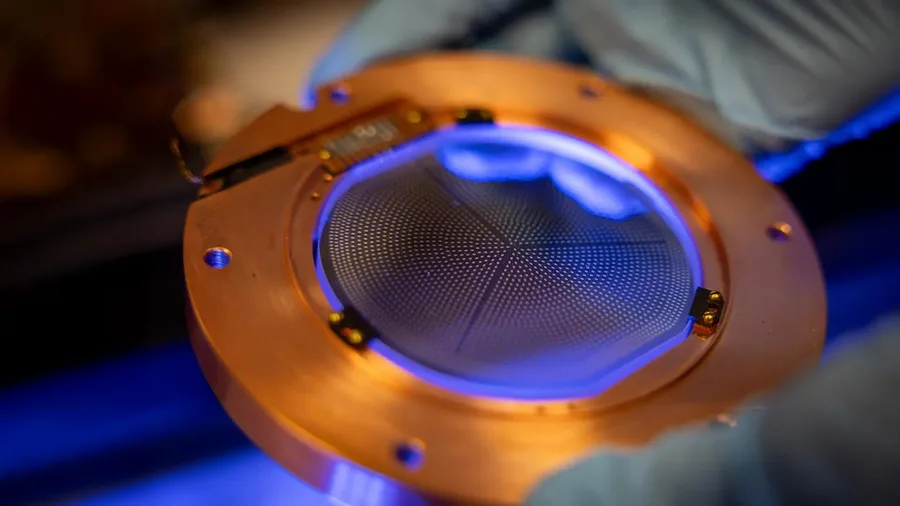
In a striking glimpse into extreme physics, scientists have captured the split-second chaos that unfolds when powerful laser flashes blast matter into a superheated plasma. By combining two cutting-edge lasers, researchers were able to track how copper atoms lose and regain electrons in trillionths of a second, creating and dissolving highly charged ions in a rapid, almost cinematic sequence.
Cosmic voids may seem like the emptiest places in the universe, stripped of matter, radiation, and even dark matter. But they’re far from nothing. Even in these vast empty regions, the fundamental quantum fields that fill all of space remain, carrying a small but real amount of energy known as vacuum energy, or dark energy. While this energy is overwhelmed by matter in galaxies and clusters, in t…
Fusion energy may be one of the most promising clean power sources of the future—but only if scientists can precisely measure the extreme, fast-moving plasmas that make it possible. A new U.S. Department of Energy–sponsored report urges major investment in advanced diagnostic tools—the high-tech “sensors” that track plasma temperature, density, and behavior inside fusion systems. Bringing togethe…
A sweeping nationwide study has found that U.S. counties located closer to operating nuclear power plants have higher cancer death rates than those farther away. Researchers analyzed data from every nuclear facility and all U.S. counties between 2000 and 2018, adjusting for income, education, smoking, obesity, environmental conditions, and access to health care. Even after accounting for those fa…
Physicists at Heidelberg University have developed a new theory that finally unites two long-standing and seemingly incompatible views of how exotic particles behave inside quantum matter. In some cases, an impurity moves through a sea of particles and forms a quasiparticle known as a Fermi polaron; in others, an extremely heavy impurity freezes in place and disrupts the entire system, destroying…
Astronomers propose that an ultra-dense clump of exotic dark matter could be masquerading as the powerful object thought to anchor our galaxy, explaining both the blistering speeds of stars near the center and the slower, graceful rotation of material far beyond. This dark matter structure would have a compact core that pulls on nearby stars like a black hole, surrounded by a broad halo shaping t…
Dark matter, one of the Universe’s greatest mysteries, may have been born blazing hot instead of cold and sluggish as scientists long believed. New research shows that dark matter particles could have been moving near the speed of light shortly after the Big Bang, only to cool down later and still help form galaxies. By focusing on a chaotic early era known as post-inflationary reheating, researc…
Nearly everything in the universe is made of mysterious dark matter and dark energy, yet we can’t see either of them directly. Scientists are developing detectors so sensitive they can spot particle interactions that might occur once in years or even decades. These experiments aim to uncover what shapes galaxies and fuels cosmic expansion. Cracking this mystery could transform our understanding o…
Einstein’s claim that the speed of light is constant has survived more than a century of scrutiny—but scientists are still daring to test it. Some theories of quantum gravity suggest light might behave slightly differently at extreme energies. By tracking ultra-powerful gamma rays from distant cosmic sources, researchers searched for tiny timing differences that could reveal new physics. They fou…
Researchers using China’s “artificial sun” fusion reactor have broken through a long-standing density barrier in fusion plasma. The experiment confirmed that plasma can remain stable even at extreme densities if its interaction with the reactor walls is carefully controlled. This finding removes a major obstacle that has slowed progress toward fusion ignition. The advance could help future fusion…
Scientists have precisely measured two unstable atomic nuclei that play a crucial role in explosive X-ray bursts on neutron stars. The results reveal faster nuclear reactions than previously thought, reshaping how we understand element formation in extreme cosmic environments.
Researchers say fusion reactors might do more than generate clean energy—they could also create particles linked to dark matter. A new theoretical study shows how neutrons inside future fusion reactors could spark rare reactions that produce axions, particles long suspected to exist but never observed. The work revisits an idea teased years ago on The Big Bang Theory, where fictional physicists c…
In collisions at CERN’s Large Hadron Collider, hotter than the Sun’s core by a staggering margin, scientists have finally solved a long-standing mystery: how delicate particles like deuterons and their antimatter twins can exist at all. Instead of forming in the initial chaos, these fragile nuclei are born later, when the fireball cools, from the decay of ultra-short-lived, high-energy particles.