Strange & Offbeat: Education & Learning News -- ScienceDaily
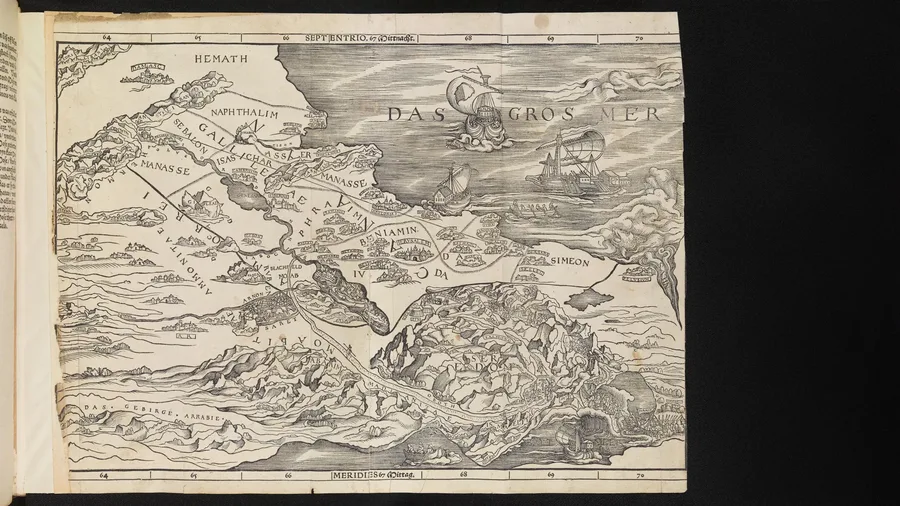
Five hundred years ago, a Bible accidentally printed with a backwards map of the Holy Land sparked a revolution in how people imagined geography, borders, and even nationhood. Despite the blunder, the map reshaped the Bible into a Renaissance book and spread new ideas about territorial organization as literacy expanded. Over time, sacred geography evolved into political boundary-making, influenci…

Gaslighting, often seen as a form of manipulation, has now been reframed by researchers at McGill University and the University of Toronto as a learning process rooted in how our brains handle prediction and surprise. Instead of merely being explained through outdated psychodynamic theories, this new model highlights how trust and close relationships can be exploited by manipulators who repeatedl…

The world of quantum physics is experiencing a second revolution, which will drive an exponential leap in the progress of computing, the internet, telecommunications, cybersecurity and biomedicine. Quantum technologies are attracting more and more students who want to learn about concepts from the subatomic world -- such as quantum entanglement or quantum superposition -- to explore the innovativ…

Researchers have derived a formula for viral behavior in the Wild Cards, a science fiction series written by a collection of authors about an alien virus called the Wild Card that mutates human DNA. The formula he derived is a Lagrangian formulation, which considers the different ways a system can evolve. It's also a fundamental physics principle, which also makes the fictional example a powerful…

Do speakers of different languages build sentence structure in the same way? In a neuroimaging study, scientists recorded the brain activity of participants listening to Dutch stories. In contrast to English, sentence processing in Dutch was based on a strategy for predicting what comes next rather than a 'wait-and-see' approach, showing that strategies may differ across languages.

Explaining a theoretical science concept to high school students requires a new way of thinking altogether, which is precisely what researchers did when they orchestrated a dance with high school students at Orange Glen High School in Escondido as a way to explain topological insulators.

A university professor has found a way to help students -- and himself -- power through long lecture classes: exercise breaks. A new study showed that five-minute exercise sessions during lectures were feasible and that students reported positive impacts on their attention and motivation, engagement with their peers and course enjoyment.

The sound a disc makes while soaring through the air is full of information about how fast the disc is flying and how quickly it spins. This inspired Kyle S. Dalton of Penn State University to combine disc golf and acoustics into an interactive acoustic signal processing lesson. He set three microphones in a line and connected them to equipment that converts each microphone's signal to a data poi…

The artificial intelligence language model GPT-3 performed as well as college students in solving certain logic problems like those that appear on standardized tests. The researchers who conducted the experiment write that the results prompt the question of whether the technology is mimicking human reasoning or using a new type of cognitive process. Solving that question would require access to t…

research.ioresearch.io

Sign up to keep scrolling

Create your feed subscriptions, save articles, keep scrolling.

Already have an account?