I am working on a Monte Carlo simulation of a medical linear accelerator (LINAC) using MCNP5. My objective is to calculate the radiation dose at the isocenter of the LINAC treatment setup. I have constructed the LINAC geometry, including the relevant components of the treatment head, and... Read more
This month, Linzee Phillips Hensley will start her first class in the Department of Nuclear Engineering’s accredited medical physics program. […] The post Medical Physics Program Empowers Student Success—and Quality Care first appeared on Department of Nuclear Engineering .
Before a healthcare robot can be useful in the real world, it has to learn how the physical world pushes back. Anatomy varies. Instruments bend, press, slip and interact with tissue. Imaging can be noisy or incomplete. And the rare, edge scenarios developers most need to understand don’t appear on schedule. That creates one of […]
Hi, after I majored in physics, I moved to the field of medical physics. However, I cannot understand some of their explanations. One of them that is bothering me a lot is RF pulse and in-phase. What we measure in MRI is the magnetization of water particles. The magnetization comes from the sum... Read more
Backstory: I am a newly qualified and hired MRI medical physicist. Throughout my residency, I became depressed as I seen the lack of physics and math's involved. Senior physicists would shun me from trying to involve more advanced math/physics into my work. I am unable to change... Read more
American Physics Society (APS) March meeting is one of the largest physics meetings in the world. To help the community quickly catch up on the work presented in this conference, Paper Digest Team processed all accepted work, and generated one highlight sentence (typically the main topic) for each. Readers are encouraged to read these machine generated highlights to quickly get the main idea of e…
American Physics Society (APS) March meeting is one of the largest physics meetings in the world. In 2022, the meeting will take place in Chicago. To help the community quickly catch up on the work presented in this conference, Paper Digest Team processed all accepted papers, and generated one highlight sentence (typically the main topic) for each paper. Readers are encouraged to read these machi…
A single x-ray can unravel an enormous molecule, physicists report in the March 17 issue of Physical Review Letters. Their findings could lead to safer medical imaging and a more nuanced understanding of the electronics of heavy metals. Medical imaging techniques such as MRIs use heavy metals from the bottom of the periodic table as ...
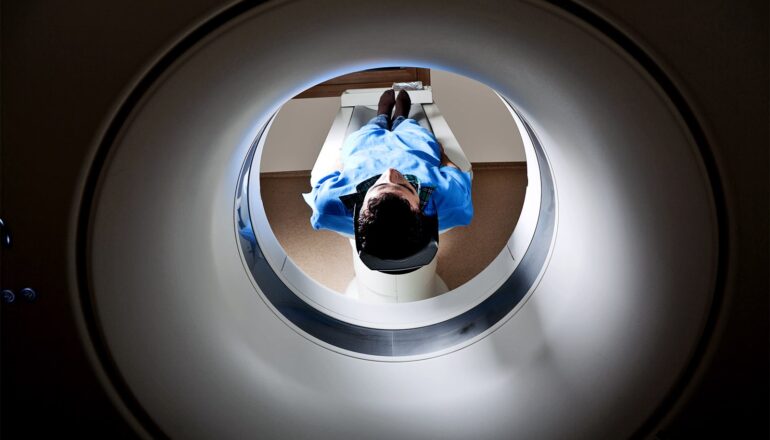
Chalk this up to an application of high-energy physics in the medical diagnostic field. The first human has been scanned by a new type of x-ray scanner (registration required to read article at this moment). The MARS scanner uses Medipix3 technology developed at CERN to produce multi-energy images with high spatial resolution and low
noise. Medipix is a family of read-out chips originally develo…
Practical applications of fundamental theoretical physics Positron Emission Tomography (PET) Less often, people ask about potential applications of anti-matter. Both of those questions can be answered with a common medical diagnostic technology, Positron Emission Tomography, or PET. Brief history of positrons Positrons were first theorized by Paul Dirac in 1928 when he realized that his...
For many physics students, Medical Physics is that branch of the discipline that seems to hover in the no-man’s land between academia and “industry.” It’s not as glamorous or fundamental as some of the other branches that may have originally drawn students into physics in the first place. It didn’t get a chapter in Hawking’s...
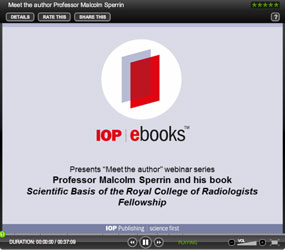
The IOP ebooksTM "Meet the author" webinar series gives you the chance to get to know our authors, as well as the research behind their latest book.
In our latest webinar, Professor Malcolm Sperrin, Director of Medical Physics, Royal Berkshire NHS Foundation Trust, talks about his new book, Scientific Basis of the Royal College of Radiologists Fellowship: Illustrated questions and answers.
He sho…
If you have read the news, you would have heard of the issues surrounding the parents of a sick child desperately seeking to have their son undergo a proton therapy. Jon Butterworth has a nice article for the general public on the physics of proton therapy , and especially why it is different than other forms. When you are reading this, please note that this medical treatment came DIRECTLY out of…
This is a good article that reviews Lancet's special issue on Physics and Medicine . While many of us, and especially those who are in this field, are aware of this, the article is more useful when it is preached to those who are not in the choir. The general public, and especially the politicians that determine fundings, need to be told of this FACT. While the knowledge that is gained out of app…
I've been shortlisted as a possible Schools Lecturer for the Institute of Physics next year. My pitch is about applications of nuclear physics to medicine. Any clever ideas of how to present this to school kids would be most welcome. Please comment!
Blogging will be on hold for a few days, as I'm going to have an appendectomy very soon. Thank you, medical physicists, for developing the wicked cool CT machine (and blech-tasting contrast agents) key to confirming my diagnosis! Thanks, too, to the scientists and engineers that gave us wireless Internet..... UPDATE! I had the surgery this morning and it seemed to go smoothly. Barring weirdnes…