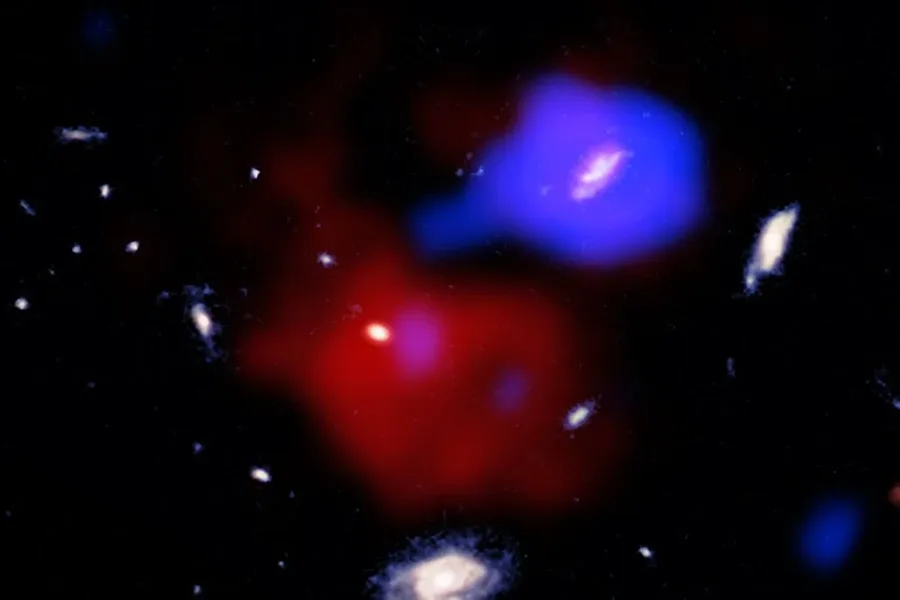
Galaxies attract cold gas from the intergalactic medium and turn it into stars. But the JWST has found galaxies that aren't forming stars in the early Universe, long before they should've become quiescent. In at least one instance involving the Red Potato Galaxy, an AGN jet from a neighbouring galaxy is the likely culprit.
Matthew Williams (https://www.universetoday.com/authors/houseofwilliams)
6/23/2026
Astronomers have discovered a huge reservoir of cold molecular gas, the direct fuel for star formation, in REBELS-25, a massive, star-forming galaxy.The team, led from Leiden University, focused on REBELS-25, seen when the universe was only about 700 million years old, around 5% of its current age. Astronomers use “redshift” to describe this distance, which measures how much the universe’s expa…
Are fainter galaxies really different than brighter ones? This study reveals that, despite being dimmer, low surface brightness galaxies obey the same fundamental laws of galaxy formation, offering new clues about how galaxies and dark matter halos evolve.
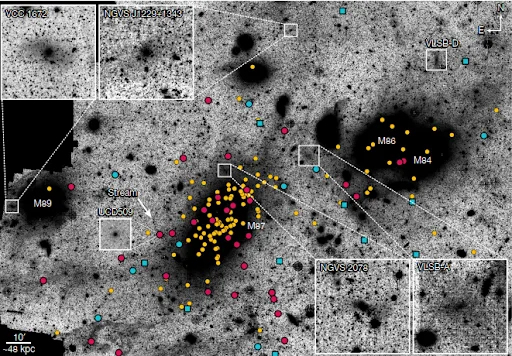
In today's bite, we look at some newly observed systems in the Virgo cluster. These observations provide clues to understanding how some of the most dense galaxies known to us form.
The Lambda Cold Dark Matter (Lambda CDM) model is the current cosmological model and explains much of what we see in the cosmos. One of Lambda CDM's core features is the prediction that structure grows hierarchically from the bottom up. It begins with dark matter density fluctuations, then dwarf galaxies form, then those dwarfs merge to form more massive galaxies, which merge into still larger ga…
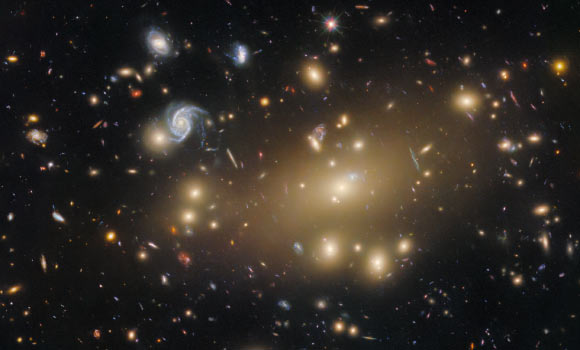
Abell 209 is a massive galaxy cluster located about 2.8 billion light-years away in the constellation of Cetus. The post Hubble Spots More Than Hundred Galaxies in Abell 209 appeared first on Sci.News: Breaking Science News .
Wednesday 31 Aug 2022 @ 12:00 p.m., Laby Theatre(+Zoom) Dr Giulia Santucci, ICRAR/UWA; Email: g.santucci[at]unsw.edu.au Abstract Galaxy mergers are thought to play an important role in …
CIERA’s Alex Gurvich, a second-year astronomy graduate student advised by Professor Claude-André Faucher-Giguère, recently accepted two important fellowships within the same week. Part of the Galaxy Formation Group at Northwestern, Alex explores “the invisible universe” (the history and features of galaxies, stars, and supernovae) using computer simulations. Alex will receive three years of fundi…
I learned from an article in New Scientist by David Shiga that there have been recently found four more small satellite galaxies of our Milky Way galaxy.
The satellites are dwarf galaxies a few hundred to a few thousand light years across. The tiny galaxies are thought to be the building blocks of large galaxies, such as our own Milky Way – which is about 100,000 light years wide.
As you may kn…