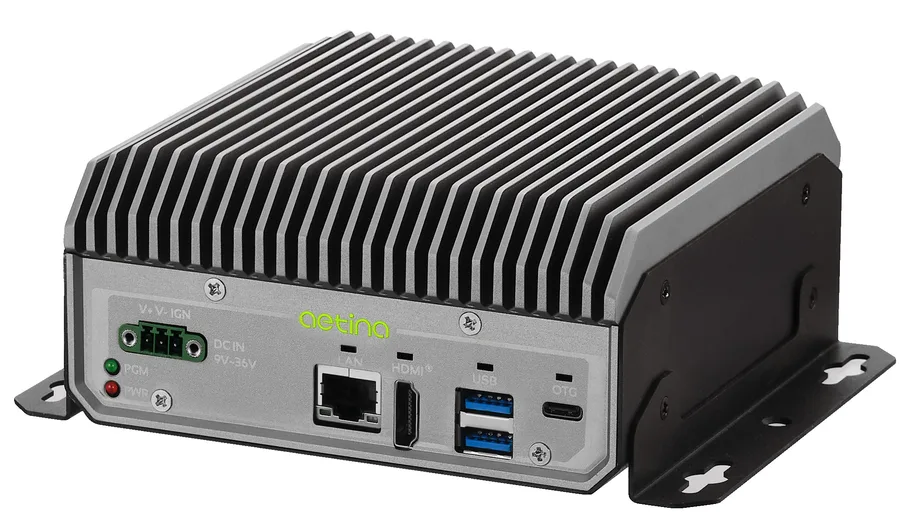
Aetina Corporation has announced the DeviceEdge AIE-VN34/44 and AIE-VO24/34 palm-sized in-vehicle edge AI systems powered by NVIDIA Jetson Orin NX and NVIDIA Jetson Orin Nano modules. The systems deliver up to 100 TOPS or 67 TOPS of AI performance, support up to four GMSL2 cameras, use a 136.3 x 132 x 63 mm fanless chassis […] The post Edge AI systems support four GMSL2 cameras appeared first on …
SolidRun, a developer of embedded computing and edge AI solutions, and Leopard Imaging, a global contributor in embedded vision and camera technology, has announced a technology collaboration to simplify and … Continued The post SolidRun and Leopard Imaging collaborate to accelerate Edge AI vision development appeared first on IoT Now News - How to run an IoT enabled business .
How to Run an 80B Qwen Model in 4.3GB of RAM: The Edge AI Revolution Explained It started with a single Hacker News post — a screenshot of system_profiler showing 4.3GB of memory used by Qwen 80B , running at an uncomfortable but usable 4 tokens per second. Within hours, someone posted a follow-up: a 35B model running on an iPhone 18 Pro, not in the cloud, not even in the high-end Pro Max, but th…
Edge AI semiconductor leader expands use of ChipAgents' agentic AI platform to accelerate ultra-low power chip design and verification. The post Ambiq and ChipAgents Collaborate to Advance Agentic AI for Semiconductor Engineering appeared first on Semiconductor Digest .
General-purpose robots and autonomous machines are moving from research labs to real-world mass-market deployment, creating demand for compact, power-efficient AI supercomputers capable of running foundation models at the edge. To meet that need, NVIDIA today introduced the T3000 and T2000, new modules based on the NVIDIA Thor architecture that enable mass-market robotics and edge AI […]
Imagine you are building the next generation of "always-on" smart assistants. Your app needs to listen for a specific wake word, suppress background noise in a crowded cafe, or provide real-time transcription—all while the user’s smartphone sits in their pocket. If you attempt to run these heavy neural networks on a standard mobile CPU, you will run into a brutal reality: your user's battery will…
Sixfab AI HAT+ and Edge AI Expansion Board, the most accessible way to bring edge AI to Raspberry Pi 5, processed entirely on-device. Now available. [...] Read More... The post See Everything. Send Nothing. appeared first on Sixfab .
You’ve spent weeks optimizing your transformer-based model. You’ve pruned the weights, quantized the tensors, and fine-tuned the architecture to ensure your Edge AI application runs like a dream on high-end Android hardware. But then, something unexpected happens. Ten minutes into a real-world user session, the smooth 30 FPS object detection begins to stutter. The latency, which was a crisp 30ms,…
You’ve spent weeks optimizing your machine learning model. You’ve pruned the weights, quantized the tensors, and fine-tuned the hyperparameters. On your high-end development workstation, the inference speed is blistering. But then, you deploy it to a real-world Android device. Three minutes into usage, the app starts to lag. The frame rate drops. The device feels uncomfortably warm in the user's …
What happens when adoption is limited not by the silicon itself, but the development model around it. The post Three Things DSP Adoption Can Teach Us About Edge AI appeared first on Semiconductor Engineering .
Firefly Aerospace Operates NVIDIA Jetson in Lunar Orbit for the First Time
The NVIDIA Inception member’s Ocula moon imaging service will harness the NVIDIA Jetson platform for edge AI, running inference directly in space to significantly accelerate insights compared with downlinking all data back down to Earth.
In highly volatile industrial environments—such as automated manufacturing plants, autonomous robotics, or smart utility infrastructures—processing sensor telemetry in real-time is a massive challenge. Traditional architectures often rely on fixed thresholds to detect systemic anomalies or physical disruptions. However, when the environment becomes noisy (High-Clutter / High-Variance), these stat…
Breakthroughs in semiconductor technologies and edge AI are accelerating the rapid advancement of wearable biosensors, but despite the pace of innovation, wearables still struggle to scale beyond everyday wellness into clinically accepted healthcare solutions. The post SEMI Smart MedTech Initiative Identifies Obstacles and Opportunities to Scale Wearable Biosensors for Clinical Use appeared first…
Chip and system designers scramble to leverage existing and future standards as edge AI increases demand for faster data movement and greater reliability. The post Wi-Fi Flies Higher As Edge AI Build-Out Takes Root appeared first on Semiconductor Engineering .
After three years of intensive research and collaboration, the European project NimbleAI reaches its conclusion, delivering significant advances in edge artificial intelligence technologies and contributing to Europe’s ambition for technological sovereignty. The post NimbleAI: A European Consortium Advances Next-Generation Edge AI Technologies and Strengthens Technological Sovereignty appeared fi…
The 3.7 kB Alarm: A Zero-Bloat Edge AI Smoke Detector in Pure C You are building a critical IoT safety device — a smart smoke and fire detector. It monitors 12 environmental variables in parallel: temperature, humidity, TVOC, eCO2, raw hydrogen, ethanol, barometric pressure, and five particulate matter metrics. You want a neural network to catch the non-linear chemical signatures of an imminent f…
This is a submission for the Gemma 4 Challenge: Write About Gemma 4 There is a quiet revolution happening in artificial intelligence. For years, the prevailing narrative has been that the most powerful AI models must live in the cloud, guarded by massive server farms and accessible only via APIs that charge by the token. Google DeepMind's release of Gemma 4 under the Apache 2.0 license fundamenta…
Discover how AJProTech is advancing AI-powered hardware development with edge AI, embedded analytics, computer vision, and human-centered engineering aligned with 2026 design trends.
This article covers sensor data processing, real-time decision-making, edge AI, predictive maintenance, and practical AIoT applications for hardware teams developing scalable intelligent systems.








 research.io