OpenAI shares new results on long-standing open problems in mathematics and theoretical computer science, including advances in geometry, cryptography, and complexity.
Complex systems, be they living beings or fundamental particles, need to have enough structure to hang together along with unpredictability that can allow for change. Columnist Thomas Lewton explores whether this idea is simply a pattern seen across the cosmos or could be a “theory of everything”
Nature Reviews Physics, Published online: 14 July 2026; doi:10.1038/s42254-026-00967-0 Rathindra Nath Das recounts how a simple framework to assess complexity published in 2022 shaped his own approach to physics.
Consider a disk in the complex plane. If one applies an affine-linear map to this disk, one obtains For maps that are merely holomorphic instead of affine-linear, one has some variants of this assertion, which I am recording here mostly for my own reference: Theorem 1 (Holomorphic images of disks) Let be a disk in […]
Today, I interrupt the news of the rapid disintegration of the United States of America, on every possible front at once (medical, economic, social…), to bring you something far more important: a long-planned two-hour podcast, where theoretical physicist and longtime friend-of-the-blog Sean Carroll interviews yours truly about complexity theory! Here’s Sean’s description of this…
Our observable universe started out in a highly non-generic state, one of very low entropy, and disorderliness has been growing ever since. How, then, can we account for the appearance of complex systems such as organisms and biospheres? The answer is that very low-entropy states typically appear simple, and high-entropy states also appear simple, and complexity can emerge along the road in betwe…
Resistance to complex math seems to never die out. I see it frequently in PF posts. Often it takes the form of challenges rather than questions. First challenge: Complex is just a mathematical trick that has nothing to do with physics. Second challenge: Everything that complex does can be accomplished by ordinary real numbers. My...
This is the latest in a series of blog posts to address the list of '52 Things Every PhD Student Should Know' to do Cryptography: a set of questions compiled to give PhD candidates a sense of what they should know by the end of their first year. We continue the Complexity Theory section with an alternative definition of NP... This question is very much a follow up question to the previous one. La…
Carl Zimmer has a great article in Quanta about the origins of biological complexity. Quanta, in case you’re wondering, is the new name for the Simons Foundation’s online science magazine, which is certainly going to be a go-to resource for reliable science stories much of the media would consider to be too subtle or insufficiently […]
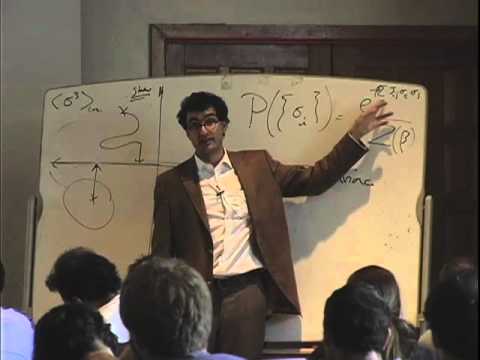
Simon DeDeo is a theoretical physicist and very smart guy, who started out as a cosmologist and has made the transition to complexity theorist at the Santa Fe Institute. (He’s not smart because he made that transition, it just so happens that both statements are true.) This summer he gave a series of three lectures […]