CHES 2017 was held September 25th - 28th in Taipei, Taiwan. This being my first trip to CHES, I was glad to see a mix of academics and people in industry whom had ties with cryptographic hardware on embedded systems. Although I have a limited frame of reference, I feel the standard of the conference was quite high - the presenters all knew what they were talking about in great detail, and were ab…
In the second invited talk at Crypto, Cédric Fournet from Microsoft Research presented the recent efforts of Project Everest (Everest VERified
End-to-end Secure Transport), which seems an attempt to fix implementing TLS once and for all. Appropriately for such a gigantic task, more than a dozen researchers on three continents (and the UK) work on making it verifiable and efficient at the same tim…
Crypto 2017 kicked off this morning in Santa Barbara. After a quick eclipse-watching break, the lattice track ended with the presentation of LPN Decoded by Andre Esser, Robert Kübler, and Alexander May. Learning Parity with Noise (LPN) is used as the underlying hardness problem in many cryptographic protocols. It is equivalent to decoding random linear codes, and thus offers strong security guara…
MathJax TeX Test Page Side-channel analysis made its way into Eurocrypt this year thanks to two talks, the first of which given by François-Xavier Standaert on a new model to prove security of implementations in. When talking about provable security in the context of side-channel analysis, there is one prominent model that comes to mind: the d -probing model, where the adversary is allowed to pro…
Last week I was in Malta for Financial Cryptography and Data Security 2017 to present my recent work on securing the PKCS#11 cryptographic API. One talk that stood out for me was by researchers from the University of Birmingham, who looked for vulnerabilities in the mobile apps provided by major UK banks. Sadly, they found major weaknesses in apps from 5 of the 15 banks they investigated. Several…
The member of the TLS 1.3 working group is willing to bet for a beer that the 0-RTT handshake of TLS 1.3 will get broken in the first two years. In his invited talk, Kenny managed to fill a whole hour on the history of SSL/TLS without even mentioning symmetric cryptography beyond keywords, thus staying within the topic of the conference. Despite all versions of SSL being broken to at least some d…
Security proof for even simple cryptographic systems are dangerous and ugly beasts. Luckily, they are only rarely seen: they are usually safely kept in the confines of ``future full-versions'' of papers, or only appear in cartoon-ish form, generically labelled as ... ``proof sketch". The following two quotes frame the problem in less metaphorical terms. `` In our opinion, many proofs in cryptogr…
Fresh back from an enlightening trip across the pond, I wanted to write about one of my favourite talks, all about password (in)security, from this year's Real World Cryptography conference. As we know: Passwords protect everything. Passwords are terrible. But happily, Hugo Krawczyk from IBM Research spoke about some great new work to resolve these two seemingly incompatible statements. There wer…
A new year takes off and, along
with it, thousands of resolutions are formulated. Although I am not the right
person to talk about them (my diet will begin next Monday), I wish to discuss a
resolution that the cryptographic community as a whole has set for itself in this 2017. Because that's what people do at Real World Crypto (RWC): they talk
about new threads, topics could be worth exploring du…
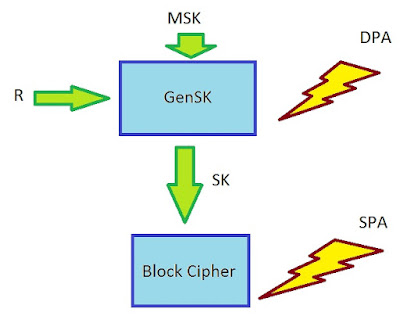
MathJax TeX Test Page The first study group on side-channel analysis in the academic year 2016/2017 is "Towards Sound Fresh Re-keying with Hard (Physical) Learning Problems" from Stefan Dziembowski, Sebastian Faust, Gottfried Herold, Anthony Journault, Daniel Masny and Francois-Xavier Standaert, and recently published at Crypto this year. There are mainly two reasons why I chose to present it: it…
Today's study group was on the now a little dated paper of 2009 'Crying Wolf: An Empirical Study of SSL Warning Effectiveness' [1], which was published at USENIX. In cryptography research, it is easy to overlook implementation and usability and instead focus on theory. As is succinctly explained in Randall Munroe's well-known comic , the weaknesses in our cryptographic solutions are seldom in the…
Today I kicked off the study groups for 2016/17. I spoke about On the Impossibility of Tight Cryptographic Reductions , from this year's Eurocrypt. Keen readers of the blog might recall that this paper is a particular favourite of mine . Since I've wrote about it before, I won't go into much detail about the paper. Instead I'll say why I (still) like it, and a bit about how it's shaped my own wor…
The CRYPTO 2016 Best Paper Award went to Boyle et al [1]. The paper provides several new protocols based on a DDH assumption with applications to 2PC (2 party-computation), private information retrieval as well as function secret sharing. Even more interesting, the authors present a protocol where 2PC for branching programs is realized in a way that communication complexity depends only on the in…
MathJax TeX Test Page Leon Groot Bruinderink presented at CHES a cache-attack against the signature scheme BLISS, a joint work with Andreas Hulsing, Tanja Lange and Yuval Yarom. The speaker first gave a brief introduction on BLISS (Bimodal Lattice Signature Scheme), a signature scheme whose security is based on lattice problems over NTRU lattices. Since such problems are believed to be hard even …
Paul Kocher was invited to give an invited presentation at Crypto and CHES, which was certainly deserved on the 20th anniversary of his paper that has more than 3500 citations on Google Scholar. The content of his talk ranged from tales of his work over philosophical considerations on security to an outlook to the future. It was interesting to see how Kocher, a biologist by training, got into cry…
On the first day of CRYPTO 2016, Adam Sealfon presented his work with Ranjit Kumaresan and Srinivasan Raghurama on Network Oblivious Transfer . Oblivious transfer (OT) is a two party protocol in which party $A$ inputs two strings and party $B$ a bit $b$: $B$ receives exactly one of the strings according to his bit and finds out nothing about the other string, while $A$ does not find out which of …
This year's Crypto kicked off this morning in sunny Santa Barbara. The early afternoon session in track A covered asymmetric Ccryptography and cryptanalysis. Shi Bai presented A subfield lattice attack on overstretched NTRU assumptions: Cryptanalysis of some FHE and Graded Encoding Schemes , which is joint work with Martin Albrecht and Leo Ducas. The talk consisted of three main parts, an introdu…
On the morning that the CAESAR competition entered its third round , track A of CRYPTO 2016 begin with a session on provable security for symmetric cryptography. It contained 5 talks, all of which were very well presented. In each case the results were given in context, along with a sketch of the key techniques behind their proofs, and very clear diagrams. First up was Viet Tung Hoang, presenting…
On the first day of USENIX, there was one talk particularly catching my attention. Daniel Lowe Wheeler from Dropbox talked about a password strength estimation, and he started with the USENIX online account registration, which rates "password" as a fair password, "Password" as good, and "Password1" as strong, while "zjwca" is rated as weak. He argued that, while password guessing has improved ove…
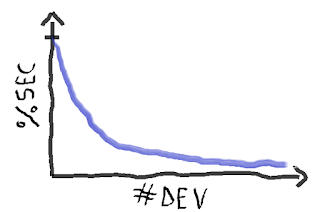
IoT stands for "Internet of Things": thousands of interconnected devices sharing (sensitive) information and personal data. As many of them are small and embedded (not all: during a summary talk, Florian Böhl pointed out the existence of connected Caterpillars, for instance... these , not these ), this directly translates to the need for a careful evaluation of threats due to side-channel attacks…

 research.io