Shtetl-Optimized

Scott
12d ago

The comments on my previous post, on recent AI breakthroughs in solving Erdös problems and beyond, must’ve set some sort of record for the number of separate reasons commenters offered me to despair about the future of humanity. All this in a post that I saw as relatively nerdy and anodyne, goring few oxen, when […]

As most readers have presumably heard by now, Paul Erdös’s Unit Distance Problem from 1946—one of the central open problems from the field of discrete geometry—has been solved by an internal OpenAI model. Erdös had conjectured that, given n points in the plane, at most n1+o(1) pairs of them could be unit distance apart. Using […]

Over the years, I’ve written two op-eds for The New York Times about quantum computing, at the NYT editors’ invitation: I’ve also visited the NYT office and helped NYT reporters with numerous stories about quantum computing and beyond. In the wake of Cade Metz’s infamous NYT hatchet job against Scott Alexander and the rationalist community, […]

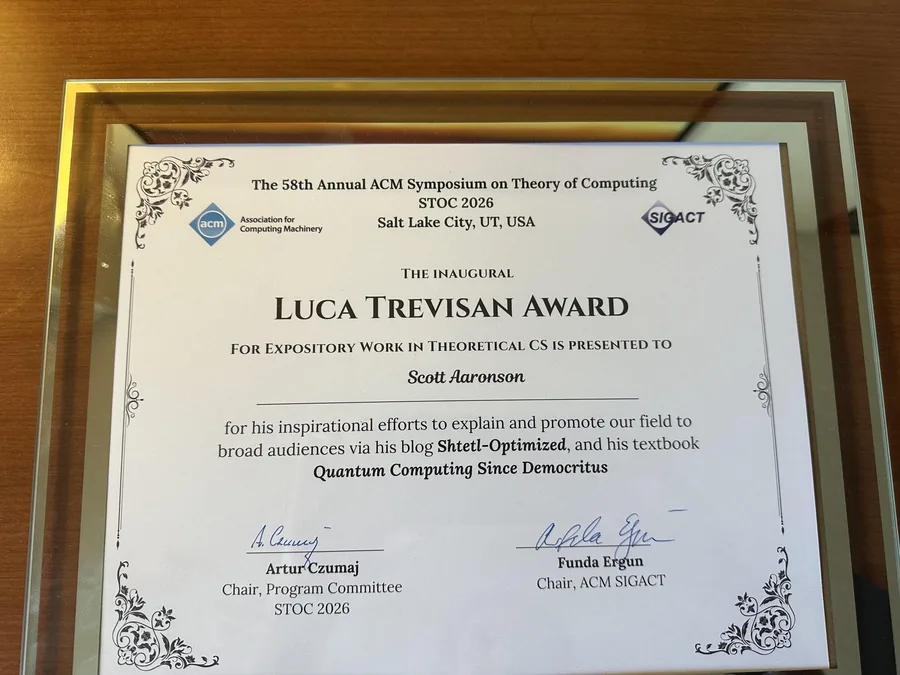
WHOA … I’ve won the inaugural Luca Trevisan Award for Expository Work in Theoretical Computer Science! This has a particular meaning for me as someone who knew Luca Trevisan as well as I did for 25 years — who had him as a professor and thesis committee member, whose blog bounced off his blog, who […]

algorithmscomputer-science

Holy crap … yesterday I was elected to the US National Academy of Sciences! If you don’t believe me, click the link and keep scrolling down until you hit the name “Aaronson.” But then continue scrolling to see 144 other inductees, including my IAS postdoctoral classmate Maria Chudnovsky, my longtime friend and colleague Salil Vadhan, […]

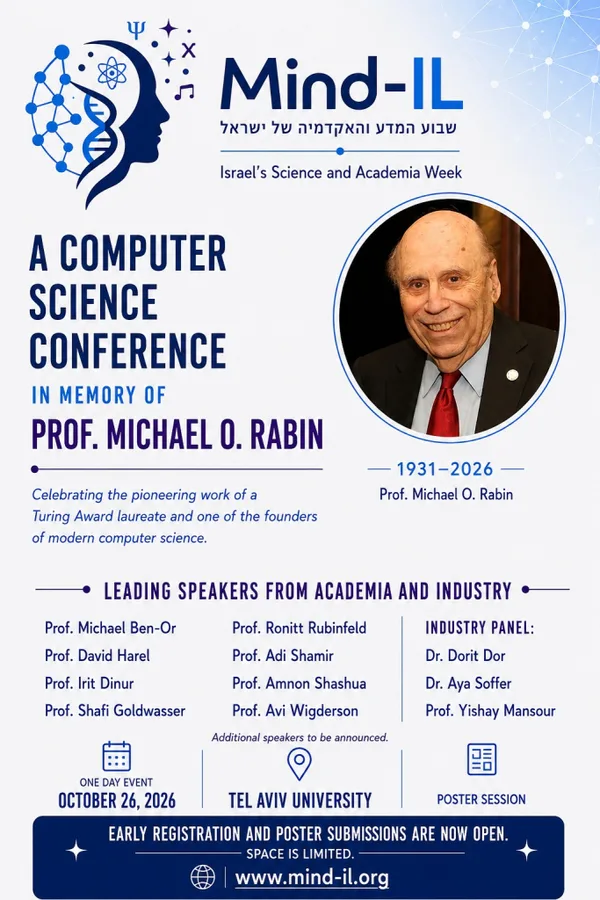
Sir Charles Antony Richard Hoare (1934-2026) won the 1980 Turing Award for numerous contributions to computer science, including foundational work on concurrency and formal verification and the invention (with Dijkstra) of the dining philosophers problem. But he’s perhaps best known, to pretty much everyone who’s ever studied CS, as the inventor of the Quicksort algorithm. […]

algorithmscomputer-science

Imagine that every week for twenty years, people message you asking you to comment on the latest wolf sighting, and every week you have to tell them: I haven’t seen a wolf, I haven’t heard a wolf, I believe wolves exist but I don’t yet see evidence of them anywhere near our town. Then one evening, you hear a howl in the distance, and sure enough, on a hill overlooking the town is the clear silhou…

physicsquantum-physics

For those of you who haven’t seen, there were actually two “bombshell” QC announcements this week. One, from Caltech, including friend-of-the-blog John Preskill, showed how to do quantum fault-tolerance with lower overhead than was previously known, by using high-rate codes, which could work for example in neutral-atom architectures (or possibly other architectures that allow nonlocal operations,…

quantum-computingtechnology

Yesterday Dana, the kids, and I went to the theater to watch The AI Doc: Or How I Became An Apocaloptimist, the well-reviewed new documentary about whether AGI will destroy the world. This was surely the weirdest family movie night we’ve ever done. Firstly, because I personally know probably half of the many people interviewed in the film, from Eliezer Yudkowsky to Ajeya Cotra to Liv Boeree to Da…

aimachine-learning

Last summer, I was privileged to teach a two-week course on theoretical computer science to exceptional 11- and 12-year-olds at Epsilon Camp, held at Washington University in St. Louis. The course was basically a shorter version of the 6.045 course that I used to teach to undergrads at MIT. I was at Epsilon Camp to accompany my son Daniel, who attended a different course there, for the 7- and 8-y…

algorithmscomputer-science

I’m on a spring break vacation-plus-lecture-tour with Dana and the kids in Mexico City this week, and wasn’t planning to blog, but I see that I need to make an exception. Charles Bennett and Gilles Brassard have won the Turing Award, for their seminal contributions to quantum computing and information including the BB84 quantum key distribution scheme. This is the first-ever Turing Award specific…

aiquantum-computing

Last Thursday, my friend and colleague Sam Baker, in UT Austin’s English department, convened an “emergency panel” here about the developing Pentagon/Anthropic situation, and asked me to speak at it. Even though the situation has continued to develop since then, I thought my prepared remarks for the panel might be of interest. At the bottom, I include a few additional thoughts. Hi! I’m Scott Aaro…

aicomputer-sciencequantum-computing

Sorry to interrupt your regular programming about the AI apocalypse, etc., and return to the traditional beat of this blog’s very earliest years … but I’ve now gotten multiple messages asking me to comment on something called the “JVG (Jesse–Victor–Gharabaghi) algorithm” (yes, the authors named it after themselves). This is presented as a massive improvement over Shor’s factoring algorithm, which…

aialgorithms

I don’t have time to write a full post right now, but hopefully this is self-explanatory. Regardless of their broader views on the AI industry, the eventual risks from AI, or American politics, right every person of conscience needs to stand behind Anthropic, as they stand up for their right to [checks notes] not be effectively nationalized by the Trump administration and forced to build murderbo…

aiai-ethics
Scott
2/20/2026

- The STOC’2026 accepted papers list is out. It seems to me that there’s an emperor’s bounty of amazing stuff this year. I felt especially gratified to see the paper on the determination of BusyBeaver(5) on the list, reflecting a broad view of what theory of computing is about. - There’s a phenomenal profile of Henry Yuen in Quanta magazine. Henry is now one of the world leaders of quantum comple…

algorithmscomputer-science

So, a group based in Sydney, Australia has put out a preprint with a new estimate of the resource requirements for Shor’s algorithm, claiming that if you use LDPC codes rather than the surface code, you should be able to break RSA-2048 with fewer than 100,000 physical qubits, which is an order-of-magnitude improvement over the […]

algorithmscomputer-sciencephysicsquantum-physics

Friend-of-the-blog Salil Vadhan has asked me to share the following. The Trevisan Award for Expository Work is a new SIGACT award created in memory of Luca Trevisan (1971-2024), with a nomination deadline of April 10, 2026. The award is intended to promote and recognize high-impact work expositing ideas and results from the Theory of Computation. The exposition can have various […]

mathematical-physicsmathematics

Here’s a 53-minute podcast that I recorded this afternoon with a high school student named Micah Zarin, and which ended up covering …[checks notes] … consciousness, free will, brain uploading, the Church-Turing Thesis, AI, quantum mechanics and its various interpretations, quantum gravity, quantum computing, and the discreteness or continuity of the laws of physics. I strongly recommend 2x speed …

aimachine-learningphysicsquantum-computingquantum-physics

I woke up yesterday morning happy and relieved that the Venezuelan people were finally free of their brutal dictator. I ended the day angry and depressed that Trump, as it turns out, does not seek to turn over Venezuela to María Corina Machado and her inspiring democracy movement—the pro-Western, Nobel-Peace-Prize-winning, slam-dunk obvious, already electorally-confirmed choice […]

political-sciencesocial-science

Merry Christmas, everyone! Ho3! Here’s my beloved daughter baking chocolate chip cookies, which she’ll deliver tomorrow morning with our synagogue to firemen, EMTs, and others who need to work on Christmas Day. My role was limited to taste-testing. While (I hope you’re sitting down for this) the Aaronson-Moshkovitzes are more of a latke/dreidel family, I […]

research.ioresearch.io

Sign up to keep scrolling

Create your feed subscriptions, save articles, keep scrolling.

Already have an account?