What's new

This post concerns the following conjecture of Sendov, as well as its strengthening by Phelps–Rodriguez: Conjecture 1 (Sendov’s conjecture) Let , and let be a degree polynomial with all zeroes in the unit disk. Then for every zero of , there exists a critical point of with . Conjecture 2 (Phelps–Rodriguez conjecture) Let , and […]

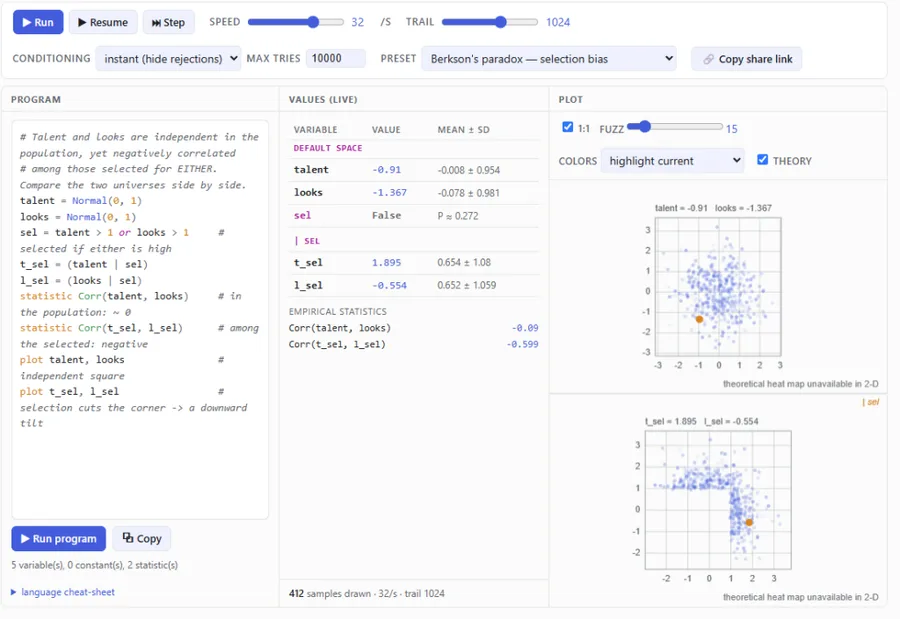
I believe that the creation of visualization apps to illustrate mathematical or scientific concepts is a particularly favorable use case for modern coding agents, as many of the downside risks attached to other LLM use cases are limited: I would however caution against unrestricted LLM use when one or more of the above five favorable […]

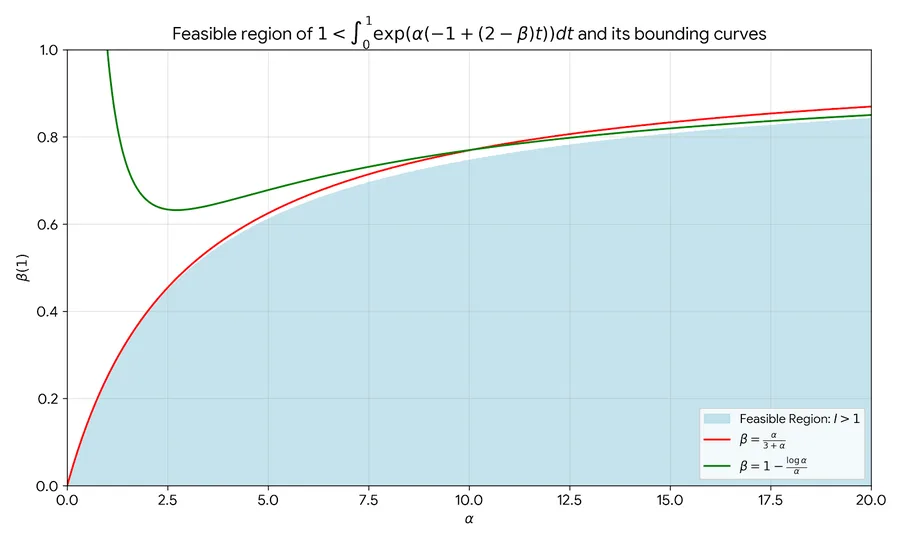
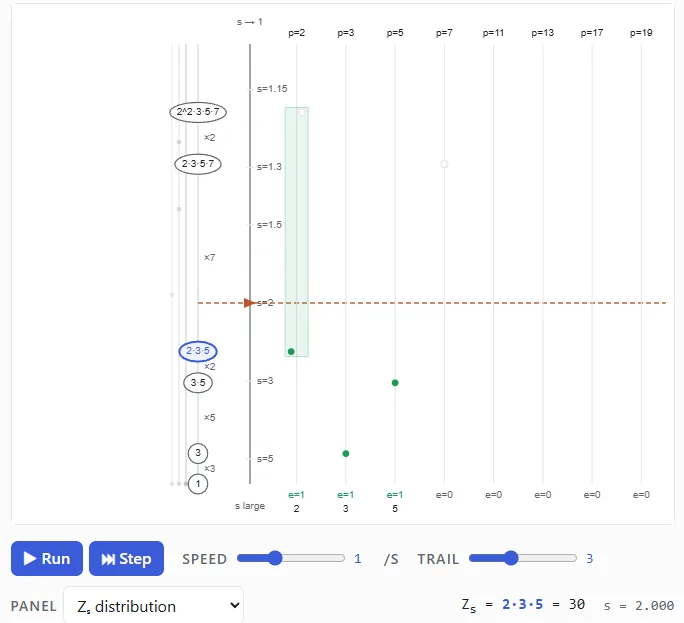
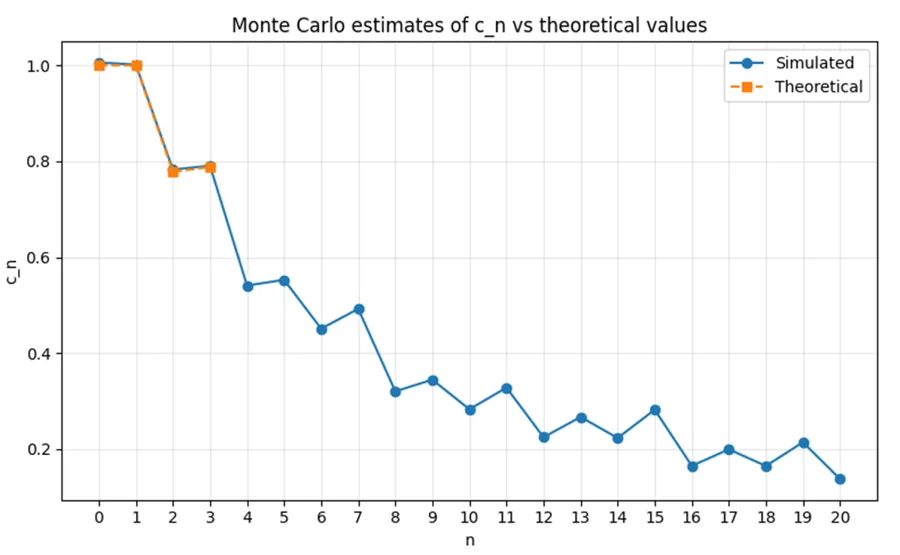
One byproduct of learning how to use coding agents to create visualization apps is that it now becomes straightforward to convert any figure in one’s papers that had already been generated by code (e.g., in Python) into a more interactive, animated applet. I can illustrate this with Figure 1 from my recent paper on the […]

(I am writing here in my capacity as Director of Special Projects at IPAM.) IPAM seeks program proposals from the mathematical, statistical, and scientific communities for long programs, workshops, and summer schools.  Most program proposals are reviewed at IPAM’s Science Advisory Board meeting, held in November each year.  Programs are selected on the basis of […]

Terence Tao
7/14/2026

I am finding the newly revealed capability to code old applet ideas into reality to be very tempting to sink more time into, though I am certainly encountering the common “vibe coding” experience that the process can produce something that superficially resembles a finished product well before a satisfactory level of testing and review has […]

Terence Tao
7/13/2026

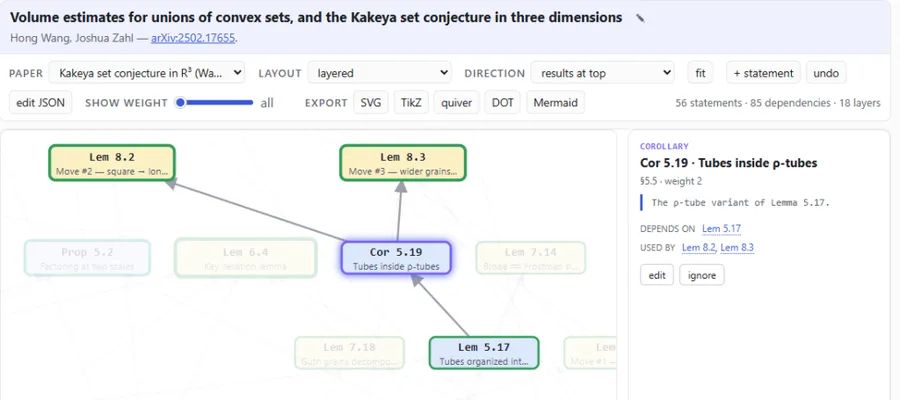
With the advent of modern coding agents, many visualization projects that I had proposed in the past, but dropped due to the time and complexity of the coding portion of the task, have now become relatively feasible, in that a reasonable quality prototype (suitable for non-mission-critical tasks such as providing secondary visual aids, where it […]

Suppose that one has a set of points in the plane, which we will think of as the complex plane . Let denote the number of unit distances determined by these points, i.e., pairs of points whose displacement obeys the equation (It makes little difference for the asymptotics, but we will count the pair separately […]

I am happy to announce the third SAIR challenge, which is focused on obtaining numerical data for the infamous inverse Galois problem. This is a collaborative project with the L-functions and modular forms database (LMFDB), and is organized by John Jones, Jen Paulhus, David Roe, Andrew Sutherland, and myself. The challenge is somewhat similar to […]

The United States Office of Management and Budget (OMB) has proposed a vast and radical set of rule changes to how federal grants from all funding agencies are administered.  (A summary of the key changes, by a former Senior Program Officer at the National Institutes for Health, can be found here.) This is no mere […]

Terence Tao
6/8/2026

A couple months ago, Damek Davis and I launched the first mathematical challenge at the SAIR Foundation, aimed at “distilling” the ability to solve 22 million problems in universal algebra into a condensed form. Stage one of that challenge has now been completed, with several effective “cheat sheets” generated to guess the truth or falsity […]

I’ve just uploaded to the arXiv my paper “Products of consecutive integers with unusual anatomy“. This paper answers some questions of Erdős and Graham which were initially motivated by the study of the Diophantine factorial equation where denotes the squarefree part of (the smallest factor of formed by dividing out a perfect square). For instance, we haveThe equation (1) ties into the general qu…

Tanya Klowden and I have uploaded to the arXiv our preprint “Mathematical methods and human thought in the age of AI“. This is an unabridged version of a solicited article for a forthcoming Blackwell Companion to the Philosophy of Mathematics. I rarely write article-length essays of a philosophical nature (perhaps the last one was in 2007), but given the topical interest in AI and formalization f…

I’ve just uploaded to the arXiv my paper “Local Bernstein theory, and lower bounds for Lebesgue constants“. This paper was initially motivated by a problem of Erdős} on Lagrange interpolation, but in the course of solving that problem, I ended up modifying some very classical arguments of Bernstein and his contemporaries (Boas, Duffin, Schaeffer, Riesz, etc.) to obtain “local” versions of these c…

Mathematical research traditionally involves a small number of professional mathematicians working closely on difficult problems. However, I have long believed that there is a complementary way to do mathematics, in which one works with a broad community of mathematically minded people on problems which may not be as deep as the problems one traditionally works on, but still are of mathematical i…

Terence Tao
2/16/2026

Just a brief announcement that I have been working with Quanta Books to publish a short book in popular mathematics entitled “Six Math Essentials“, which will cover six of the fundamental concepts in mathematics — numbers, algebra, geometry, probability, analysis, and dynamics — and how they connect with our real-world intuition, the history of math and science, and to modern practice of mathemat…

(Sharing this in my capacity of director of special projects at IPAM.) IPAM is holding an Industrial Short Course on Generative AI Algorithms on March 5-6, 2026. The short course is aimed at people from industry or government who want to get started in deep learning, apply deep learning to their projects, learn how to code deep learning algorithms, and upgrade their skills to the latest AI algori…

Thomas Bloom’s Erdös problem site has become a real hotbed of activity in recent months, particularly as some of the easiest of the outstanding open problems have turned out to be amenable to various AI-assisted approaches; there is now a lively community in which human contributions, AI contributions, and hybrid contributions are presented, discussed, and in some cases approved as updates to the…

Terence Tao
1/19/2026

A basic problem in sieve theory is to understand what happens when we start with the integers (or some subinterval of the integers) and remove some congruence classes for various moduli . Here we shall concern ourselves with the simple setting where we are sieving the entire integers rather than an interval, and are only removing a finite number of congruence classes . In this case, the set of in…

Like many other areas of modern analysis, analytic number theory often relies on the convenient device of asymptotic notation to express its results. It is common to use notation such as or , for instance, to indicate a bound of the form for some unspecified constant . Such implied constants vary from line to line, and in most papers, one does not bother to compute them explicitly. This makes the…

research.ioresearch.io

Sign up to keep scrolling

Create your feed subscriptions, save articles, keep scrolling.

Already have an account?