Every so often a mathy essay climbs the ladder by saying something that feels almost too obvious once said out loud: humans think in whole rotations more naturally than they think in π. Turns versus radians is one of those fights that looks pedantic until you have debugged a graphics bug at midnight and watched two coordinate systems disagree by a factor nobody can feel in their bones. Radians ar…
(Edit: I suspect that all the apparatus below can reduce microlocal smoothness to microlocal smoothness in dimension one. So one good answer would be a geometric definition of microlocal smoothness ...
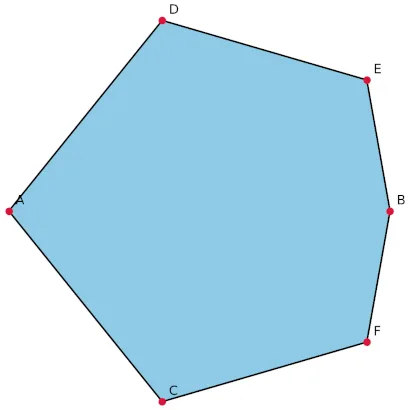
A new paper just came out, The Maximum-Area Small Polygon Problem. The paper solves the problem of finding, for each n, the n-gon with diameter 1 and maximum area. For odd n, the solution is what you might expect: a regular n-gon. I would expect this to be the solution for even n as well, […] The post Big little hexagon first appeared on John D. Cook .
I found that Max Dehn (1903) proved that if a rectangle is dissected into squares, then the ratio of length of side of squares are rational.
Is the following generalization true ? :
If a rectangle is ...
I couldn't resist posting this problem I just came up with (see the attached figure).
I consulted Google's AI several times to get an idea of what this unknown angle might be, but each time, I ...
The mathematical beauty of hyperbezier curves
Raph Levien, August 8, 2026
I have for many decades been fascinated by the prospect of a curve family better suited for interactive design than cubic Béziers. In that search, I have come to a new-found respect for those Béziers. In particular, though other curves like Euler spirals are better at representing smooth curves, they fall short at represent…
Recent Groundbreaking Discoveries in Mathematics
The Hat and the Spectre
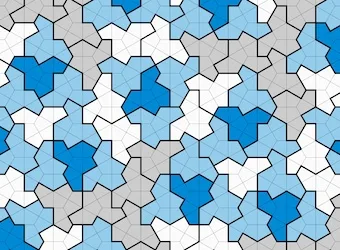
In tiling the plane, the Hat mixed unreflected and reflected tiles, leaving open the question of whether a single shape could tile aperiodically using translations and rotations alone. This question was answered with the exciting discovery of the Spectre, an aperiodic monotile that is “chiral,” meaning that reflected copies …
Ref 1: Tiling with similar tiles
Ref 2: Tiling the plane with pair-wise non-congruent and mutually similar triangles
Ref 3: Tiling the plane with pair-wise non-congruent and mutually similar ...
I know that, for $\vec{u},\vec{v},\vec{w}\in V$ where $V$ is an inner product space, the distance between $\vec{u}$ and $\vec{w}$ is given by the norm $d\left( \vec{u},\vec{w}\right)=\left\| ...
In 1987, Miles Reid conjectured that a combination of contracting (resp. introducing) some isolated curves and smoothing (resp. singularizing) deformation connects all Calabi-Yau 3-folds to each other, as well as to a (non-Kähler, ) connected sum of copies of , called a rakshasa, thus connecting their individual moduli spaces into an irreducible object: The moduli space of 3-folds with may nevert…
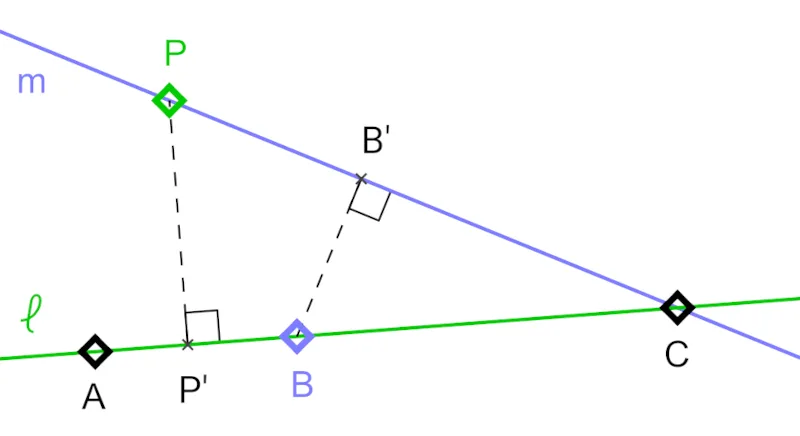
Every finite set of points in the Euclidean plane that is not collinear has a line that passes through exactly two of the points.
This proof is by Michigan State University mathematician Leroy Milton Kelly. Consider a set S of points that aren’t all collinear, and define a connecting line to be a line that contains at least two of these points. There must be some point P and connecting line ℓ tha…
Let $M$ be a smooth manifold. Let $D\leq TM$ be a subbundle i.e. a distribution of rank $k$. Then $D$ is integrable at $p \in M$ if there is a submanifold $N \subseteq M$ with $p \in N$ and $T_xN = ...
A tiling T of the Euclidean plane (E2) is a countable collection of closed topological disks called tiles T = {Ti : i ∈ N} that is a covering (Ui Ti = E2) as well as a packing (Int(Ti) ∩ Int(Tj) = ∅ if i ̸= j, Int(T) denotes the interior of tile T). One of the problems of interest in discrete geometry is the classification of tilings based on transitivity properties of their vertices, edges and t…



 research.io