combinatorics

Electronic Journal of Graph Theory and Applications (EJGTA)
Daryl DeFord (ddeford@vassar.edu)
3d ago

In this paper we present enumerative results for Stirling numbers of the first kind for two graph products, the matched product and the m-star, using the combinatorial model of rearrangements. The kth Stirling number of the first kind for a simple graph G counts the number of ways to decompose G into exactly k vertex-disjoint cycles, including single vertices as 1-cycles, single edges as 2-cycles…

combinatoricsgraph-theorymathematics
Hot Questions - Stack Exchange
Algorithms and Complexity
Anonymous
3/23/2026

ACO Seminar - Zion Hefty Wean Hall 8220 Anonymous (not verified) Mon, 03/23/2026 - 10:19 In Person Improving R(3,k) in just two bites ZION HEFTY The Ramsey number R(t,k) is the smallest n such that any red-blue edge coloring of the n-vertex complete graph has either a t-vertex red complete subgraph or a k-vertex blue complete subgraph. We will investigate the…

combinatoricsmathematics
Algorithms and Complexity
Anonymous
3/16/2026

ACO Seminar - Tracy Chin Wean Hall 8220 Anonymous (not verified) Mon, 03/16/2026 - 09:37 In Person Valuated Delta Matroids and Principal Minors TRACY CHIN Delta matroids are a generalization of matroids that arise naturally from combinatorial objects such as matchings, ribbon graphs, and principal minors of symmetric and skew symmetric matrices. In this talk,…

combinatoricsmathematics
Algorithms and Complexity
Anonymous
3/9/2026

ACO Seminar - Daniel Zhu Wean 6220 Anonymous (not verified) Mon, 03/09/2026 - 16:30 In Person Schur complements for tensors and multilinear commutative rank DANIEL ZHU We show that three notions of ranks for matrices of multilinear forms are equivalent. This result generalizes a classical result of Flanders, corrects a minor hole in work of Fortin and Reutena…

combinatoricsmathematics
Algorithms and Complexity

Theory Lunch Seminar - Zeyu Zheng Gates Hillman 8102 Anonymous (not verified) Tue, 02/24/2026 - 10:44 In Person The generalized trifference problem ZEYU ZHENG We study the problem of finding the largest number T(n,m) of ternary vectors of length n such that for any three distinct vectors there are at least m coordinates where they pairwise differ. For m=1 , t…

algorithmscombinatoricsmathematics
Algorithms and Complexity

ACO Seminar - Carl Schildkraut Wean Hall 8220 Anonymous (not verified) Mon, 02/23/2026 - 10:38 In Person Ramsey Cayley graphs over non-abelian groups CARL SCHILDKRAUT A conjecture of Alon states that, for some absolute constant C, every finite group G possesses a Cayley graph with clique and independence number each at most C*log|G|. Recently, Conlon, Fox, Ph…

combinatoricsgraph-theorymathematics
Algorithms and Complexity
Anonymous
2/16/2026

ACO Seminar - Michael Zheng Wean Hall 8220 Anonymous (not verified) Mon, 02/16/2026 - 10:54 In Person A Lovász-Kneser theorem for triangulations MICHAEL ZHENG We show that the Kneser graph of triangulations of a convex n-gon has chromatic number n - 2. Joint work with Anton Molnar, Cosmin Pohoata, and Daniel G. Zhu. 4:00 pm → Jane Street-sponsored tea and coo…

combinatoricsmathematics
Algorithms and Complexity

ACO Seminar - Bernardo Subercaseaux Wean Hall 8220 Anonymous (not verified) Mon, 02/02/2026 - 16:38 In Person Breaking down graphs and hypergraphs into structured pieces, optimally and efficiently BERNARDO SUBERCSEAUX We will consider the problem of writing an arbitrary graph as an edge-disjoint union of complete bipartite graphs, and its natural generalizati…

algorithmscombinatoricsmathematics
John D. Cook

A few days ago I wrote two posts about perfect shuffles. Once you’ve cut a deck of cards in half, an in-shuffle lets a card from the top half fall first, and an out-shuffle lets a card from the bottom half fall first. Suppose we have a deck of 52 cards. We said in the […] The post Combining in-shuffles and out-shuffles first appeared on John D. Cook .

combinatoricsmathematics
Paper Digest

The field of Combinatorics in arXiv covers Discrete mathematics, graph theory, enumeration, combinatorial optimization, Ramsey theory, combinatorial game theory. Paper Digest Team analyzes all papers published in this field in the past years, and presents up to 30 most influential papers for each year. This ranking list is automatically constructed based upon citations from both research papers a…

combinatoricsgraph-theorymathematics
John D. Cook

There are several numbers that are analogous to binomial coefficients and, at least in Donald Knuth’s notation, are written in a style analogous to binomial coefficients. And just as binomial coefficients can be arranged into Pascal’s triangle, these numbers can be arranged into similar triangles. In Pascal’s triangle, each entry is the sum of the […] The post Analogs of binomial coefficients fir…

combinatoricsmathematics
John D. Cook

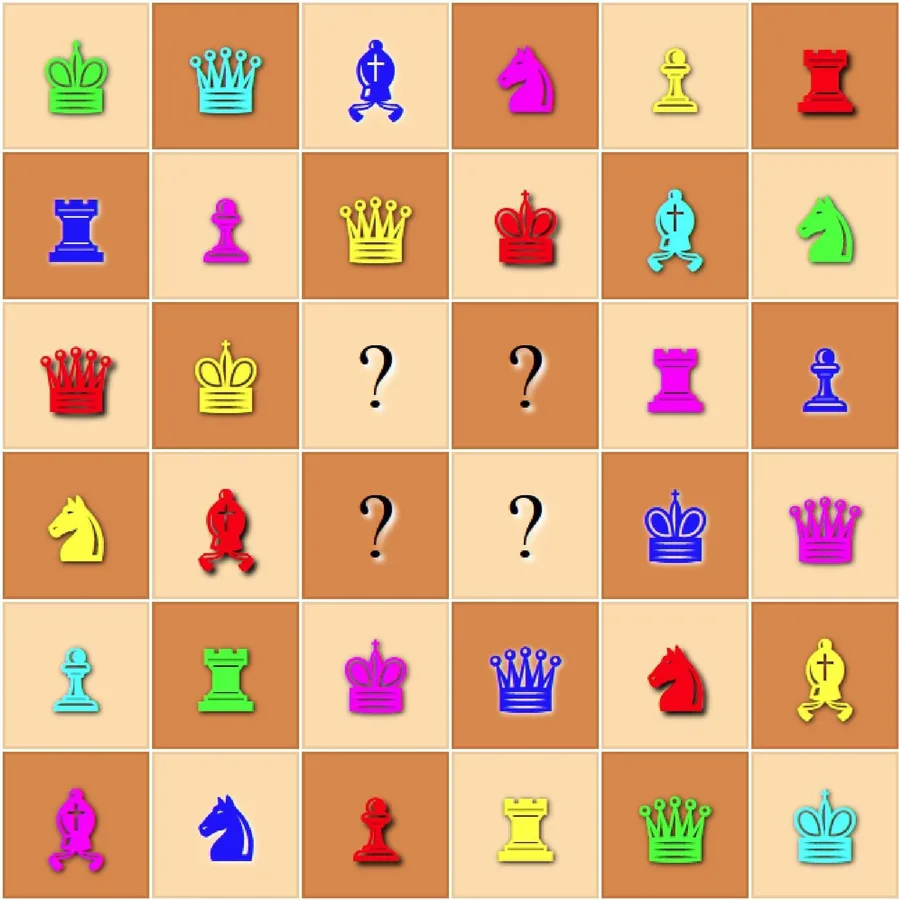
Here’s another little chess puzzle by Martin Gardner, taken from this paper. The task is to place all the pieces—king, queen, two bishops, two knights, and two rooks—on a 6 × 5 chessboard, with the requirement that the two bishops be on opposite colored squares and no piece is attacking another. Here is a solution. The post All pieces on a small chessboard first appeared on John D. Cook .

combinatoricsmathematics
Statistics By Jim
Jim Frost
6/8/2025

This permutation calculator finds the number of ways to arrange a sample of items from a larger set when the order matters. Enter the total number of objects (n) and the number of items in your arrangement (r). For example, the permutations calculator can tell you how many ways you can arrange 4 books from […] The post Permutation Calculator appeared first on Statistics By Jim .

combinatoricsmathematics
John D. Cook

I just stumbled across the binomial number system in Exercise 5.38 of Concrete Mathematics. The exercise asks the reader to show that every non-negative integer n can be written as and that the representation is unique if you require 0 ≤ a < b < c. The book calls this the binomial number system. I skimmed a paper […] The post Binomial number system first appeared on John D. Cook .

combinatoricsmathematics
John D. Cook

The nth row of Pascal’s triangle contains the binomial coefficients C(n, r) for r ranging from 0 to n. For large n, if you print out the numbers in the nth row vertically in binary you can see a circular arc. Here’s an example with n = 50. You don’t have to use binary. Here’s are the numbers in the row […] The post The ellipse hidden inside Pascal’s triangle first appeared on John D. Cook .

combinatoricsmathematics
John D. Cook

Imagine you are a soldier in charge of stacking cannonballs. Your fort has a new commander, a man with OCD who wants the cannonballs stacked in a very particular way. The new commander wants the balls stacked in tetrahedra. The balls on the bottom of the stack are arranged into a triangle. Then the next […] The post Stacking positive and negative cannonballs first appeared on John D. Cook .

combinatoricsmathematics
research.ioresearch.io

Sign up to keep scrolling

Create your feed subscriptions, save articles, keep scrolling.

Already have an account?