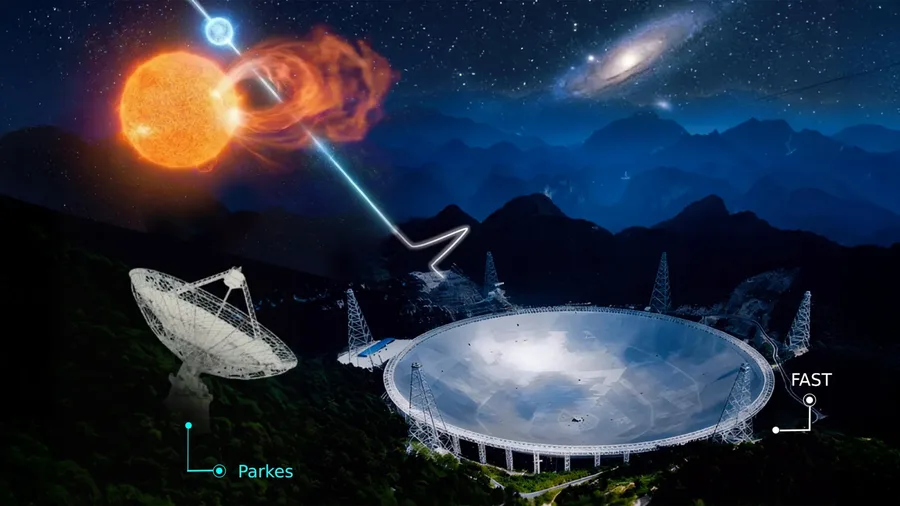
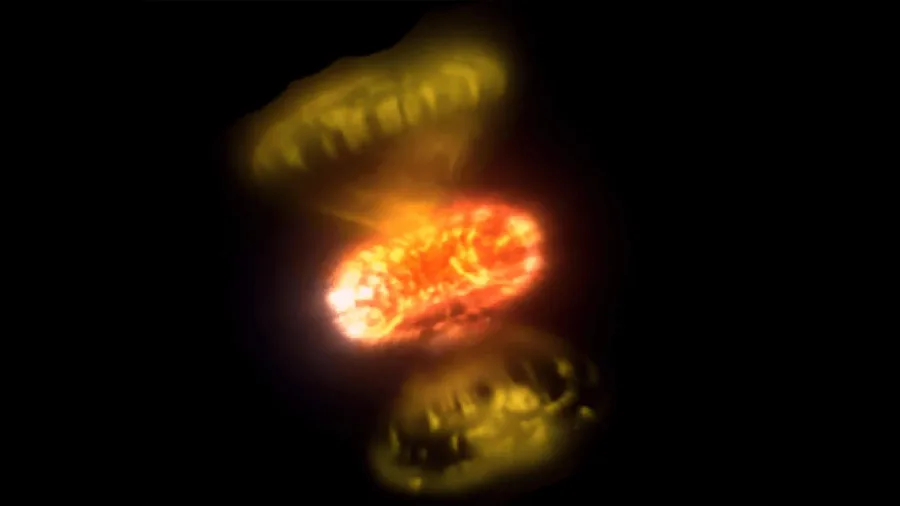
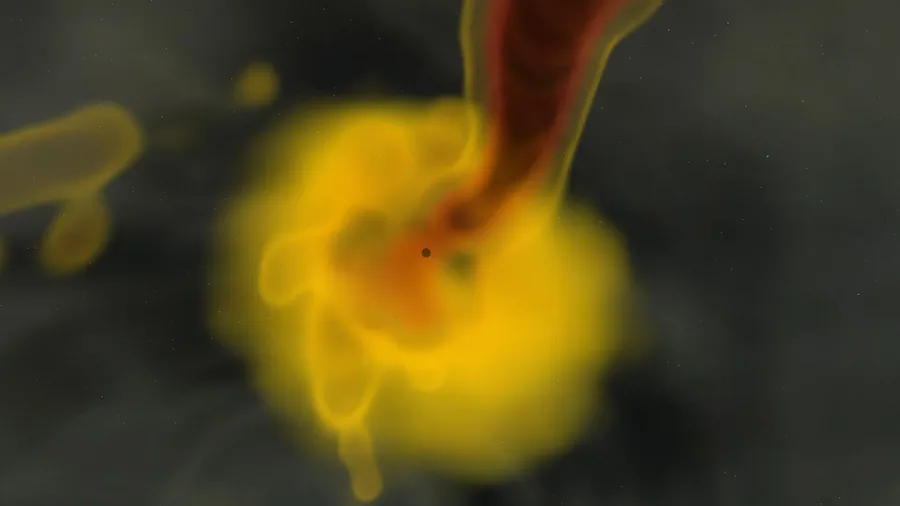
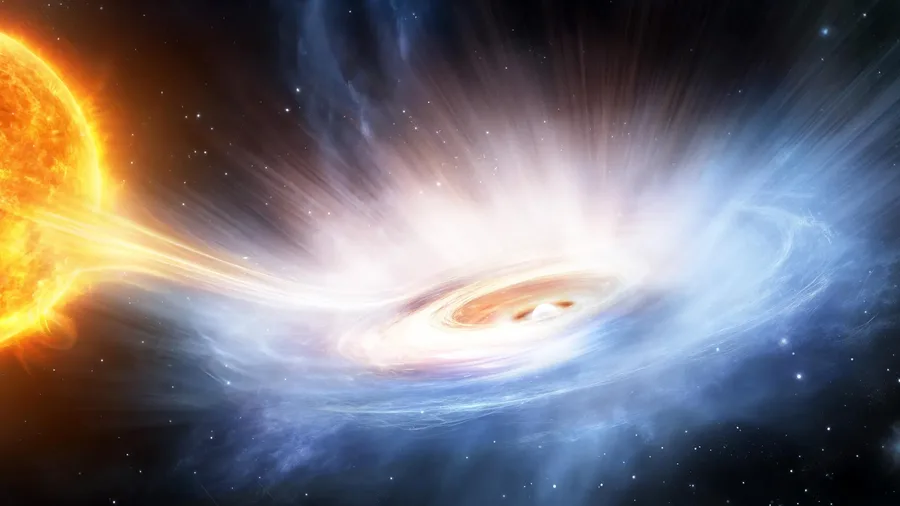
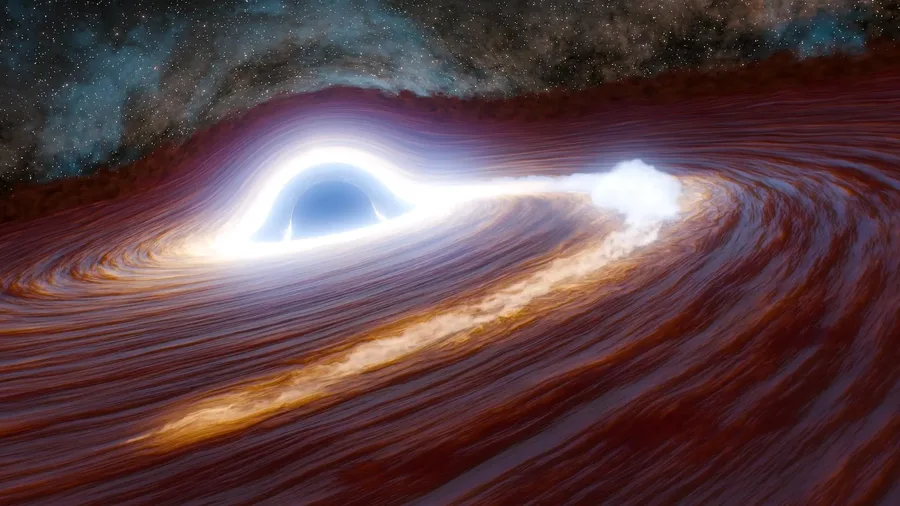
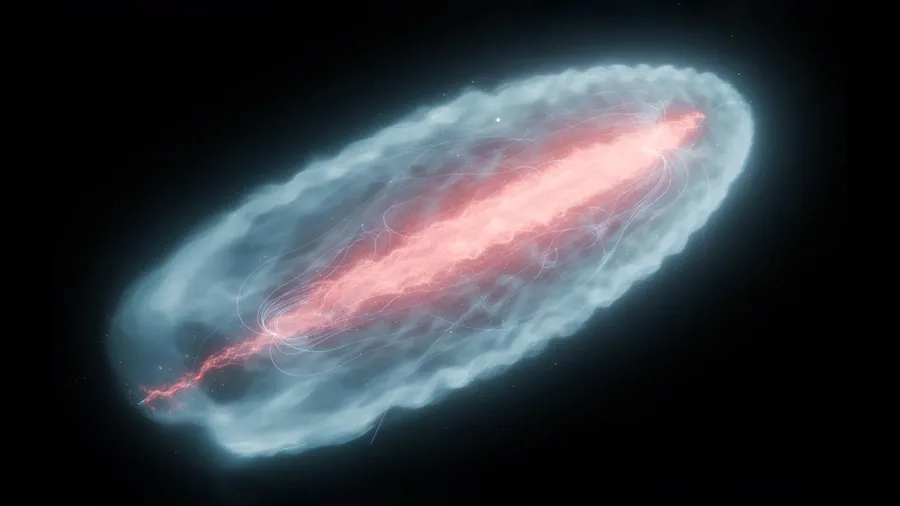
A repeating fast radio burst has just given up one of its biggest secrets. Long-term observations revealed a rare signal flare caused by plasma likely ejected from a nearby companion star. This shows the burst source isn’t alone, but part of a binary system. The finding strengthens the case that magnetars interacting with stellar companions can generate repeating cosmic flashes.
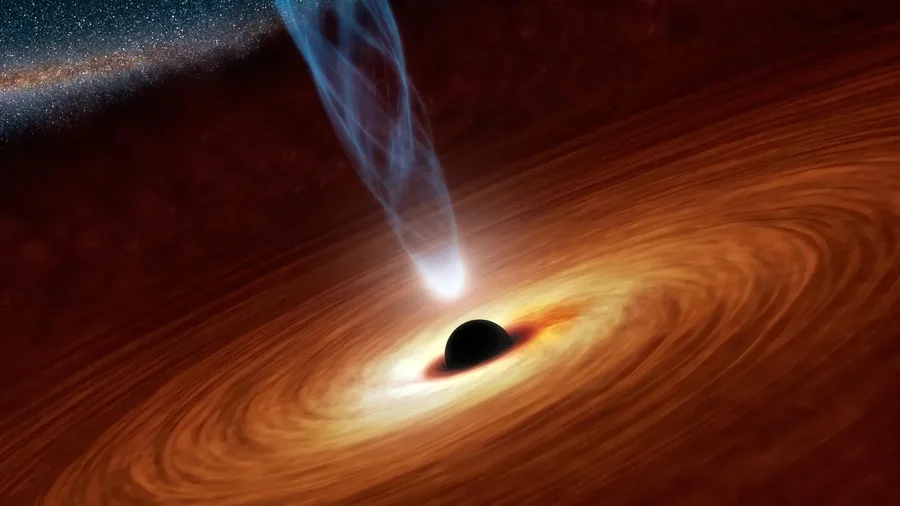
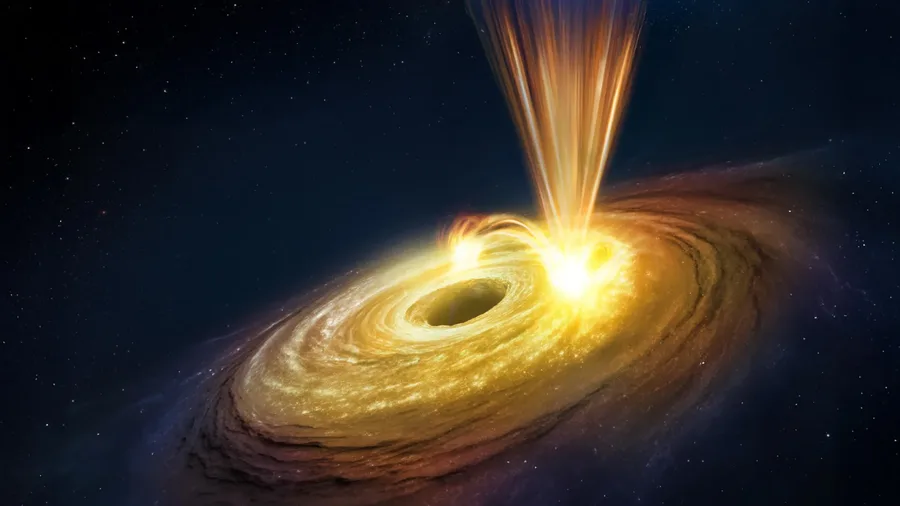
Astronomers have spotted a rare, rule-breaking quasar in the early Universe that appears to be growing its central black hole at an astonishing pace. Observations show the black hole is devouring matter far faster than theory says it should—about 13 times the usual “speed limit”—while simultaneously blasting out bright X-rays and launching a powerful radio jet. This surprising combination wasn’t …
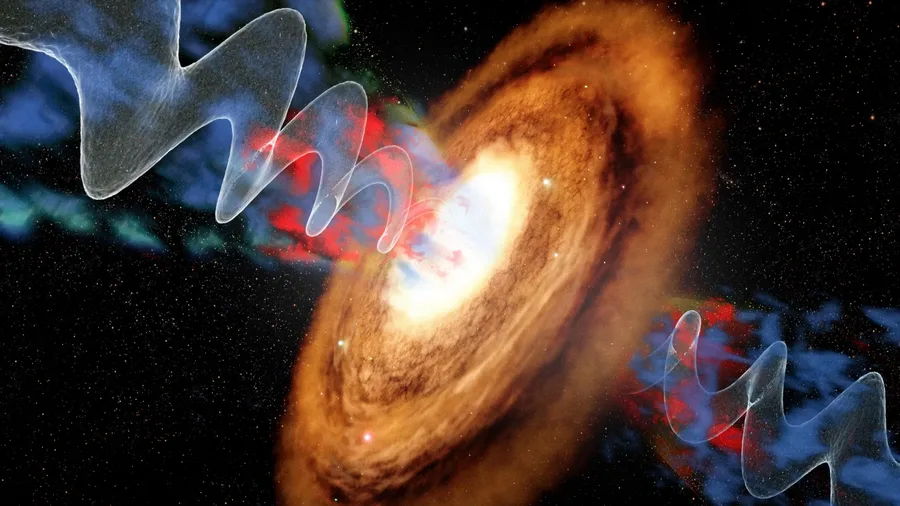
Scientists have discovered an enormous stream of super-hot gas erupting from a nearby galaxy, driven by a powerful black hole at its center. The jets stretch farther than the galaxy itself and spiral outward in a rare, never-before-seen pattern. NASA’s James Webb Space Telescope pierced through thick dust to reveal this violent outflow. The process is so intense it’s robbing the galaxy of star-fo…
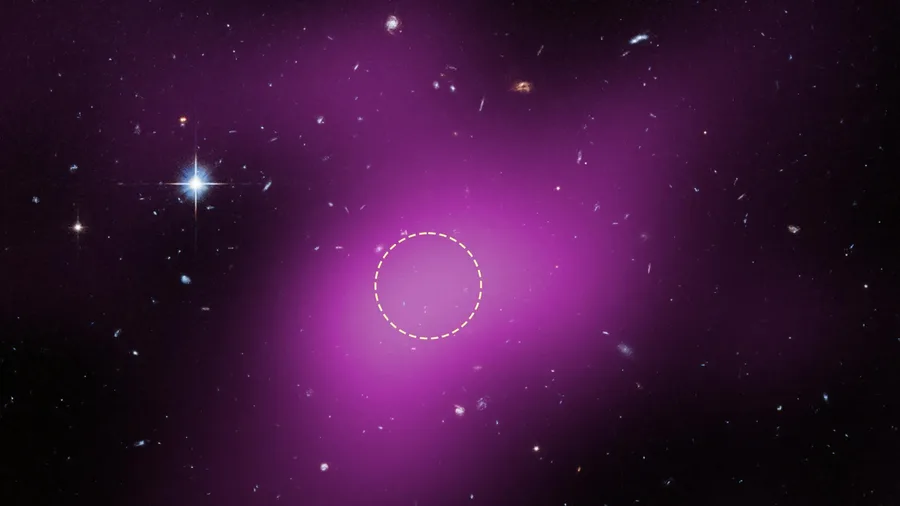
Hubble has revealed a strange cosmic object called Cloud-9, a dark matter–dominated cloud with no stars at all. Scientists believe it is a “failed galaxy,” a leftover building block from the early Universe that never lit up. Its discovery confirms long-standing theories about starless galaxies. Cloud-9 offers a rare glimpse into the dark side of cosmic evolution.
New high-resolution images show that novae are anything but simple stellar fireworks. One exploded with multiple gas streams colliding almost immediately, while another shockingly delayed its eruption for more than 50 days before unleashing a powerful blast. These complex outflows create shock waves that produce intense gamma rays, confirming long-standing theories with direct visual evidence. Th…
A sudden X-ray flare from a supermassive black hole in galaxy NGC 3783 triggered ultra-fast winds racing outward at a fifth the speed of light—an event never witnessed before. Using XMM-Newton and XRISM, astronomers caught the blast unfold in real time, revealing how tangled magnetic fields can rapidly “untwist” and hurl matter into space much like an enormous, cosmic-scale version of the Sun’s c…
Knotted structures once imagined by Lord Kelvin may actually have shaped the universe’s earliest moments, according to new research showing how two powerful symmetries could have created stable “cosmic knots” after the Big Bang. These exotic objects may have briefly dominated the young cosmos, unraveled through quantum tunneling, and produced heavy right-handed neutrinos whose decays tipped the b…
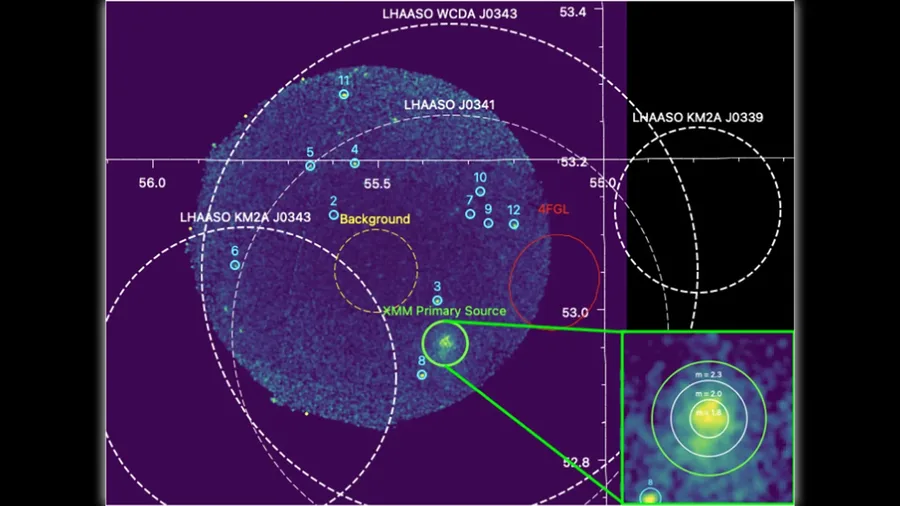
Michigan State University astrophysicists are closing in on one of space science’s biggest mysteries: where the galaxy’s most energetic particles come from. Their studies uncovered a pulsar wind nebula behind a mysterious LHAASO signal and set important X-ray constraints on other potential sources.
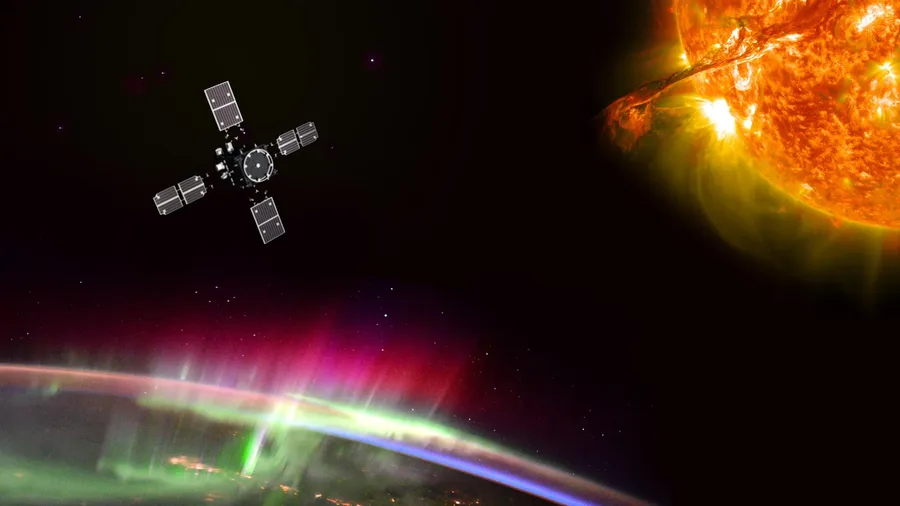
A massive solar storm in May 2024 gave scientists an unprecedented look at how Earth’s protective plasma layer collapses under intense space weather. With the Arase satellite in a perfect observing position, researchers watched the plasmasphere shrink to a fraction of its usual size and take days to rebuild. The event pushed auroras far beyond their normal boundaries and revealed that a rare “neg…
LHAASO has uncovered that micro-quasars, black holes feeding on companion stars, are powerful PeV particle accelerators. Their jets produce ultra-high-energy gamma rays and protons that exceed long-held expectations. Precise cosmic-ray measurements reveal a new high-energy component, suggesting multiple sources within the Milky Way. These findings finally tie the “knee” structure to black hole je…
Dark matter may be invisible, but scientists are getting closer to understanding whether it follows the same rules as everything we can see. By comparing how galaxies move through cosmic gravity wells to the depth of those wells, researchers found that dark matter appears to behave much like ordinary matter, obeying familiar physical laws. Still, the possibility of a hidden fifth force lingers, o…
New simulations suggest magnetic fields hold the key to forming black holes that defy known mass limits. When powerful magnetic forces act on a collapsing, spinning star, they eject vast amounts of material, creating smaller yet faster-spinning black holes. This process could explain the puzzling GW231123 collision and the existence of “forbidden” black holes.
XRISM’s observations of GX13+1 revealed a slow, fog-like wind instead of the expected high-speed blast, challenging existing models of radiation-driven outflows. The discovery hints that temperature differences in accretion discs may determine how energy shapes the cosmos.
A colossal black hole 10 billion light-years away has been caught devouring one of the universe’s biggest stars, unleashing a flare 30 times brighter than any seen before. The flare, detected by Caltech’s ZTF, likely marks a tidal disruption event — when a star is shredded by a black hole’s gravity.
Using CERN’s Super Proton Synchrotron, researchers generated plasma fireballs to simulate blazar jets. The beams stayed stable, suggesting plasma instabilities aren’t responsible for missing gamma rays. Instead, the data strengthens the idea of ancient intergalactic magnetic fields, possibly from the Universe’s earliest moments.