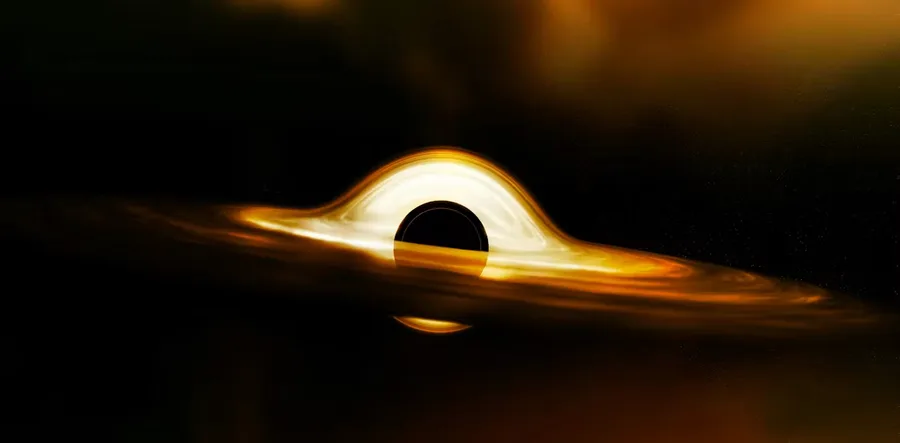
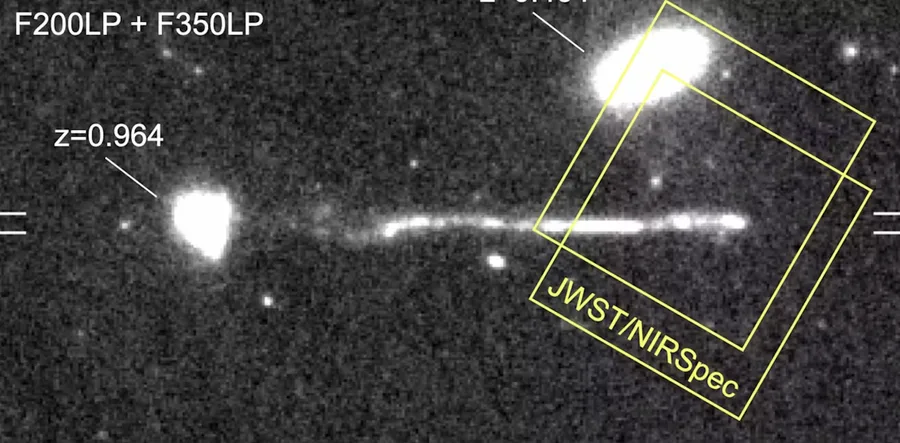
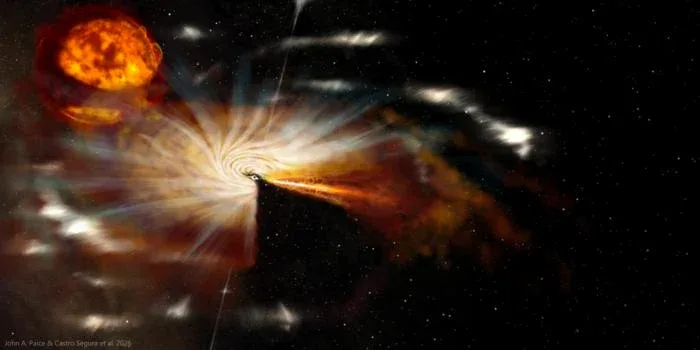
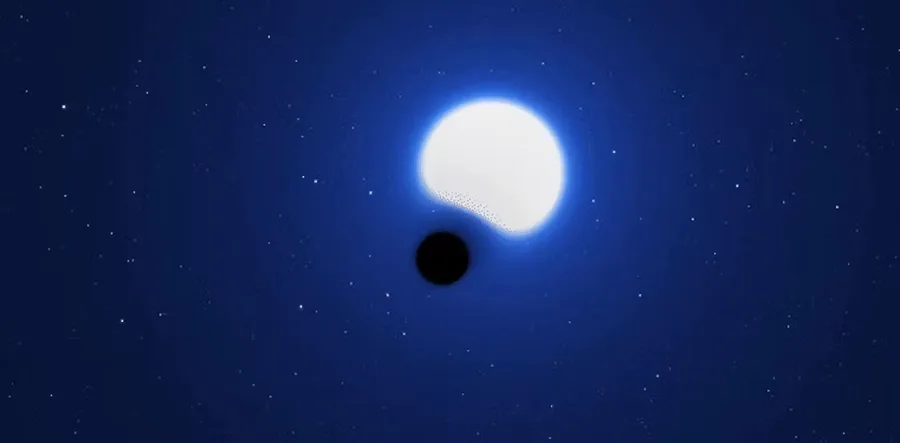
When two black holes find each other in the vastness of space, they can form a binary odd couple—and it’s more common than researchers expected.
Scientists think most black holes are born when a star dies and its core collapses. This is also the case for binary black holes, pairs of black holes that orbit around each other and slowly move closer together. These pairs are often the remains of star…
If the event horizon of a black hole is the distance from the center from within which light cannot escape, imagine a person with a flashlight falls into the black hole. He points his flashlight in a precisely radial direction and turns it on. Now there is a light ray moving outward at the speed of light. If it now cannot move in an arc, but rather is constrained to radial motion, it must, at som…
I watched videos, read articles, learned a lot about black holes and got confused: Lets say that a light is doing its way inside a black hole toward the singularity. If it's inside the event horizon, can this light escape it? I heard that if you want to escape from the event horizon you have to do it faster than the speed of light, can you escape it by the speed of light itself? I also heard abou…
On microscopic explanation of Bekenstein-Hawking entropy via geometric engineering of black holes in string theory as bound states of D-branes:
Discussion of black hole entropy of D2-D6 brane bound states as black holes in string theory:
On D1-D3 brane intersections as spikes/BIons in the D3-brane DBI-theory:
On the AdS-CFT correspondence:
Juan Maldacena, The Large N limit of superconformal field…
Black holes are some of the most awe-inspiring and mysterious celestial objects in the universe. This is primarily because astronomers still don’t understand the underlying mechanisms that drive black holes, including its formation, evolution, and end. As their name implies, black holes can’t be viewed directly since they blend into the background of the vastness […] The post Astronomers Catch Bl…
A star’s rotation may help solve a longstanding mystery involving repeated encounters between stars and supermassive black holes. At the center of most galaxies sits a supermassive black hole, an object millions to billions of times more massive than the Sun. Its gravity is powerful enough to tear apart a star that ventures too close, [...]
A black hole is seen by an observer as a black disc. I understand that this is due to its strong gravitational pull that does not allow light to escape and thus it doesn’t reach the observer. I am trying to understand this situation within a Penrose diagram of Schwarzschild spacetime. The event horizon of the black hole therein is the 45° tilted line. From any point in the exterior region, the pa…
Astronomers have found stars that repeatedly skim past supermassive black holes, surviving each encounter while producing a new burst of light. In some systems, those flares mysteriously fade with every return. Researchers now think the key may be stars that were already spinning extremely fast before being captured. That rapid rotation could explain both the fading flares and how the stars ended…
This article highlights the groundbreaking work of MIT observational astrophysicist Erin Kara, who studies how supermassive black holes grow, behave, and influence the galaxies around them. Because black holes are too distant to image directly with conventional telescopes, Kara pioneered and advanced a technique known as X-ray reverberation mapping. Similar to how bats use echolocation, […] The p…
Regular black holes are black holes (regions of spacetime bounded by an event horizon) without any singularity. Black hole spacetime's that allow observers to avoid singularities (because the holes lack them or because they are "timelike") lead to new universes. Such as the Kerr metric , an ideal rotating hole. A regular black hole prison cell? Disclaimer: real black holes are thought to have, fo…
I hit a snag while trying to explain black holes to my son. I was explaining that black holes gradually lose mass through Hawking radiation. As the mass decreases, the Schwarzschild radius $$
r_s = \frac{2GM}{c^2}
$$ also decreases. My son asked what happens when the black hole becomes extremely small. In particular, is there a point at which the concept of an event horizon ceases to be meaningfu…
Roger Penrose helped resurrect Einstein’s general theory of relativity, and Reinhard Genzel and Andrea Ghez showed there was a black hole in the middle of our galaxy.
Astronomers have discovered the first dormant black hole outside of the Milky Way. These black holes are not absorbing matter from a nearby star, making them incredibly hard to find.



 research.io