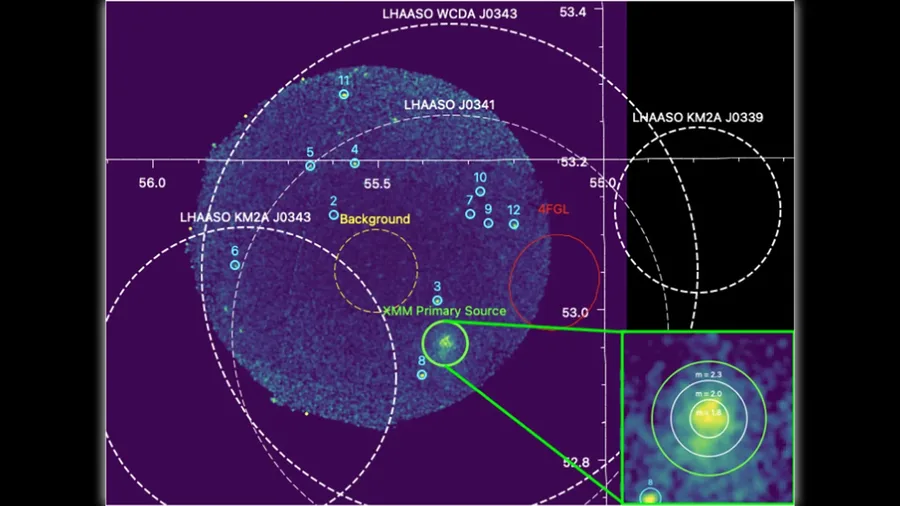
Michigan State University astrophysicists are closing in on one of space science’s biggest mysteries: where the galaxy’s most energetic particles come from. Their studies uncovered a pulsar wind nebula behind a mysterious LHAASO signal and set important X-ray constraints on other potential sources.
LHAASO has uncovered that micro-quasars, black holes feeding on companion stars, are powerful PeV particle accelerators. Their jets produce ultra-high-energy gamma rays and protons that exceed long-held expectations. Precise cosmic-ray measurements reveal a new high-energy component, suggesting multiple sources within the Milky Way. These findings finally tie the “knee” structure to black hole je…