
stochastic-processes-and-financial-applications

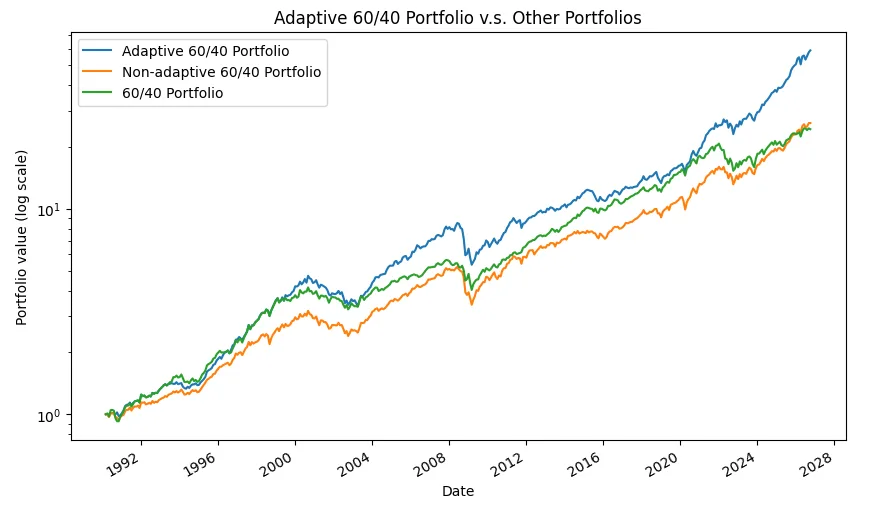
Welcome to 2026, where bonds no longer diversify stocks, volatility remains elevated and inflation isn’t going anywhere1. This is the dramatic, although factual, opening of Basis Points’s video Morgan Stanley’s asset allocation playbook for the next 5 years. As a consequence, the 60/40 Portfolio - invested 60% in stocks and 40% in bonds - which for decades has stood as the institutional benchmark…

A backtest does not need to crash to be broken. The dangerous version runs cleanly, produces a smooth equity curve, and reports a Sharpe ratio that makes deployment feel obvious. Then live performance diverges because one quiet assumption allowed future information, ignored trading costs, or rewarded the luckiest configuration. Before trusting a backtest, I now ask five questions. 1. Could later …
The explosive growth of hyper-liquid 0-DTE markets has pushed traditional options pricing infrastructure to its breaking point, as continuous Black-Scholes calculus can collapse into an unusable point mass at expiration. Rather than patching a broken formula with hand-fitted tweaks, a new paper suggests dismantling legacy math by replacing continuous geometric Brownian motion with a discrete, ord…
I’m currently at a smaller prop firm that, as I understand it, is structured as a family office for legal and financial reasons. I’ll be allocated firm capital and given my own book to trade. I’m curious whether spending 1–2 years here could be a good stepping stone to a larger prop firm or hedge fund. Assuming I develop a solid trading process and track record, how would that experience be viewe…
Early warning of market turbulence is usually treated as a classification problem, yet a usable system must also produce trustworthy probabilities, stay parsimonious and convert forecasts into defensible positions. We formulate that joint problem as a seven-objective optimisation task in which indicator selection, ridge-logistic regularization, decision threshold, calibration temperature and five…

In his course, AI and Data Science in Finance, Associate Professor Winston Dou connects cutting-edge research with real-world financial challenges, from autonomous trading to market prediction. Learn how students are building the skills to navigate an AI-driven financial future and how those ideas are helping shape the vision for the Wharton AI in Finance Lab. … Read More The post How Wharton Is …
The Heston local-stochastic volatility (HLSV) model is used to investigate optimal consumption, life insurance, and investment strategies for a decision maker with habit formation and heterogeneous discounting. The decision maker can allocate wealth in a financial market consisting of risk-free and risky assets, where the price process of the risky asset follows the HLSV model. The habit formatio…
I am designing a quantitative trading strategy inside the XtraAlgoQ PULSE architecture. The strategy relies on non-standard alternative signals based on luni-solar calendar metrics (traditionally categorized as Panchang variables—such as solar/lunar longitude differences, tithi durations, and planetary sidereal angles) to evaluate potential intraday regime changes and volume/volatility anomalies.…
Scientific Reports, Published online: 13 September 2026; doi:10.1038/s41598-026-71418-0 Heterogeneous performance of machine learning models in financial market forecasting
The prompts, filters, and research checks I use to separate promising signals from noise and overfitting.

What 284,807 Credit Card Transactions Taught Me About Fraud (And About Trusting My Own Charts) I've been building a data analytics portfolio that combines my finance and accounting background with hands on Python. My first project looked at ROE across the top 200 US companies. For this one, I wanted something with a bit more edge, so I picked a dataset that's practically a rite of passage in data…
Three articles ago I wrote that "endogeneity" was the deepest of the three critiques a derivatives-savvy reader made of my crash simulator. Two articles ago I built the margin spiral. Last article I built the dealer short-gamma spiral and ended with: "The last piece is to wire the gamma state into the hazard layer itself — that's V9-P2, and it's next." It's done. This is the closing of that loop.…
I’m trying to work this out every day but when I calculate the below clients are saying that it does not look right based just wondered if any one could help me work out if what it should be? Contract CTD CUSIP Coupon Conversion Factor Bond clean price Futures price Accrued interest (today) Delivery date used Days to delivery Repo rate Gross Basis (32nds) Net Basis (32nds) Implied Repo TUZ6 91282…
Expected shortfall (ES), also known as conditional value-at-risk, is a widely recognized risk measure that complements value-at-risk by capturing tail-related risks more effectively. Compared with quantile regression, which has been extensively developed and applied across disciplines, ES regression remains in its early stage, partly because the traditional empirical risk minimization framework i…

Why MtM declines drive two-thirds of crisis losses: deconstructing CVA spikes during the 10-day MPoR window, the xVA framework, and Basel III SA-CVA rules. 📊 Deep Research Topics: quantitative finance, investment analysis, financial education, financial research, market analysis

If you have ever attempted to build an algorithmic trading bot in Python, you have almost certainly walked this exact path: You install TA-Lib (after wrestling with C compilers, missing headers, and broken Windows wheels for an hour). You write a script scanning for classic candlestick patterns: Bullish Engulfing , Hammer , Morning Star . You backtest it on your favorite stock or crypto pair. Res…

research.ioSign up to keep scrolling
Create your feed subscriptions, save articles, keep scrolling.