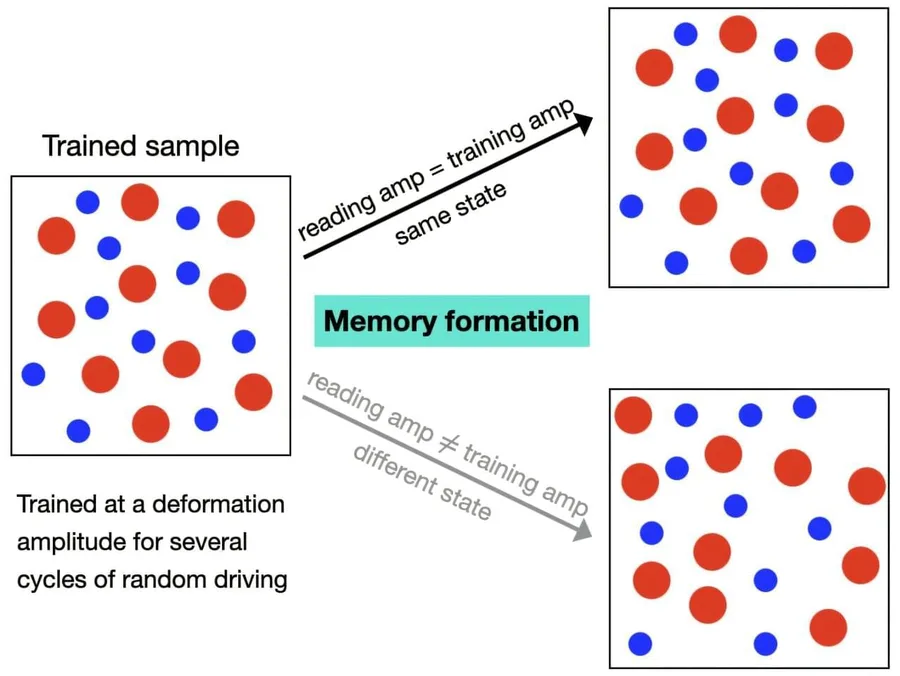
Amorphous materials such as glass are solids whose internal structure lacks a repeating pattern. Their molecules are arranged in a random and irregular way. Surprisingly, these disordered materials can “remember” past mechanical experiences; that is, the way they respond to a force can depend on how they have responded to external forces before. Roni Chatterjee […]
Porous glasses from zeolitic imidazolate frameworks (ZIFs) show strong potential for gas separation applications. By applying concepts from silicate glass science, we developed a strategy to tune their structure and properties, expanding the currently limited chemical design space of ZIF glasses.
Nature Chemistry, Published online: 04 May 2026; doi:10.1038/s41557-026-02115-8 The properties of metal–organic framework glasses can be modulated by additives, but understanding how they modify the glass network is challenging. Now, alkali-modifier sites in MOF glasses have been identified, and the impact of both modifier content and identity on the processing temperatures and hierarchical poros…
The vitrification driving force of metallic glasses: the (VDF^(MGs)): derived from the crystallization driving force (CDF) , calculated within ΔT_l–g = (T_l – T_g), where crystallization and vitrification compete.
As mentioned previously , structural glasses are materials in which there is no periodic lattice (no long-range spatial order) and the building blocks get "stuck" in some configuration, kinetically unable to get to the true energetic minimum state which would almost certainly be a periodic crystal. Upon cooling from the liquid state, their viscosity increases by many orders of magnitude ( in var…