
solar-cells
A new study has revealed a surprisingly simple way to improve one of the biggest weaknesses of next-generation solar cells. Researchers from Korea University and University of Surrey have shown that just bringing two special solar materials into contact can make them both more efficient and more durable—without adding any extra chemicals or coatings. The […] The post A simple touch that could mak…
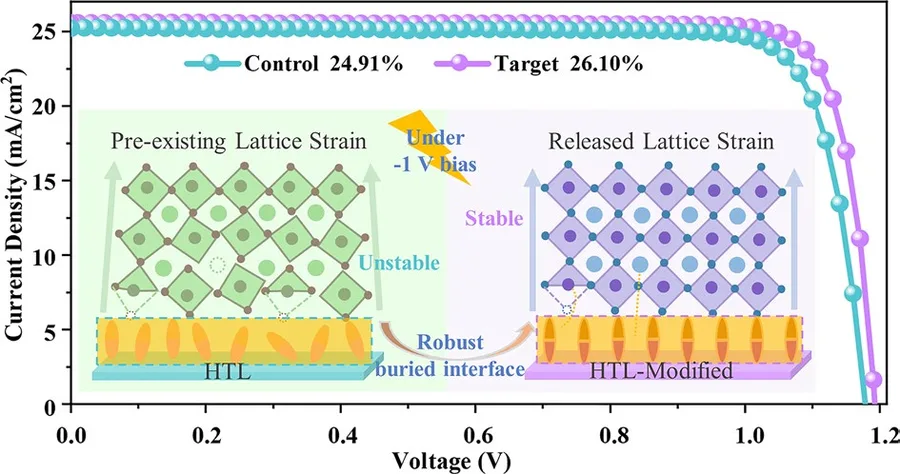
Nature Communications, Published online: 20 April 2026; doi:10.1038/s41467-026-72097-1 Co-deposited perovskite solar cells suffer from self-assemble monolayer (SAM) aggregation that weakens interfacial adhesion and limits performance. Zhuang et al. design an asymmetric SAM and a crosslinking additive to curb aggregation, enabling efficient, stable devices.
Perovskite solar cells shouldn’t work as well as they do—but they do. Scientists have now discovered that defects inside the material actually help, creating networks that separate and guide electric charges efficiently. Using a novel imaging method, they revealed hidden structures acting like charge “highways.” This insight could unlock even more powerful, low-cost solar cells.
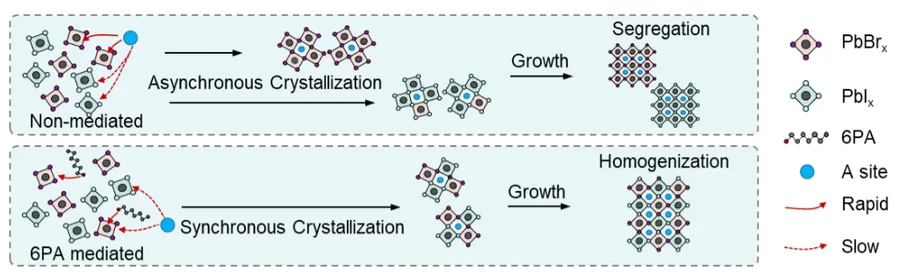
Tandem solar cells (TSCs) comprise two stacked layers, with each subcell absorbing different wavelengths of sunlight, which makes TSCs more efficient than single-layer solar cells. All-perovskite TSCs hold great promise for next-generation photovoltaics, with a theoretical efficiency exceeding 40%. However, their practical performance is hampered by mismatched crystallization kinetics between the…
New research has shown that perovskite solar cells (PSCs) are remarkably resilient to dust during production, challenging the industry belief that high-performance solar technology must be manufactured in sterile and expensive "cleanrooms”.
Tiny crystal “seeds” could solve a hidden flaw in perovskite solar cells—unlocking high efficiency at larger scales. Traditional perovskite solar cells (PSCs) are built with the electron transport layer underneath the perovskite light-absorbing layer and the hole transport layer on top. While this design has delivered strong performance in laboratories, it faces challenges when scaled [...]
FAU team accelerating predictions for environmentally friendly and affordable materials for solar cells Perovskite cells may soon offer an alternative to silicon solar cells. These semiconductors are cheaper to manufacture and feature a high degree of efficiency and a high defect tolerance. This means that defects in the crystal lattice structure barely reduce their performance. […]
A team of researchers from Friedrich-Alexander-Universität Erlangen-Nürnberg (FAU), the Helmholtz Institute Erlangen-Nürnberg for Renewable Energy (HI ERN) and the Karlsruhe Institute of Technology (KIT) have developed a closed process for finding optimal high-performance materials for perovskite solar cells (PSC). The approach introduced in the current Science study combines computer-assisted mo…
Abstract: Silicon solar cells have dominated the science and market for solar cells. Their efficiency was boosted after the passivation of their surface and minimised charge losses at the interface, allowing better contacts to extract the photoelectrical current. In molecular solar cells, either organic or hybrid perovskite-based photoactive layers, selective contacts are paramount to obtain high…
Dyes are generally small molecules that have electronic transitions with energies corresponding to the visible spectrum of light (around 1-3 eV). Around 35 years ago, the idea was put forward, particularly by Michael Grätzel and Brian O'Regan , to couple dye molecules to semiconductors and electrolytes, so that when the dye molecules are excited by light, the electrons/holes can be captured and …
Jose Venegas I spent my summer at the Adolphe Merkle Research Institute in Switzerland, conducting research and development on perovskite solar cells. My professors, Andria Costello Staniec and Zhao Qin, both informed me about this opportunity and provided letters of recommendation. My work aimed to increase their long-term stability by increasing ion-migration resistance through bio-inspired…
With global energy-related carbon dioxide emissions reaching an all-time high in 2021, the need for clean energy is greater than ever. Solar energy is one such alternative to fossil fuels. Solar cells have been created using various materials, but selenium (Se) is popular because it is inexpensive, stable, and non-toxic. Its efficiency, however, is limited [..] The post Selenium Solar Cells – Imp…
Perovskite Solar Cells (PSCs) are a fast-advancing solar technology with a promising combination of high efficiency and low production costs. The big challenge for PSCs is long-term stability and the prevention of degradation by moisture. CarnotCycle is pleased to note that the absolute humidity computation formula published by this blog is proving useful in quantifying […]
Dye-sensitized solar cells (DSSCs) are electrochemical devices that can convert solar energy into electricity. The critical component of a DSSC is its dye molecules which are covalently adsorbed on the electrodes of the DSSC. These molecules are responsible for light absorption and energy conversion in the device. DSSCs are more economical than commercial Si-based solar […]
Researchers create highly efficient and stable tandem solar cell, one of the best-performing reported to date. Researchers from the University of Toronto Engineering and King Abdullah University of Science and Technology (KAUST) have overcome a key obstacle in combining the emerging solar-harvesting technology of perovskites with the commercial gold standard — silicon solar cells. The result is a…
Looking back at 2019, we would like to highlight some of the great research that has been published in RSC Advances over the year. We are proud to present a selection of the most popular 2019 articles published on solar cells so far. We hope you enjoy reading these articles – free to read and […]
As a result of their two-year joint project, the materials researchers of Tallinn University of Technology have improved the efficiency of next generation solar cells by partial substitution of copper with silver in absorber material. Economic development and the general growth in energy consumption have led to an increased demand for environmentally friendly energy production at lower cost. Most…
In a new study, researchers develop a better method to use formamidinium lead iodide to produce solar cells. The new finding may help produce high-quality solar cells. The study was conducted by the University of Groningen scientists. Previous studies have shown that formamidinium lead iodide is a very good material for producing solar cells. It is a perovskite, which is a crystal with a distinct…
The Institute for Solar Energy Research Hamelin (ISFH) in collaboration with Singulus Technologies AG have successfully increased the conversion efficiency of screen-printed silicon solar cells from today’s industry typical 17.0% to 18.5% to a record value of 20.1%, as confirmed by an independent measurement from the Fraunhofer ISE. A novel ICP-AlOx/SiNy double layer at the rear side of the solar…
research.ioSign up to keep scrolling
Create your feed subscriptions, save articles, keep scrolling.