The COUSIN project video, Flagship Crop – Brassica: From Wild Relatives to Future Crops, demonstrates how crop wild relatives can strengthen Brassica crops by improving their resilience, sustainability, and nutritional value, contributing to more resilient, sustainable, and future-proof agriculture across Europe. Brassica crops, including broccoli, cabbage, cauliflower, rapeseed, and many others,…
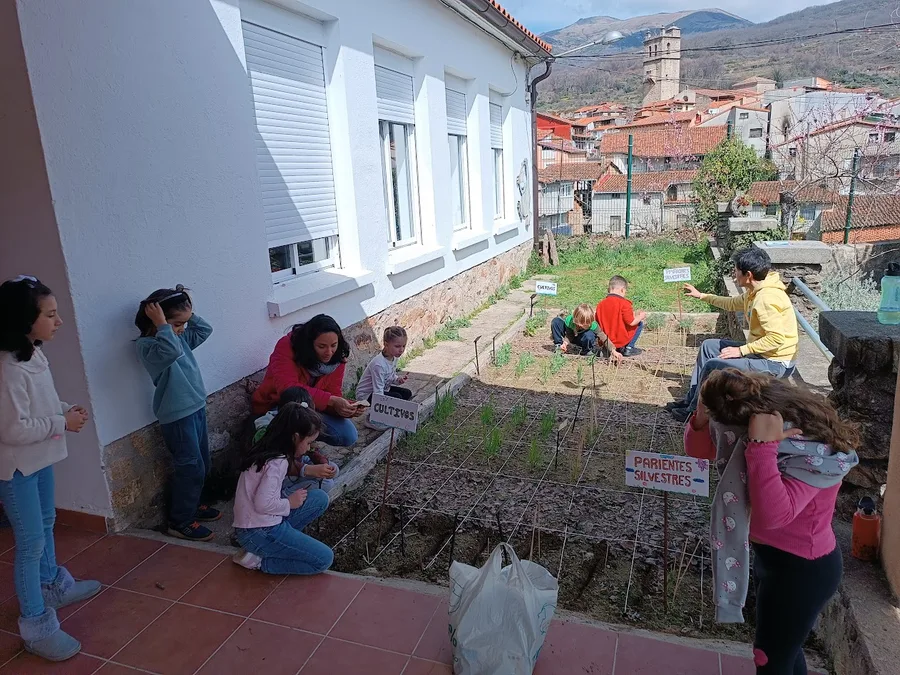
The conservation ofCWRs is closely linked to rural communities, where land use change and rural depopulation can threaten in situ populations. The COUSIN Project demonstrates how participatory education initiatives between researchers and rural schools can raise awareness of CWR value, foster co-creation of learning activities, and strengthen the connection between biodiversity conservation and l…
The transfer of CWRs between institutions is often hindered by inconsistent local identifiers, limiting traceability and data sharing. The COUSIN Project highlights the FAO Global Information System (GLIS) and its Digital Object Identifier (DOI) system as a solution for creating permanent, interoperable identifiers that link CWR material to its associated data across conservation and breeding net…
The effective conservation and use of CWRs requires not only protection in their natural habitats but also standardized data systems for documenting their in situ populations. The COUSIN Project highlights key international and European descriptor frameworks, supporting harmonised recording of CWR populations to ensure data compatibility, traceability, and integration across conservation and bree…
The conservation and collection CWRs are increasingly important for sustainable agriculture and climate resilience, but are governed by complex legal frameworks. The COUSIN Project provides an overview of international and EU regulations, including access and benefit-sharing requirements, supporting compliant and responsible use of CWR genetic resources in research and breeding.
Reliable phenotyping of pea crop wild relatives (CWRs) and breeding progeny is essential for effective selection in plant breeding, but field conditions often limit the assessment of individual plants. The COUSIN Project presents a fence-supported field screening system that improves the evaluation of pea genotypes under realistic growing conditions, enabling more precise selection for plant arch…
Modern crops have lost valuable genetic diversity through domestication, while crop wild relatives (CWRs) retain traits important for resilience and adaptation. The COUSIN Project provides high-quality genomic resources and maps for multiple CWR species, enabling the identification of beneficial genes and supporting their targeted introgression into modern crops to accelerate breeding for improve…
Crop wild relatives (CWRs) and CWR-derived materials from barley, wheat, pea and lettuce offer underused potential for innovative food product development. The COUSIN Project demonstrates how these resources can be incorporated into a range of food applications, supporting the creation of more diverse, nutritious and sustainable food systems.
Barley crop wild relatives (CWRs) offer valuable genetic diversity for improving the nutritional quality of future barley varieties. The COUSIN Project highlights variation in key nutritional traits, supporting the identification of promising breeding materials for healthier, more resilient, and sustainable cropping and food systems.
Lactuca serriola, a crop wild relative, shows valuable traits for phosphorus use efficiency under nutrient stress. The COUSIN Project identifies genetic markers linked to improved photosynthesis and nutrient uptake, enabling breeders to develop resilient lettuce varieties with lower fertiliser needs.
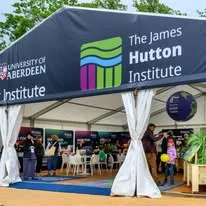
COUSIN partners from the James Hutton Institute presented findings from their work in the project on developing novel crosses between CWRs of barley and elite lines at the Royal Highland Show. The event took place in Edinburgh, UK between June 18th-21st 2026 and we demonstrated that our redomestication approach can unlock diversity for stress resilience […]
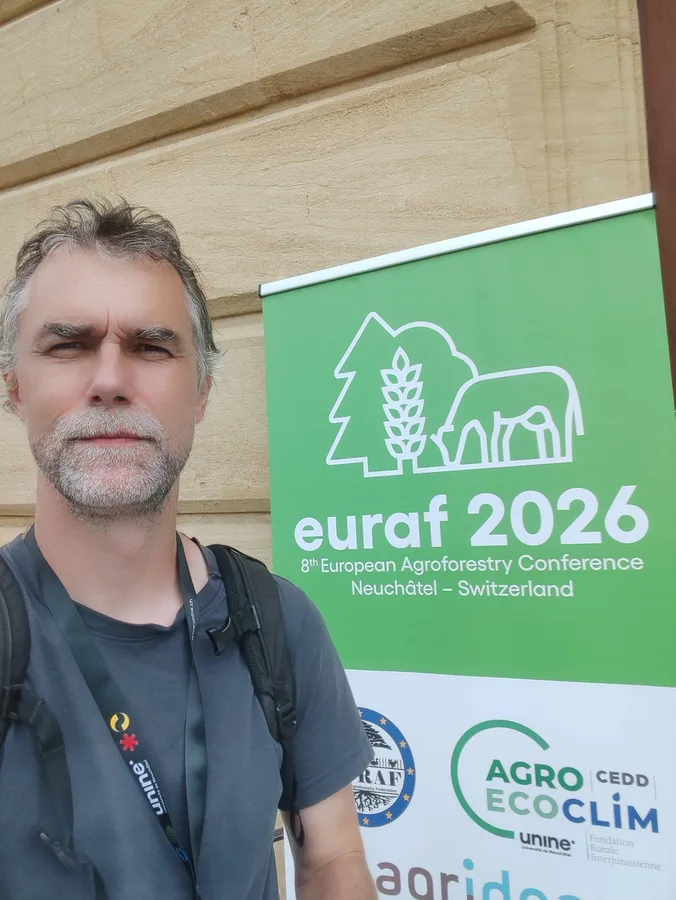
At the 8th European conference organized by the European Agroforestry Federation in Neuchâtel, Switzerland, Christian Schöb (Universidad Rey Juan Carlos) presented an invited talk in the session “More than simple: increasing tree and shrub complexity in agroforestry” and presented results on complementarity and facilitation mechanisms in polycultures and how to harness diversity in ag…
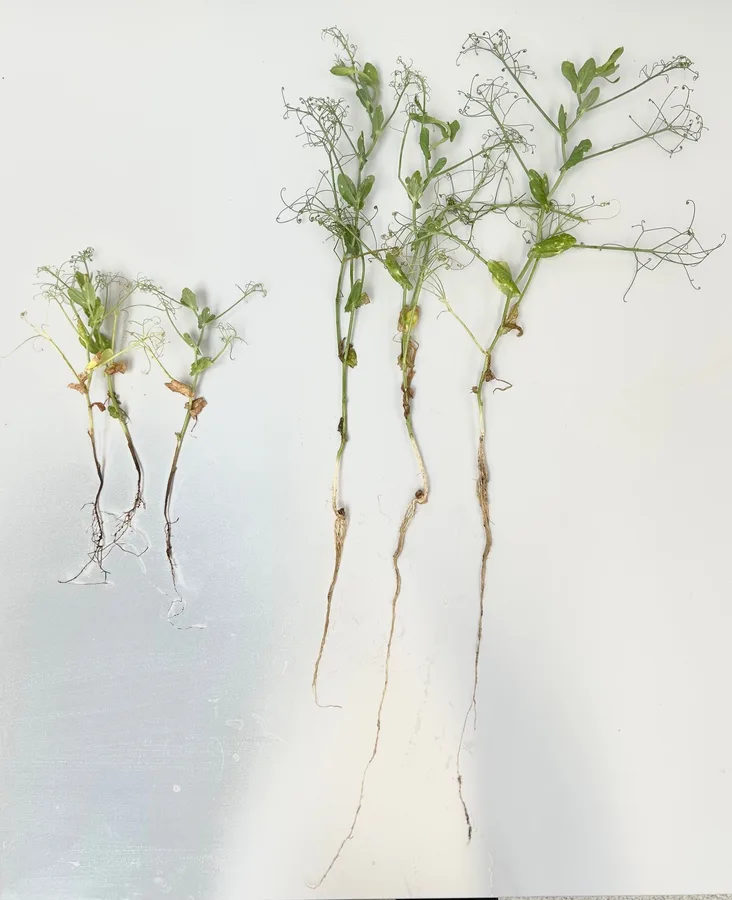
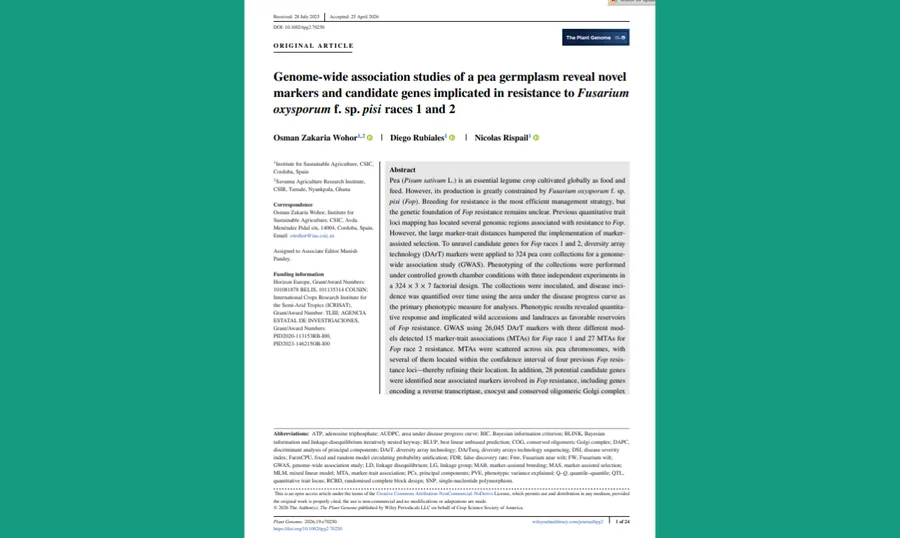
On May 2026, the scientific journal “The Plant Genome” published an article written by Osman Zakaria Wohor, Diego Rubiales, Nicolas Rispail entitled “Genome-wide association studies of a pea germplasm reveal novel markers and candidate genes implicated in resistance to Fusarium oxysporum f. sp. pisi races 1 and 2″. AbstractPea (Pisum sativum L.) is an essential legume cro…
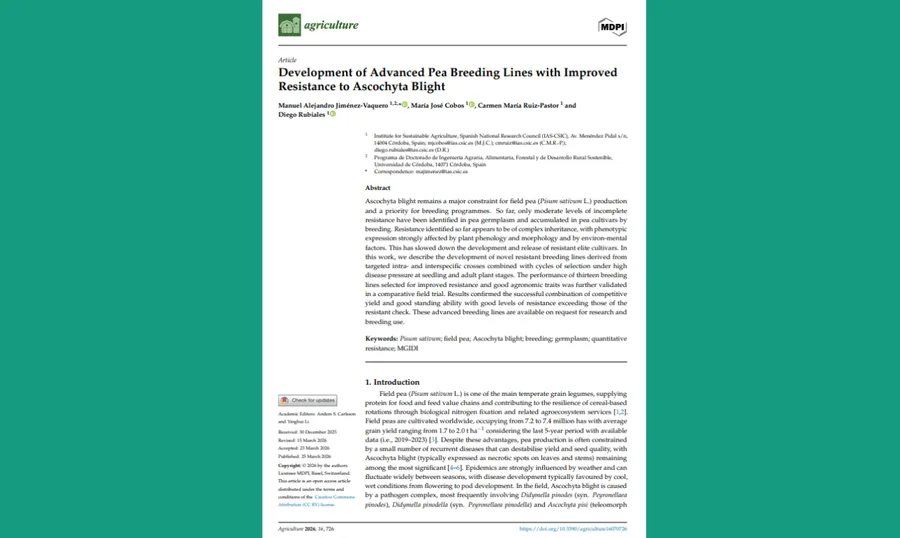
On March 2026, the scientific journal “Agriculture” published an article written by Manuel Alejandro Jiménez-Vaquero,María José Cobos,Carmen María Ruiz-Pastor, and Diego Rubiales entitled “Development of Advanced Pea Breeding Lines with Improved Resistance to Ascochyta Blight” Abstract Ascochyta blight remains a major constraint for field pea (Pisum sativum L.) produ…
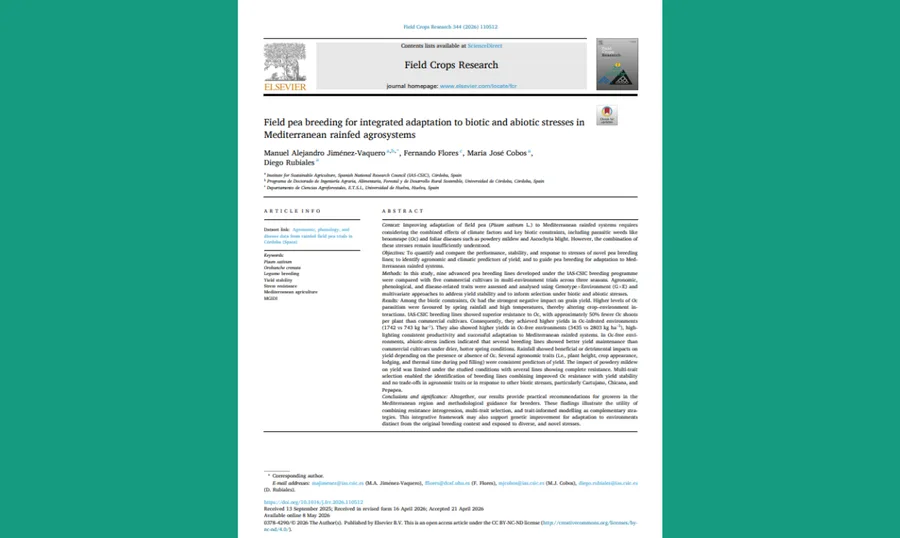
On June 15th, the scientific journal “Field Crops Research” published an article written by Manuel Alejandro Jiménez-Vaquero, Fernando Flores, Maria José Cobos, Diego Rubiales entitled “Field pea breeding for integrated adaptation to biotic and abiotic stresses in Mediterranean rainfed agrosystems” AbstractImproving adaptation of field pea (Pisum sativum L.) to Mediterran…
With the end of the school year, a wonderful educational experience also came to a close, involving students and teaching staff from the Russell Newton institute in a journey to discover biodiversity and the origins of our crops. The initiative, carried out within the framework of the COUSIN Project in collaboration with the partner Rete […]
The third COUSIN Annual Meeting took place from 25 to 27 May in Scandicci, Italy, and was hosted by the project partner Rete Semi Rurali. The event brought together representatives from across the consortium to review project achievements, exchange knowledge, and jointly plan the next phases of the project. COUSIN activities had already begun during […]
Elisa Pizarro Carbonell of Aprisco participated in the roundtable discussion on the topic “Biodiversity Management in Agroecosystems: Keys to Climate Resilience” as part of the Conference on Agroecology organized by the SEAE in Pamplona from April 22 to 25. Elisa Pizarro’s presentation, delivered alongside Christian Schöb and titled “BiodivRURAL: A Thousand and One Ways to […]
As part of the 4th edition of Inventar a Alimentação do Futuro (“Inventing the Food of the Future”), promoted by the Escola Superior de Biotecnologia, several student groups took part in an activity designed to encourage reflection on the links between food, health, sustainability and innovation. Among the different possible categories, some groups chose to […]

 research.io