I understand the concept of excess charge to be on the outside surface of the conductor. What happens if conductor is a 2 dimensional conducting Disk and 1 dimensional conducting needle? I am reading Griffiths and he seems to mention in a footnote that above cases will different without giving much details.
Around 1600, William Gilbert invented the versorium, the first electroscope, to detect static electric charges. The English physician and natural philosopher studied electricity and magnetism through experiments. His work helped separate magnetism from static electricity. He also argued that Earth is a giant magnet and used a terrella to demonstrate how magnetic behavior works.
As the figure shows, I have a 2D image of a conductor seen from the front. It is located a height, h1 , above a grounded plane of infinite area. The conductor has a voltage, Vc , as shown. Around the conductor is air. The conductor has a radius, r , but is so narrow that it does not effect the forming of the electrical field. The ground plane however will (as shown in the figure) effect how the e…
In Griffiths, it is noted that there is a discontinuity in the electric field for a material with a surface charge density. What is the significance of this boundary condition in practicality when calcuating the electric fields of say, a conductor, where all the charge is located at the surface (because there can be no electric field in the "meat" of the conductor)? For instance, say I want to fi…
An early physics demonstration that many of us see in elementary school is that of static electricity : an electrical insulator like a wool cloth or animal fur is rubbed on a glass or plastic rod, and suddenly the rod can pick up pieces of styrofoam or little bits of paper. Alternately, a rubber balloon is rubbed against a kid's hair, and afterward the balloon is able to stick to a wall with su…
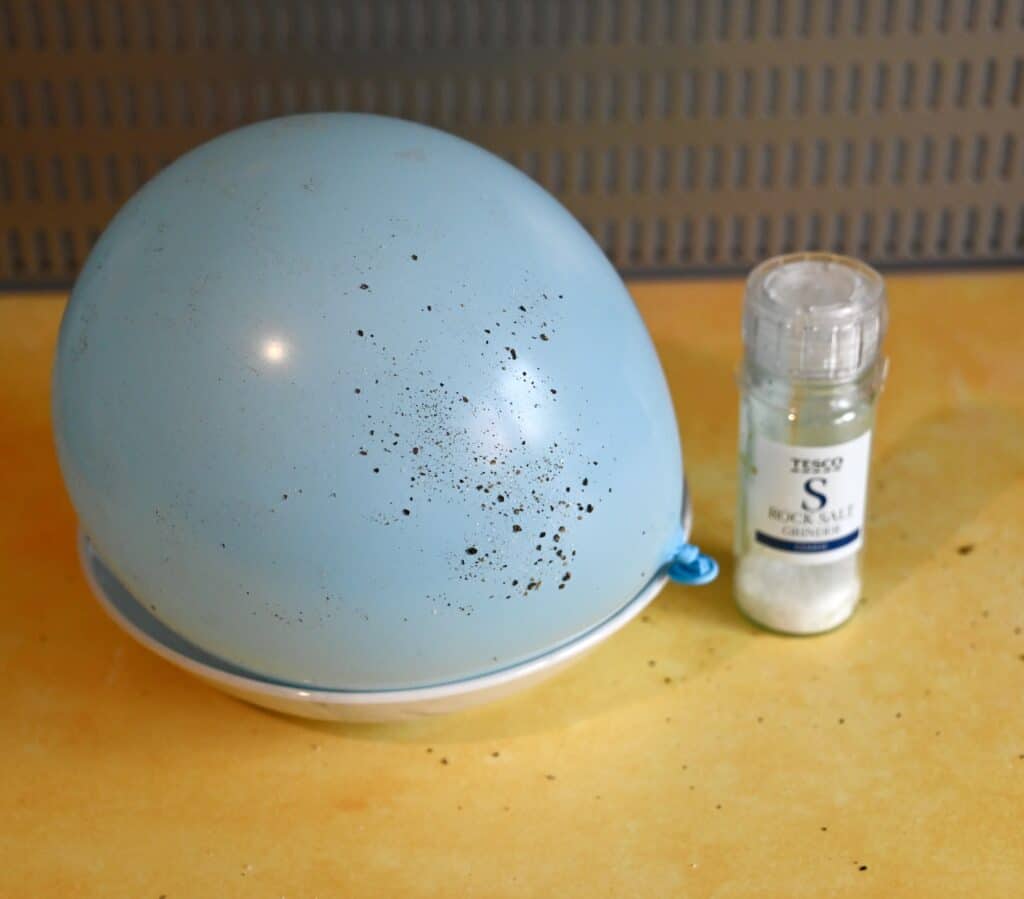
Did you know you can separate salt and pepper with static electricity? It works because pepper is lighter than salt, so while both salt and pepper are attracted to an object charged with static electricity, only the lighter pepper jumps up.
Static electricity is the build-up of electrical charge on the surface of an object. It is created when objects are rubbed together or pulled apart. Positive …
Static electricity is the thing that sometimes gives you a little shock when you touch a metal door handle after walking on a carpet. It makes your hair stand on end when you put a woolly jumper on and can be used for lots of fun science experiments and demonstrations. This static electricity demonstration shows […] The post How to bend water with static electricity appeared first on Science Expe…