I have not actually seen more panic online and in real life than what happened this week after Jacob Coxon resigned from Anthropic.
I don’t need to add to this debate. I just want to give my subscribers —and anyone else you know that might need this, please send it to them —some snippets and articles that will counteract the media cycle heightened emotions on this issue.
Shae O. wrote an excellen…
Hi Folks!
If you are receiving this email, you are a paid subscriber to AIs without minds, thank you for being here! I’m writing to let you know I’ll be doing an AMA live in a few weeks, either on Sep 22nd or Sep 24th, at 5 pm. This will also be a chance for us to chat live! which we haven’t yet done.
For those interested, I’d love for you to fill out t…
(1) First Up, Some Media I’ve Done Recently
Be sure to check these out for more of my thoughts on AI consciousness, intelligence, and more!
(2) A Podcast On AGI
I really loved listening to this podcast episode. It’s one where three different thinkers on the effects of AGI are interviewed, all with very different opinions on it. I wanted to link the podcast episode, but it wasn’t working (YouTube…
In recent interviews, Hinton has unabashedly spoken of AI being conscious, among many other claims, such as worrying that AI will fool humans into ceding power to AIs against our best interests, and that AIs ‘really understand’ us.
Welcome to the August 26’ round up! Each month, I go through papers, essay, cases, any interesting work that touches on the AI mind debates. I pick four or so of them and write short commentary. These are not summaries, but philosophical analysis.
This month’s reading includes (1) Chiang on AI Consciousness (2) Strategic Polysemy in AI Discourse (3) Anthropic’s Agentic Misalignment work and recen…
This is the first post in a series I’m trying out, preliminarily called an ‘autopsy’ of AI lab research papers and other documents related to all things minds in the AI space
Welcome to the July 26’ roundup! This is the first monthly roundup for paid subscribers to AIs Without Minds. I am so glad to have you here ✨
Here is how this works: Each month I’ll go through papers, essays, cases, etc that touch on the consciousness debate, the vocabulary being used to describe AI systems, or the real-world consequences of either.
I pick four or so and write short commentary on…
A new interpretability paper makes a technical discovery. Then it frames the finding in terms of Global Workspace Theory.
This framing is completely irrelevant to the findings. To understand this argument, let’s take a quick look at how large language models work.
When a large language model processes a sentence, each word or piece of a word – a ‘token’ -- gets converted into a vector, a list of …
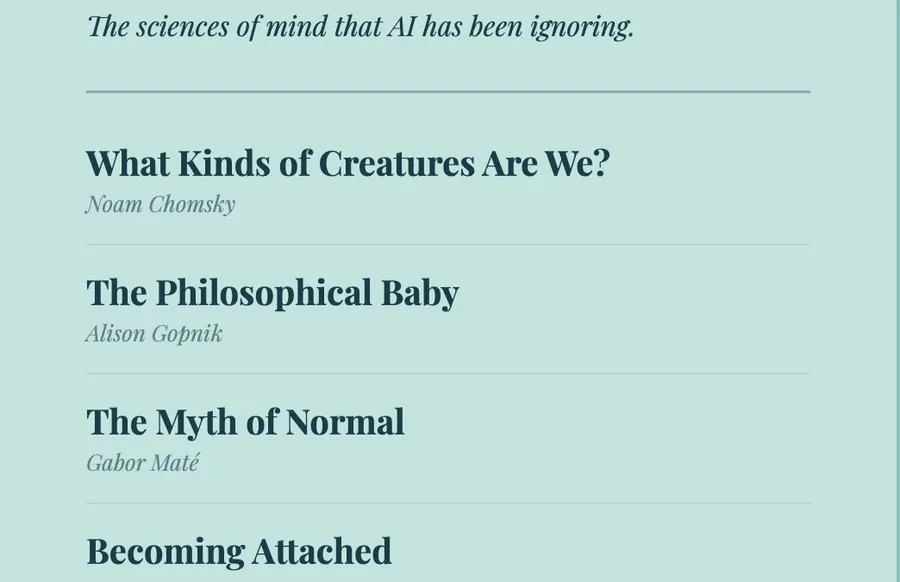
I’m having one of those moments — that LLMs can’t have because they are sophisticated technologies — realising that the antidote to AI and cognitive science monopolising our imaginations about minds, calls for de-centering AI and cognitive science discourse, and centering all of the other incredible sciences of mind/brain that gets ignored. To kick us off, here are five fascinating books on the w…
Richard Dawkins said Claude is conscious. The internet laughed. My take? Dawkins is the most honest voice in this debate — and his critics, who follow the same broken framework while stopping just short of his conclusion, haven’t seemed to notice what their own framework in fact suggests.
Here is Dawkins on machine consciousness, he says: “If these machines are not conscious, what more could it p…
I’ll Learn About The Unconscious Mind in Philosophy, Right?
A few different things drew me to want to study the philosophy of mind. One of them was learning about language (see here, for why) and another was a fascination with the mind in general. But to me, a prime reason the mind was so interesting was because of the effects of the unconscious mind.
I arrived to the philosophy of mind, naive, a…












 research.io