


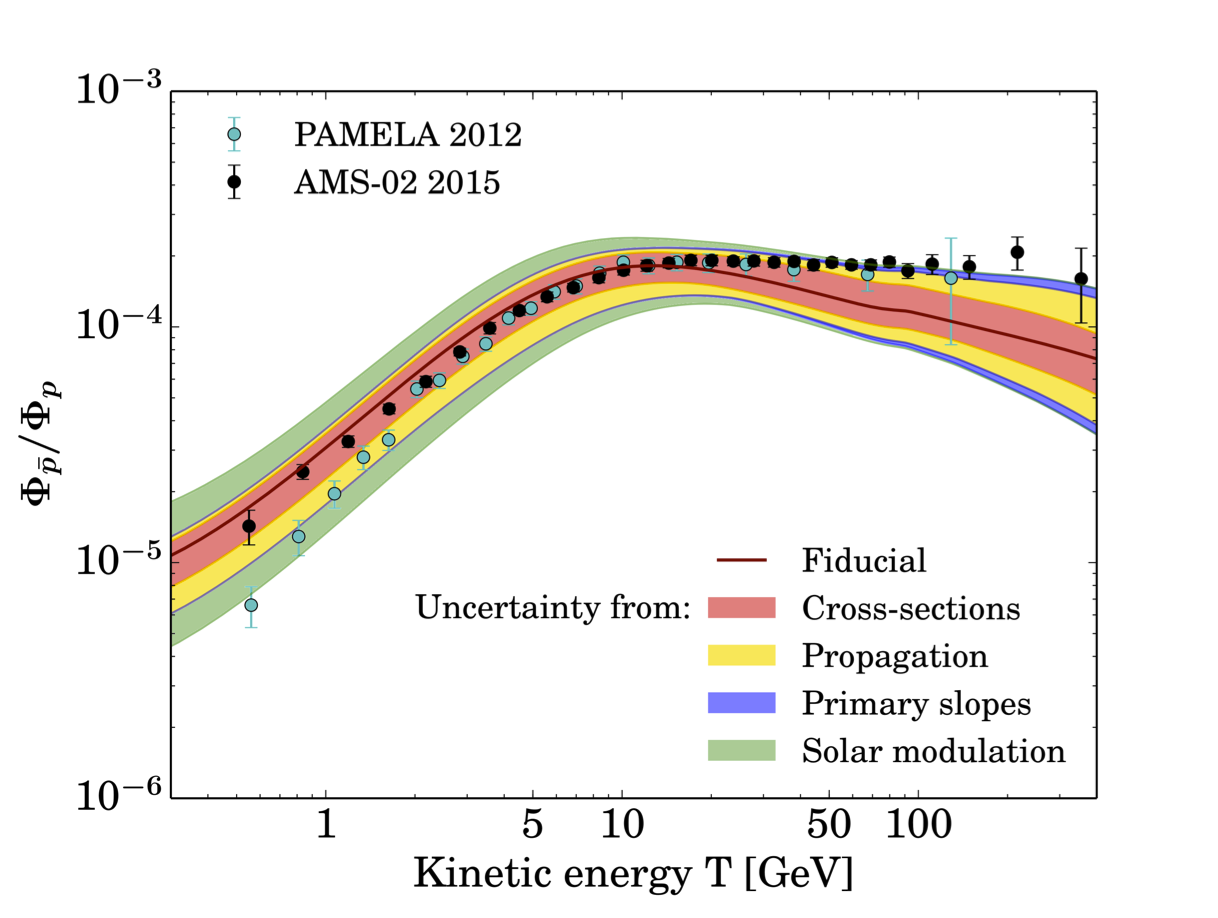
This week the AMS collaboration released the long expected measurement of the cosmic ray antiproton spectrum. Antiprotons are produced in our galaxy in collisions of high-energy cosmic rays with interstellar matter, the so-called secondary production. Annihilation of dark matter could add more antiprotons on top of that background, which would modify the shape of the spectrum with respect to the prediction from the secondary production. Unlike for cosmic ray positrons, in this case there should be no significant primary production in astrophysical sources such as pulsars or supernovae. Thanks to this, antiprotons could in principle be a smoking gun of dark matter annihilation, or at least a powerful tool to constrain models of WIMP dark matter. The new data from the AMS-02 detector extend the previous measurements from PAMELA up to 450 GeV and significantly reduce experimental errors at high energies. Now, if you look at the promotional material, you may get an impression that a clear signal of dark matter has been observed. However, experts unanimously agree that the brown smudge in the plot above is just shit, rather than a range of predictions from the secondary production. At this point, there is certainly no serious hints for dark matter contribution to the antiproton flux. A quantitative analysis of this issue appeared in a paper today. Predicting the antiproton spectrum is subject to large experimental uncertainties about the flux of cosmic ray proton and about the nuclear cross sections, as well as theoretical uncertainties inherent in models of cosmic ray propagation. The data and the predictions are compared in this Jamaican band plot. Apparently, the new AMS-02 data are situated near the upper end of the predicted range. Thus, there is no currently no hint of dark matter detection. However, the new data are extremely useful to constrain models of dark matter. New constraints on the annihilation cross section of dark matter are shown in the plot to the right. The most stringent limits apply to annihilation into b-quarks or into W bosons, which yield many antiprotons after decay and hadronization. The thermal production cross section - theoretically preferred in a large class of WIMP dark matter models - is in the case of b-quarks excluded for the mass of the dark matter particle below 150 GeV. These results provide further constraints on models addressing the hooperon excess in the gamma ray emission from the galactic center. More experimental input will allow us to tune the models of cosmic ray propagation to better predict the background. That, in turn, should lead to more stringent limits on dark matter. Who knows... maybe a hint for dark matter annihilation will emerge one day from this data; although, given the uncertainties, it's unlikely to ever be a smoking gun. Thanks to Marco for comments and plots.
Antiprotons from AMS
Jester (noreply@blogger.com)