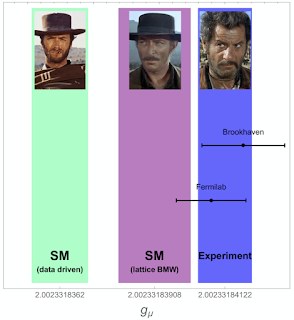
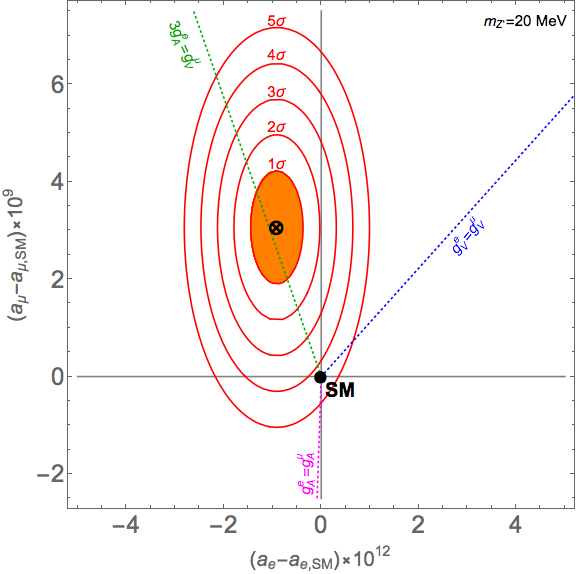
April 7, 2021 was like a good TV episode: high-speed action, plot twists, and a cliffhanger ending. We now know that the strength of the little magnet inside the muon is described by the g-factor:
g = 2.00233184122(82).
Any measurement of basic properties of matter is priceless, especially when it come with this incredible precision. But for a particle physicist the main source of excitement is t…
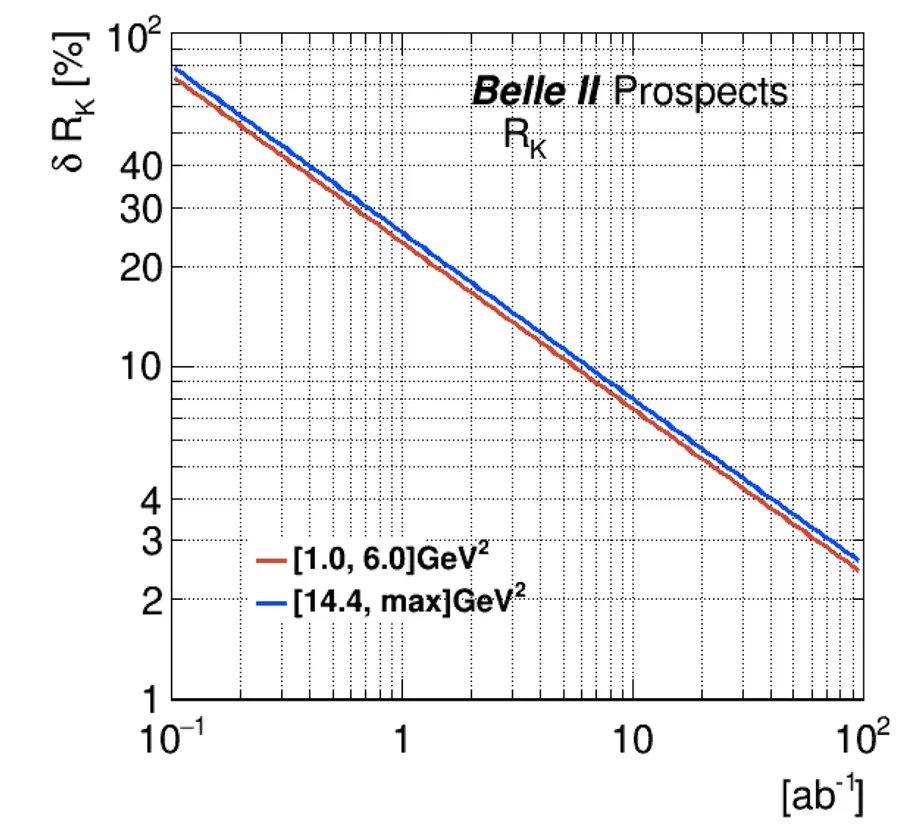
The hashtag #CautiouslyExcited is trending on Twitter, in spite of the raging plague. The updated RK measurement in LHCb has made a big splash and has been covered by every news outlet. RK measures the ratio of the B->Kμμ and B->Kee decay probabilities, which the Standard Model predicts to be very close to one. Using all the data collected so far, LHCb instead finds RK = 0.846 with the error of 0…
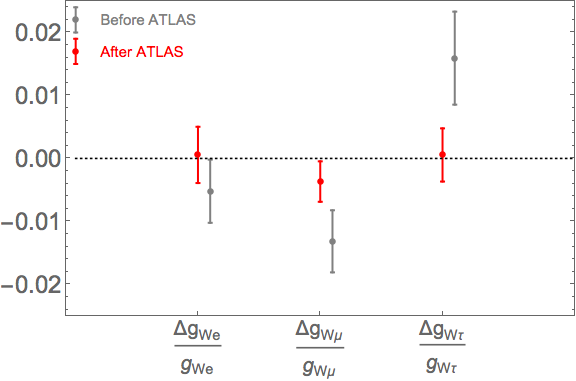
Anomalies come with a big splash, but often go down quietly. A recent ATLAS measurement, just posted on arXiv, killed a long-standing and by now almost forgotten anomaly from the LEP collider. LEP was an electron-positron collider operating some time in the late Holocene. Its most important legacy is the very precise measurements of the interaction strength between the Z boson and matter, which t…
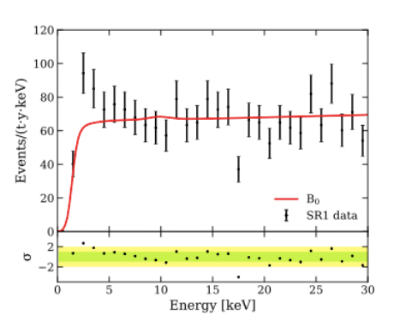
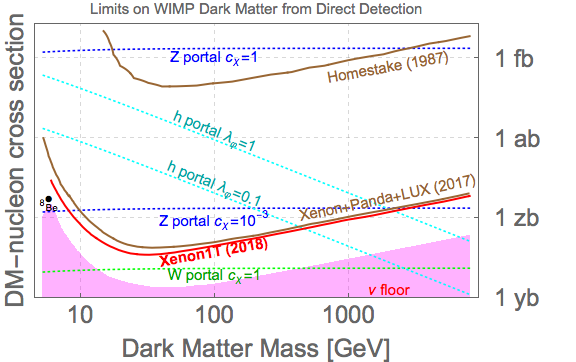
The XENON collaboration was operating a 1-ton xenon detector in an underground lab in Italy. Originally, this line of experiments was devised to search for hypothetical heavy particles constituting dark matter, so called WIMPs. For that they offer a basically background-free environment, where a signal of dark matter colliding with xenon nuclei would stand out like a lighthouse. However all WIMP …
Everybody knows the first 3 digits of the Rydberg constant, Ry≈13.6 eV, but actually it is experimentally known with the fantastic accuracy of 0.006 ppb, and the electron-to-atom mass ratio has also been determined precisely. Thus the measurement of the cesium mass can be translated into a 0.2 ppb measurement of the fine structure constant: 1/α=137.035999046(27).
You may think that this kind of r…
To detect WIMPs heavier than a few GeV, currently the most successful strategy is to use huge detectors filled with xenon atoms, hoping one of them is hit by a passing dark matter particle. Xenon1T beats the competition from the LUX and Panda-X experiments because it has a bigger
What we are learning about WIMPs is how they can (or cannot) interact with us. Of course, at this point in the game we…
Wednesday, 16 May 2018
Proton's weak charge, and what's it for
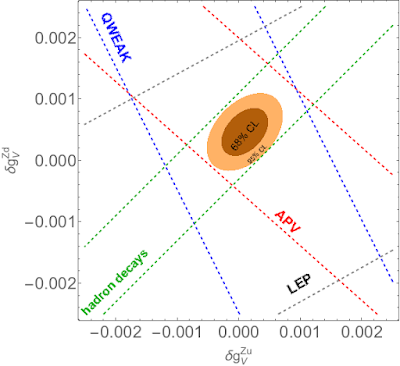
In the particle world the LHC still attracts the most attention, but in parallel there is ongoing progress at the low-energy frontier. A new episode in that story is the Qweak experiment in Jefferson Lab in the US, which just published their final results. Qweak was shooting a beam of 1 GeV electrons on a hydrogen (so basically proton…
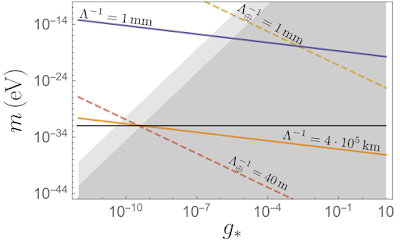
Proving Einstein wrong is the ultimate ambition of every crackpot and physicist alike. In particular, Einstein's theory of gravitation - the general relativity - has been a victim of constant harassment. That is to say, it is trivial to modify gravity at large energies (short distances), for example by embedding it in string theory, but it is notoriously difficult to change its long distance beha…
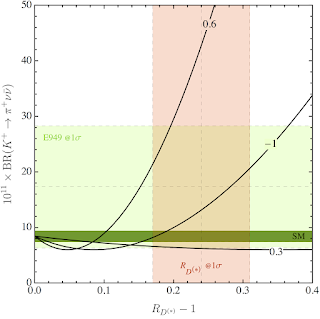
NA62 is a precision experiment at CERN. From their name you wouldn't suspect that they're doing anything noteworthy: the collaboration was running in the contest for the most unimaginative name, only narrowly losing to CMS... NA62 employs an intense beam of charged kaons to search for the very rare decay K+ → 𝝿+ 𝜈 𝜈. The Standard Model predicts the branching fraction BR(K+ → 𝝿+ 𝜈 𝜈) = 8.4x10^-11 …
Artificial intelligence (AI) is entering into our lives. It's been 20 years now since the watershed moment of Deep Blue versus Garry Kasparov. Today, people study the games of AlphaGo against itself to get a glimpse of what a superior intelligence would be like. But at the same time AI is getting better in copying human behavior. Many Apple users have got emotionally attached to Siri. Computers h…
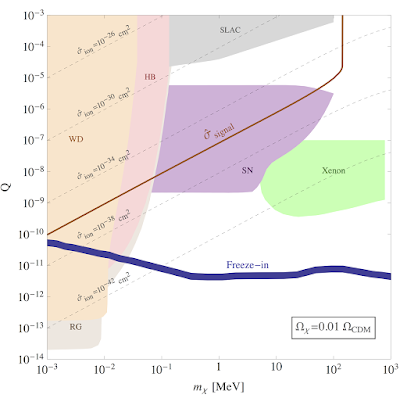
The EDGES discovery of the 21cm absorption line at the cosmic dawn has been widely discussed on blogs and in popular press. Quite deservedly so. The observation opens a new window on the epoch when the universe as we know it was just beginning. We expect a treasure trove of information about the standard processes happening in the early universe, as well as novel constraints on hypothetical parti…
- (h→bb): Decays to b-quarks.
- (Vh): Associated production with W or Z boson.
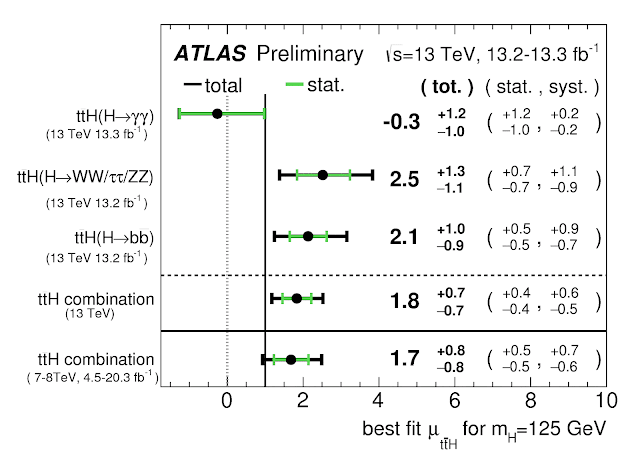
- (tth): Associated production with top quarks.
It seems that the last objective may be achieved quicker than expected. The tth production process is very interesting theoretically, because its rate is proportional to the (square of the) Yukawa coupling between the Higgs boson and top quarks. Within the Standard Model,…
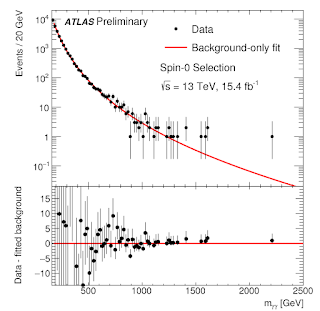
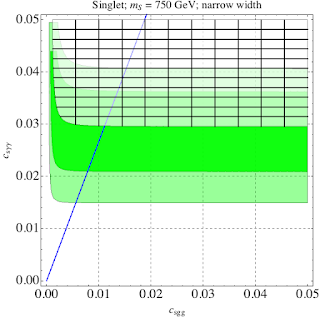
The loss of the 750 GeV diphoton resonance is a big blow to the particle physics community. We are currently going through the 5 stages of grief, everyone at their own pace, as can be seen e.g. in this comments section. Nevertheless, it may already be a good moment to revisit the story one last time, so as to understand what went wrong.
In the recent years, physics beyond the Standard Model has s…
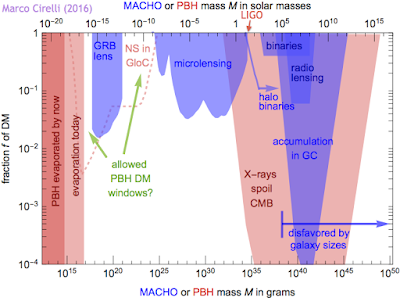
The idea that dark matter is made of primordial black holes is very old but has always been in the backwater of particle physics. The WIMP or asymmetric dark matter paradigms are preferred for several reasons such as calculability, observational opportunities, and a more direct connection to cherished theories beyond the Standard Model. But in the recent months there has been more interest, trigg…
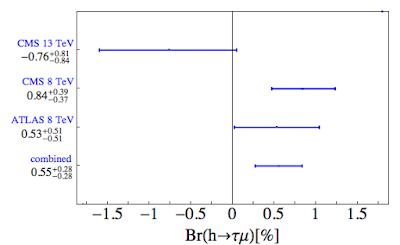
One interesting anomaly in the LHC run-1 was a hint of Higgs boson decays to a muon and a tau lepton. Such process is forbidden in the Standard Model by the conservation of muon and tau lepton numbers. Neutrino masses violate individual lepton numbers, but their effect is far too small to affect the Higgs decays in practice. On the other hand, new particles do not have to respect global symmetrie…
This Thursday the ATLAS and CMS experiments will present updated analyses of the 750 GeV diphoton excess. CMS will extend their data set by the diphoton events collected in the periods when the detector was running without the magnetic field (which is not essential for this particular study), so the amount of available data will slightly increase. We will then enter the Phase-II of the excitement…
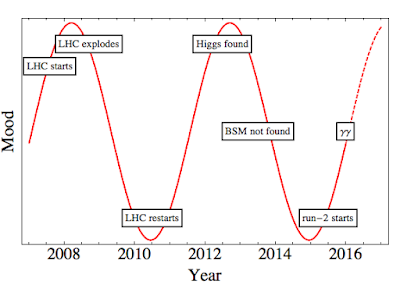
The year 2016 began as any other year... I mean the hangover situation in particle physics. We have a theory of fundamental interactions - the Standard Model - that we know is certainly not the final theory because it cannot account for dark matter, matter-antimatter asymmetry, and cosmic inflation. At the same time, the Standard Model perfectly describes any experiment we have performed here on…
ATLAS and CMS presented today a summary of the first LHC results obtained from proton collisions with 13 TeV center-of-mass energy. The most exciting news was of course the 3.6 sigma bump at 750 GeV in the ATLAS diphoton spectrum, roughly coinciding with a 2.6 sigma excess in CMS. When there's an experimental hint of new physics signal there is always this set of questions we must ask: 0. WTF ? 0…
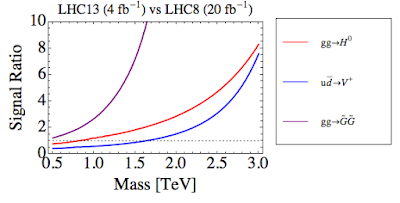
A week ago the LHC finished the 2015 run of 13 TeV proton collisions. The counter in ATLAS stopped exactly at 4 inverse femtobarns. CMS reports just 10% less, however it is not clear what fraction of these data is collected with their magnet on (probably about a half). Anyway, it should have been better, it could have been worse... 4 fb-1 is one fifth of what ATLAS and CMS collected in the glo…
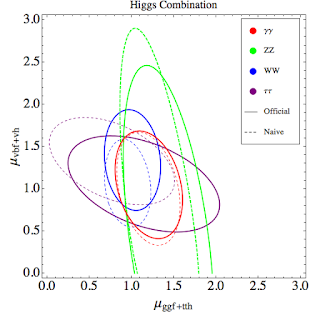
Recently, ATLAS and CMS released the first combination of their Higgs results. Of course, one should not expect any big news here: combination of two datasets that agree very well with the Standard Model predictions has to agree very well with the Standard Model predictions... However, it is interesting to ask what the new results change at the quantitative level concerning our constraints on Hi…


 research.io