


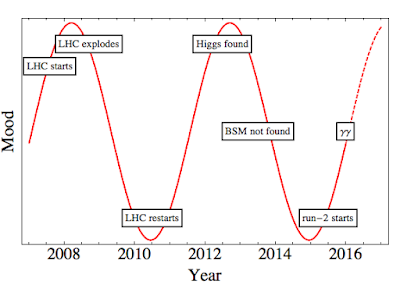
The year 2016 began as any other year... I mean the hangover situation in particle physics. We have a theory of fundamental interactions - the Standard Model - that we know is certainly not the final theory because it cannot account for dark matter, matter-antimatter asymmetry, and cosmic inflation. At the same time, the Standard Model perfectly describes any experiment we have performed here on Earth (up to a few outliers that can be shrugged off as statistical fluctuations)... If you're having a déjà vu, maybe it's the Monty Python sketch , or maybe because this post begins exactly the same as one written a year ago . Back then, I was optimistically assuming that the 2015 LHC operation would go better than the projections, and that some 15 inverse femtobarn of data would be collected by each experiment. That amount would have clarified our chances for a discovery in the LHC run-2, and determine whether or not we should dust off our No Future t-shirts. Instead, due to machine's hiccups during the summer, only about 4 fb-1 was delivered to each experiment. This added up to the magnet and calorimeters problems in the CMS experiment who managed to collect only 2.4 fb-1 of useful data, against 3.6 fb-1 in ATLAS. With that amount, the discriminating power is improved with respect to run-1 only for particles heavier than ~1 TeV. As a consequence, the boundaries of our knowledge have changed only slightly compared to the status a year ago. At the end of the day, it's this year, and not the previous one, that is going to be decisive for the field. So the tension is similar as last year at this time, however the mood is considerably better, see the plot. We have two intriguing hints of new physics that have a non-negligible chance to develop into a strong evidence: one is the B-meson anomalies discussed several times in this blog, and the other is the 750 GeV diphoton excess . Especially the latter stirs theorists' imagination, even if some experimentalists deplore the fact (theorists writing papers inspired by experimental data? oh horror...). A significant deviation from the Standard Model seen independently by 2 different collaborations in an experimentally clean channel happens for the first time in my life. In my private poll, the chances for the B-meson anomalies to be new physics are estimated as 1%, while for the diphoton the chances are 10%. This adds up to a whopping 11% chance, the biggest ever, of finding new physics soon. Moreover, if the diphoton excess is really a new particle, we are basically guaranteed to find other phenomena beyond the Standard Model. Indeed, most models accommodating the 750 GeV excess require new colored states with O(1) TeV mass, which are then most naturally embedded in a theory with new strong interactions at a few TeV scale. Not only would that give a boost to future LHC analyses, but it would also motivate building a higher-energy collider, e.g. a 30 TeV collider that could be constructed at a short time scale at CERN. Anything may happen this year, for good or for worse. Cross your fingers and fasten your seat belts.
Do-or-die year
Jester (noreply@blogger.com)