


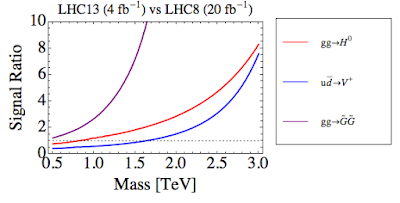
A week ago the LHC finished the 2015 run of 13 TeV proton collisions. The counter in ATLAS stopped exactly at 4 inverse femtobarns. CMS reports just 10% less, however it is not clear what fraction of these data is collected with their magnet on (probably about a half). Anyway, it should have been better, it could have been worse... 4 fb-1 is one fifth of what ATLAS and CMS collected in the glorious year 2012. On the other hand, the higher collision energy in 2015 translates to larger production cross sections, even for particles within the kinematic reach of the 8 TeV collisions. How this trade off work in practice depends on the studied process. A few examples are shown in the plot below We see that, for processes initiated by collisions of a quark inside one proton with an antiquark inside the other proton, the cross section gain is the least favorable. Still, for hypothetical resonances heavier than ~1.7 TeV, more signal events were produced in the 2015 run than in the previous one. For example, for a 2 TeV W-prime resonance, possibly observed by ATLAS in the 8 TeV data, the net gain is 50%, corresponding to roughly 15 events predicted in the 13 TeV data. However, the plot does not tell the whole story, because the backgrounds have increased as well. Moreover, when the main background originates from gluon-gluon collisions (as is the case for the W-prime search in the hadronic channel), it grows faster than the signal. Thus, if the 2 TeV W' is really there, the significance of the signal in the 13 TeV data should be comparable to that in the 8 TeV data in spite of the larger event rate. That will not be enough to fully clarify the situation, but the new data may make the story much more exciting if the excess reappears; or much less exciting if it does not... When backgrounds are not an issue (for example, for high-mass dilepton resonances) the improvement in this year's data should be more spectacular. We also see that, for new physics processes initiated by collisions of a gluon in 1 proton with another gluon in the other proton, the 13 TeV run is superior everywhere above the TeV scale, and the signal enhancement is more spectacular. For example, at 2 TeV one gains a factor of 3 in signal rate. Therefore, models where the ATLAS diboson excess is explained via a Higgs-like scalar resonance will be tested very soon. The reach will also be extended for other hypothetical particles pair-produced in gluon collisions, such as gluinos in the minimal supersymmetric model. The current lower limit on the gluino mass obtained by the 8 TeV run is m≳1.4 TeV (for decoupled squarks and massless neutralino). For this mass, the signal gain in the 2015 run is roughly a factor of 6. Hence we can expect the gluino mass limits will be pushed upwards soon, by about 200 GeV or so. Summarizing, we have a right to expect some interesting results during this winter break. The chances for a discovery in this year's data are non-zero, and chances for a tantalizing hints of new physics (whether a real thing or a background fluctuation) are considerable. Limits on certain imaginary particles will be somewhat improved. However, contrary to my hopes/fears , this year is not yet the decisive one for particle physics. The next one will be.
A year at 13 TeV
Jester (noreply@blogger.com)