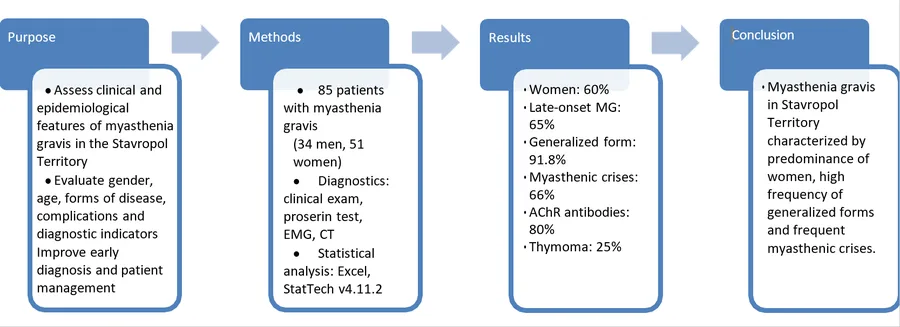
Myasthenia gravis (MG) is an autoimmune disease characterized by a disorder of neuromuscular transmission.Purpose. The aim of the study was to investigate the clinical and epidemiological features of myasthenia in the Stavropol Territory (ST).Material and methods. The study was based on an analysis of the medical records of 85 patients diagnosed with myasthenia gravis. The diagnosis was verified based on the patient's medical history, clinical and neurological examination, proserin test results, electromyography (decrement test), and computed tomography (CT) scan of the mediastinal organs. Myasthenia severity was assessed using the Myasthenia Gravis Foundation of America (MGFA) classification. Statistical data processing was performed using Microsoft Office Excel 2010 and StatTech v. 4.11.2.Results. It was established that the disease occurred more frequently in women (60%), with late-onset MG (after age 50) in 47.1% and a generalized form in 91.8%. Thymoma was detected in 25% of patients, and elevated titers of acetylcholine receptor antibodies were found in 80%. Myasthenic crises were observed in 66% of patients, occurring 1–2 times per year. Conclusion. Myasthenia gravis in the Stavropol Krai is characterized by a predominance of late onset, a higher prevalence among women, a high frequency of generalized forms, and a significant number of myasthenic crises. The data obtained support the need for early diagnosis and the development of regional registries to optimize patient monitoring and treatment.