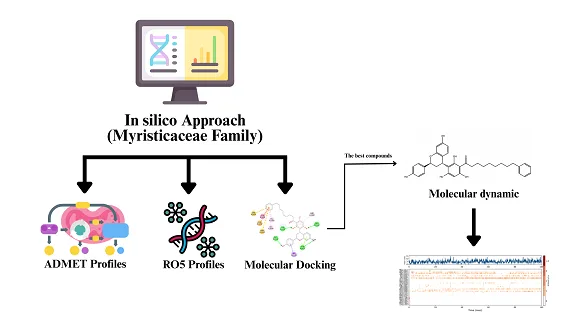
Diabetes mellitus (DM) has emerged as an international health issue due to its rapidly rising incidence. Uncontrolled diabetes leads to hyperglycemia, or elevated blood glucose levels, which can damage several body systems, including blood vessels and neurons. This study aims to predict the potential of 10 compounds, including chalcones, quinones, and alkaloids found in the Myristica, against insulin receptor kinase using an in silico approach. This research utilized molecular docking analysis with the insulin receptor kinase (PDB: 5HHW) and the 10 test compounds. Analyses of Lipinski's Rule of Five and ADMET predictions were performed utilizing SMILES codes on the pkCSM and SWISSADME platforms. A molecular dynamics study of the interaction between the receptor and myristinin D was conducted over 100 ns using Maestro Schrödinger software. All tested compounds demonstrated a higher predicted affinity for the insulin receptor kinase than metformin. Myristinin D was identified as the top compound with a binding energy value of -9.03 kcal/mol and an inhibition constant of 0.241 µM. The Lipinski's Rule of Five analysis indicated that all tested compounds meet the criteria, except myristinin A and myristinin D. The ADMET profile suggests that all compounds demonstrate promising results. According to the molecular dynamics results, while the binding mechanism of myristinin D demonstrated instability under dynamic conditions. All tested compounds showed good potential as anti-diabetic agents. These findings require validation through further in vitro and in vivo studies.