Almost 3 years ago I wrote a post entitled "If Applied Econometrics Were Easy LLMs Could Do it. " Since then the technical capabilities of AI have progressed, but the advancements only reinforce some of the main takeaways from that post: "There are risks when these tools are used like Dunning-Kruger-as-a-Service (DKaaS), where the critical thinking and actual learning begins and ends with prompt …
Abstract The period 1895–1925 saw the origins and establishment of the fields that came to be called econometrics and psychometrics. I consider what these fields owed to biometry—the statistical approach to the biological problems of evolution—and make some comparisons between all three. I emphasize developments in biology and psychology, for these are less familiar to historians of econometrics.…
Abstract Agricultural economists have embodied the notions of applied economics for a long time. They have used economic principles to address real-world problems, integrating economics and scientific knowledge. Applied economics tends to be multidisciplinary and develop applied concepts, theories, and tools. Some, like human capital, diffusion of innovation, contingent valuation, and numerous nu…
Summary Can AI do applied econometrics and causal inference? Can LLMs pick up on the nuances and social norms that dictate so many of the decisions made in applied work and reflect them in response to a prompt? LLMs bring to the table incredible capabilities and efficiencies and opportunities to create value. But there are risks when these tools are used like Dunning-Kruger-as-a-Service (DKaaS), …
I've blogged in the past about what I call linear literalism and fundamentalist econometrics . And I've blogged a bit about linear probability models (LPMs). Recently I have had some concerns about people outsourcing their thinking to LLMs and the use of these tools like Dunning-Kruger-as-a-Service (DKaaS) where the critical thinking and actual learning starts and stops with prompt engineering an…
Scott Cunningham brings up some interesting points about matching and utility maximization in this substack post: https://causalinf.substack.com/p/why-do-economists-so-dislike-conditional "Because most of the time, when you are fully committed to the notion that people are rational, or at least intentionally pursuing goals and living in the reality of scarcity itself, you actually think they are …
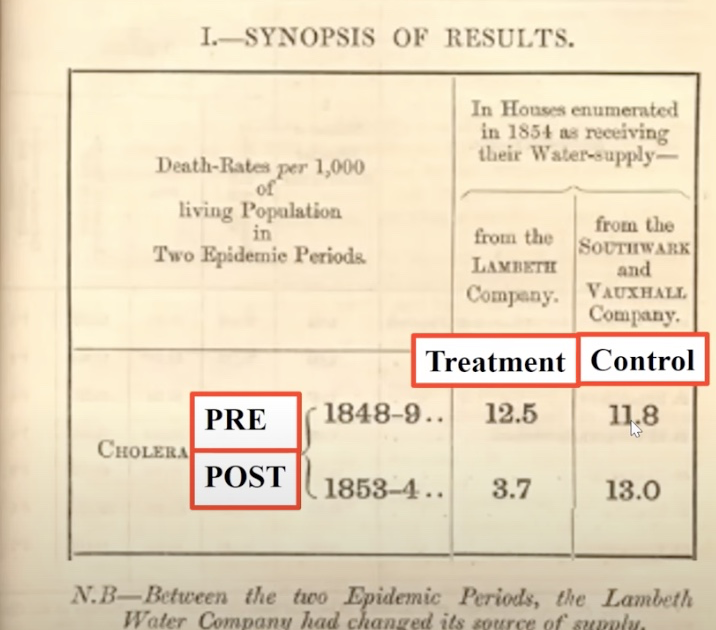
Back in 2012 I wrote about the basic 2 x 2 difference in difference analysis (two groups, two time periods). Columbia public health probably has a better introduction. The most famous example of an analysis that motivates a 2 x 2 DID analysis is John Snow's 1855 analysis of the cholera epidemic in London : (Image Source ) I have since written about some of the challenges of estimating DID with gl…
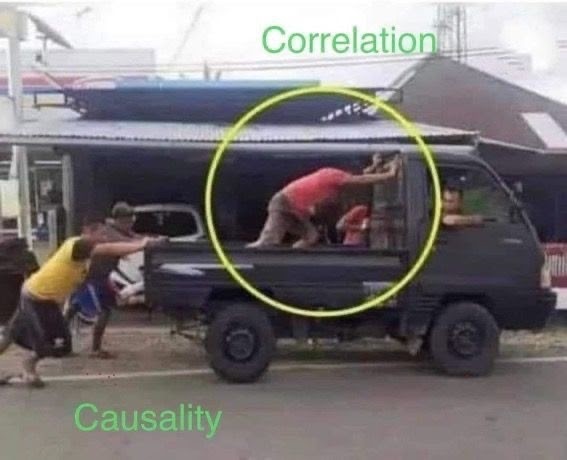
Introduction Summary: Causality in business means understanding how to connect the things we do with the value we create. A cause is something that makes a difference (Dave Lewis, Journal of Philosophy, 1973). If we are interested in what makes a difference in creating business value (what makes a difference in moving the truck above), we care about causality. Causal inference in business helps u…
In a previous post I noted: " ...correlations or 'flags' from big data might not 'identify' causal effects, but they are useful for prediction and might point us in directions where we can more rigorously investigate causal relationships" Recently on LinkedIn I discussed situations where we have to be careful about taking action on specific features in a correlational model, for instance changing…
In Thinking Fast and Slow, Kahneman points out that what matters more than the quality of evidence, is the coherence of the story. In business and medicine, he notes that this kind of 'pretended' knowledge based on coherence is often sought and preferred. We all know that no matter how great the analysis, if we can't explain and communicate the results with influence , our findings may go unappr…
If you are a reader of this blog you are familiar with the number of posts I have shared about machine learning and causal inference and the benefits of education in economics . I have also discussed how there are important gaps sometimes between theory and application. In this post I am going to talk about another important gap related to communication. How do we communicate the value of our wor…
In previous posts I have discussed the value proposition of business experiments from both a classical and behavioral economic perspective. This series of posts has been greatly influenced by Jim Manzi's book 'Uncontrolled: The Surprising Payoff of Trial-and-Error for Business, Politics, and Society.' Midway through the book Manzi highlights three important things that experiments in business can…
Applied Economics is a broad field with many applications. Applied Economics is a broad field of study covering many topics. Recognizing the wide range of applications has led departments of Agricultural Economics across numerous universities to change their degree program names to Applied Economics. In 2008, the American Agricultural Economics Association changed its name to the Agricultural an…
Classification models with binary and categorical outcomes are often assessed based on the c-statistic or area under the ROC curve. (see also: http://econometricsense.blogspot.com/2013/04/is-roc-curve-good-metric-for-model.html ) This metric ranges between 0 and 1 and provides a summary of model performance in terms of its ability to rank observations. For example, if a model is developed to pred…
In a previous post I discussed block randomized designs. Duflo et al (2008) describe this in more detail: "Since the covariates to be used must be chosen in advance in order to avoid specification searching and data mining, they can be used to stratify (or block) the sample in order to improve the precision of estimates. This technique (¯rst proposed by Fisher (1926)) involves dividing the sample…
When I first learned about randomized complete block designs as an undergraduate to me it was just another set of computations to memorize for the test. (this was before I understood statistics as a way of thinking not a box of tools) . However it is an important way to think about your experiment. In Steel and Torrie's well known experimental design text, they discuss: "in many situations it is …
Assessing the balance between treatment and control groups across control variables is an important part of propensity score matching. It's heuristically an attempt to ‘recreate’ a situation similar to a randomized experiment where all subjects are essentially the same except for the treatment (Thoemmes and Kim, 2011). Matching itself should not be viewed so much as an estimation technique, but a…
Knowledge is the most important resource in a firm and the essence of organizational capability, innovation, value creation, strategy, and competitive advantage. Causal knowledge is no exception.In previous posts I have discussed the value proposition of experimentation and causal inference from both mainline and behavioral economic perspectives. This series of posts has been greatly influenced b…
In my previous post I discussed the value proposition of experimentation and causal inference from a mainline economic perspective. In this post I want to view this from a behavioral economic perspective. From this point of view experimentation and causal inference can prove to be invaluable with respect to challenges related to overconfidence and decision making under uncertainty. Heuristic Data…
Why should firms leverage experimentation and causal inference? With recent advancements in computing power and machine learning, why can't they simply base all of their decisions on predictions or historical patterns discovered in the data using AI? Perhaps statisticians and econometricians and others have a simple answer. The kinds of learnings that will help us understand the connections betw…



 research.io