


A characteristic of emergent phenomena is how novel and complex properties can emerge from apparently simple laws. Quantum ChromoDynamics (QCD) describes the interaction of quarks and gluons. The classical Lagrangian is remarkably simple. It has an SU(3) local gauge symmetry and the A_v^mu are the associated gauge fields (gluons). The quarks are fermions with fractional electrical charge. The only parameters in the theory are the coupling constant g_s, which describes the self-interaction of the gluons, and the masses of the quarks, m_f. The gluons are massless. The Lagrangian has chiral symmetry, which transforms quarks with left-handed symmetry into right-handed. Frank Wilczek states that QCD "is conceptually simple. Its realisation in nature, however, is usually very complex. But not always." Hadronic matter (nucleons and mesons) has properties that are qualitatively different from its components (interacting quarks and gluons). In other words, it is emergent. In hadronic matter, there are no fractionally charged particles or massless bosons. Chiral symmetry is broken. (This is intimately connected to the confinement of quarks). Hadrons do not come in pairs with opposite parity and equal energy. Although the underlying Lagrangian is simple, the spectrum of hadrons and their interactions is complex. There is a "zoo" of particles. (Aside: Most can be viewed as quasiparticles as they have a finite lifetime. But strictly speaking, most decay via the weak nuclear or electromagnetic interactions, which obviously is not in the QCD Lagrangian). This all comes from a single coupling constant! The emergent state of hadronic matter only exists at "low" temperatures and densities. It "melts" at the high temperatures associated with the Big Bang, relativistic heavy ion colliders, or the high densities associated with neutron stars. But that and the associated phase diagram of QCD is another story...
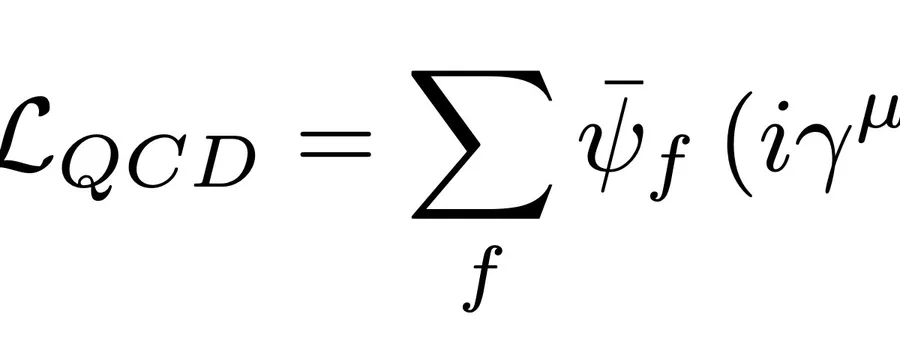
The emergence of hadronic matter from interacting quarks and gluons
Ross H. McKenzie (noreply@blogger.com)